
Key takeaways
What this article covers, in order:
- Why this comes up / what goes wrong
- Step-by-step
- Example (fictional figures)
- Common mistakes
- Doing this in HelloBooks
- Frequently asked questions
Accounting and stock control are essential for small businesses to keep accurate financial records and maintain an up-to-date inventory. Accounting involves recording all financial transactions, while stock control tracks the movement and quantity of goods. Together, they help you understand your business’s profitability and avoid stock shortages or excess.
Why this comes up / what goes wrong
Many small business owners in India maintain their books in Excel, Tally, or bill books and find it hard to keep stock and accounts aligned. Without proper stock control, you may sell items not in stock or over-order, tying up funds unnecessarily. Poor accounting can cause errors in GST returns and financial reporting. The mismatch between accounting records and physical stock often leads to confusion, lost sales, and compliance issues.
Step-by-step
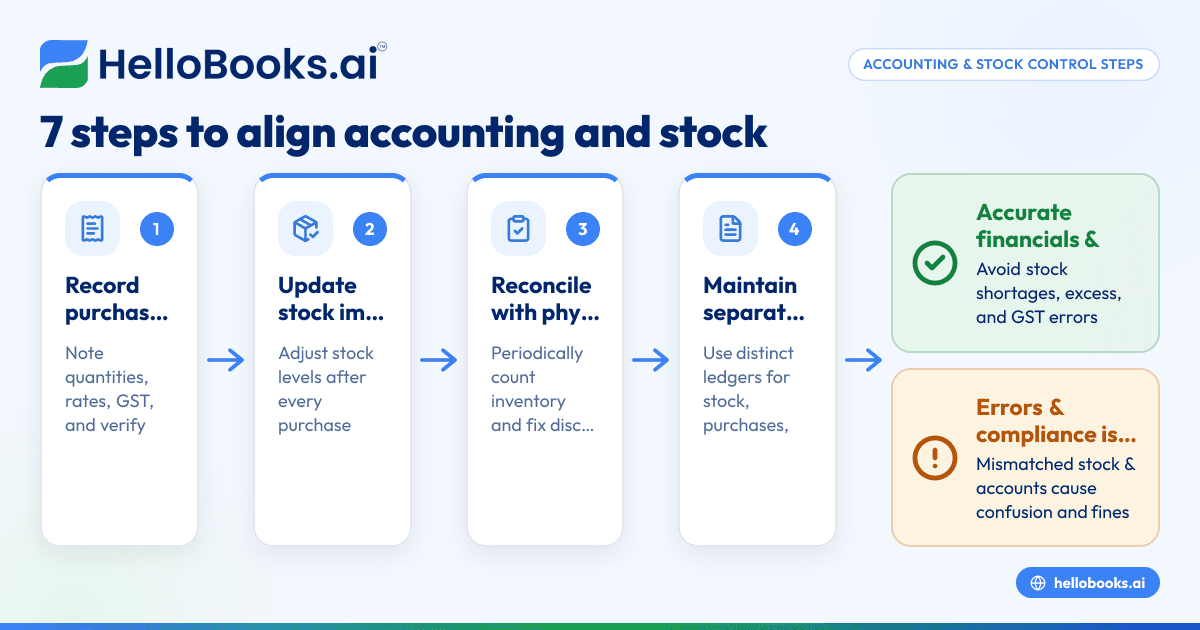
- Record Purchases and Sales Accurately: For every purchase, note the quantity, rate, GST, and total amount. For sales, record the items sold with quantities and prices. Check invoices match physical goods received or delivered.
- Update Stock Immediately: Adjust stock levels as soon as purchases or sales happen. This avoids discrepancies and helps maintain the closing stock figure correctly.
- Reconcile Stock with Physical Count: Periodically count your inventory and compare it with recorded stock. Investigate and correct any differences.
- Maintain Separate Accounts for Stock and Expenses: Use distinct ledger accounts for purchases, sales, stock, and expenses to keep financial statements clear.
- Calculate Closing Stock Value: Multiply the quantity of each item in stock by its purchase cost or weighted average cost to find the closing stock value.
- Prepare Financial Reports: Use your accounting and stock data to generate profit and loss statements and balance sheets.
- Check GST Compliance: Ensure your invoices, stock records, and GST returns like GSTR-1 and GSTR-3B match to avoid errors.
For more on managing inventory, see inventory management.
Example (fictional figures)
On 31/03/2024, ABC Traders has the following stock and transactions:
- Opening stock of 100 units of Item A at ₹500 each
- Purchased 50 units of Item A on 15/03/2024 at ₹520 each
- Sold 120 units of Item A during March at ₹700 each
Step 1: Calculate total units available:
100 (opening stock) + 50 (purchased) = 150 units
Step 2: Calculate closing stock units:
150 (total units) - 120 (sold) = 30 units
Step 3: Calculate weighted average cost per unit:
(100 × ₹500) + (50 × ₹520) = ₹50,000 + ₹26,000 = ₹76,000
Weighted average cost = ₹76,000 ÷ 150 units = ₹506.67 per unit
Step 4: Calculate closing stock value:
30 units × ₹506.67 = ₹15,200 (rounded)
This closing stock value is recorded in the accounts and helps prepare financial statements.
Common mistakes
- Not updating stock immediately after transactions: Leads to stock discrepancies. Prevent by recording sales and purchases on the same day.
- Mixing personal and business expenses: Makes accounting unclear. Use separate accounts for business transactions.
- Ignoring physical stock counts: Causes mismatches. Schedule regular stock audits.
- Incorrect GST invoicing or mismatch with stock records: Results in filing errors. Cross-check invoices with stock movement.
- Using separate registers for stock and accounting without reconciliation: Causes confusion. Integrate stock data with accounting regularly.
For more on accurate GST invoicing, see GST invoicing.
Doing this in HelloBooks
HelloBooks helps you manage accounting and stock control together. Its inventory management feature updates stock automatically with every sale and purchase, so your closing stock figure is always current without maintaining a separate register. For businesses over the ₹5 crore e-invoicing threshold, HelloBooks generates the IRN and signed QR at invoice save time, saving you from manual uploads. It also builds your GSTR-1 and GSTR-3B returns directly from the invoices recorded, ensuring your GST filings match your sales and stock records. Learn more about HelloBooks for India here.
Frequently asked questions
What is the difference between accounting and stock control?
Accounting records all financial transactions including sales, purchases, expenses, and income. Stock control specifically tracks the quantity and value of inventory items to ensure you have the right stock at the right time.
How often should I update my stock records?
Stock should be updated immediately after every purchase or sale. Periodic physical counts (monthly or quarterly) help verify accuracy and catch discrepancies.
Can stock control affect GST returns?
Yes, if your stock records do not match your sales invoices, your GST returns like GSTR-1 and GSTR-3B may have errors. Accurate stock and invoice management help maintain compliance.
Is it necessary to keep a separate stock register?
Not if your accounting software updates stock automatically with every transaction. Otherwise, a separate stock register is needed but must be reconciled regularly.
How can software help with accounting and stock control?
Software like HelloBooks integrates accounting and inventory, updates stock in real time, generates GST-compliant invoices, and files GST returns directly, reducing manual work and errors.
For more details on inventory, see inventory management.
Key takeaways
- Accounting and stock control together ensure accurate financial and inventory records.
- Update stock immediately after every purchase and sale to avoid discrepancies.
- Regular physical stock counts help detect and correct errors.
- Accurate stock records support correct GST invoicing and filing.
- Integrating accounting and stock control reduces manual effort and errors.
Start managing your accounting and stock control efficiently with HelloBooks. You can Start on the Free plan (200 transactions a year, GSTR-1 and 3B filing for one GSTIN).