


Key takeaways
What this article covers, in order:
- Why this comes up / what goes wrong
- Step-by-step
- Example (fictional figures)
- Common mistakes
- Doing this in HelloBooks
- Frequently asked questions
The best accounting program for handling GST is one that automates GST invoicing with accurate tax calculations, supports direct filing of GSTR-1 and GSTR-3B returns, and ensures compliance with GST rules like Rule 46. Choosing the right software can save time, reduce errors, and keep your business compliant with GST regulations.
Why this comes up / what goes wrong
Many small and growing Indian businesses still maintain their books using spreadsheets, Tally, or manual bill books. These methods are often time-consuming and prone to errors, especially for GST compliance. GST requires precise tax invoice details and timely filing of returns such as GSTR-1 and GSTR-3B. Common issues include incorrect GSTINs, missing or wrong HSN/SAC codes, inaccurate tax calculations, and mismatches between invoices and filed returns. These mistakes can lead to penalties, blocked ITC claims, and additional reconciliation work.
Step-by-step
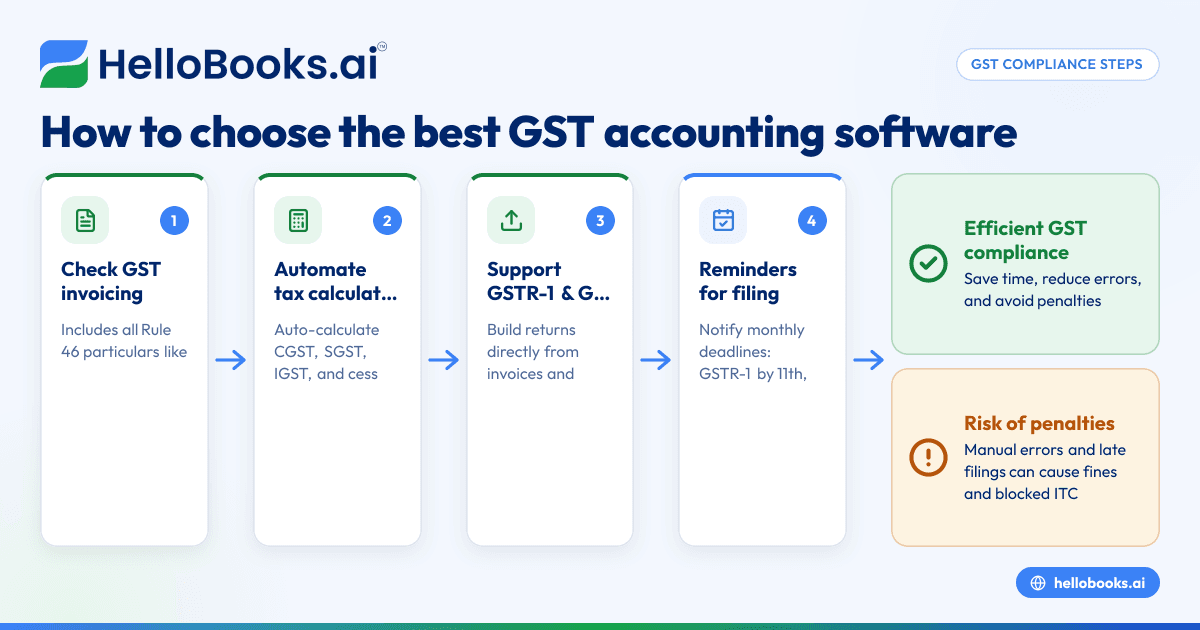
- Check GST Invoicing Compliance: Verify that the software creates GST-compliant tax invoices containing all particulars required by Rule 46. These include the supplier's and recipient's GSTIN, invoice serial number unique for the financial year, date of issue, HSN or SAC codes, tax rates (CGST, SGST, IGST), place of supply, and other mandatory fields [cgst-rule-46/rule46-particulars].
- Look for Automated Tax Calculation: The program should automatically calculate CGST, SGST, IGST, and any applicable cess based on the invoice details to avoid manual errors.
- Verify GSTR-1 and GSTR-3B Filing Support: Ensure the software builds GSTR-1 (outward supplies) and GSTR-3B (summary and payment) returns directly from the invoices recorded and files them online, eliminating the need for manual JSON export and upload.
- Check Return Filing Deadlines and Reminders: The software should support filing monthly GSTR-1 by the 11th and GSTR-3B by the 20th of the following month, and provide reminders to avoid late filing penalties [gstr1-due-date/gstr1-monthly-11th], [gstr3b-due-date/gstr3b-monthly-20th].
- Review Multi-GSTIN Handling: If your business operates with multiple GSTINs, confirm the software can manage and file returns for all registrations under your entity.
- Assess Reporting and Reconciliation Features: The program should offer GST tax reports, track payment status, and assist in reconciling invoices with GST returns like GSTR-2A or GSTR-2B (note: GSTR-2B generation specifics are outside this article's scope).
- Evaluate Ease of Use and Integration: Choose software with a user-friendly interface and options to export or share invoices as PDF. Integration with e-invoicing systems for IRN and QR code generation is a plus.
Example (fictional figures)
Assume a business sells goods on 15/05/2024 with these details:
- Total value before tax: ₹1,00,000
- GST rate assumed: 18% (CGST 9% + SGST 9%)
Tax calculation:
₹1,00,000 × 9% = ₹9,000 (CGST)
₹1,00,000 × 9% = ₹9,000 (SGST)
Total GST = ₹9,000 + ₹9,000 = ₹18,000
Total invoice value:
₹1,00,000 + ₹18,000 = ₹1,18,000
The accounting program should generate a tax invoice showing all these details, including correct HSN code, supplier and recipient GSTINs, invoice number, and date. When filing GSTR-1, the ₹1,00,000 taxable value and ₹18,000 GST must appear correctly in the outward supplies.
Common mistakes
- Incorrect or missing GSTIN on invoices: Prevent this by using software that auto-fills GSTIN from customer records.
- Wrong HSN/SAC codes: Use software that suggests or validates codes based on the goods or services sold.
- Manual filing errors: Avoid manual JSON exports by choosing software that files GSTR-1 and GSTR-3B returns directly to the GSTN.
- Mismatched invoice data and returns: Use integrated reporting to track and reconcile invoices and filed returns.
- Ignoring return deadlines: Select software that sends reminders for filing dates to avoid penalties.
- Not updating software for GST rule changes: Opt for vendors who regularly update their software to reflect GST law changes.
Doing this in HelloBooks
HelloBooks creates GST-ready invoices with the correct CGST/SGST or IGST split and fills HSN/SAC codes from the customer's GSTIN, ensuring compliance with Rule 46 [cgst-rule-46/rule46-particulars]. It builds GSTR-1 and GSTR-3B returns directly from recorded invoices and files them to the GSTN, so your returns match your books without manual JSON export or upload. You can start on the Free plan that supports up to 200 transactions a year including GSTR-1 and 3B filing for one GSTIN. Learn more about HelloBooks for India and explore GST invoicing and e-invoicing (IRN and QR) features.
Frequently asked questions
Which features are essential in an accounting program for GST compliance?
A program must generate GST-compliant invoices with all required details, automate tax calculations, support direct filing of GSTR-1 and GSTR-3B, and provide reports for reconciliation and audit.
Can I file GSTR-1 and GSTR-3B directly from accounting software?
Yes, some software like HelloBooks allows direct filing to GSTN, eliminating manual JSON exports and uploads, reducing errors and saving time.
How does the software handle multiple GSTINs?
Advanced plans in some software support filing returns for multiple GSTINs under one business entity, ensuring compliance across registrations.
What if I miss the GST return filing deadline?
Filing late can attract penalties. Use software with reminders and early alerts to avoid missing deadlines like the 11th for GSTR-1 and 20th for GSTR-3B [gstr1-due-date/gstr1-monthly-11th], [gstr3b-due-date/gstr3b-monthly-20th].
Does the software help with e-invoicing compliance?
Some accounting programs integrate e-invoicing features including IRN generation and QR code embedding to comply with mandatory e-invoice rules. Check the software's capabilities for e-invoicing e-invoicing (IRN and QR).
Key takeaways
- Choose software that automates GST invoicing with Rule 46 compliance.
- Ensure it supports direct GSTR-1 and GSTR-3B filing to GSTN.
- Look for built-in tax calculation and multi-GSTIN handling.
- Avoid manual data entry to reduce errors and save time.
- Use software with reminders for GST return deadlines.
- Verify e-invoicing support if applicable to your business.
To get started, try HelloBooks’ Free plan offering GST invoicing and direct GSTR-1 and 3B filing for one GSTIN with up to 200 transactions a year at /in/pricing.
This article is general information, not tax or legal advice. Rules change; confirm the current position on gst.gov.in or with your chartered accountant before acting.


