
Key takeaways
What this article covers, in order:
- Wait, how many returns are there?
- The two you'll file again and again
- The full GSTR list, for reference
- Should a beginner file monthly or quarterly?
- Let's walk through a first month
- The mistakes we see most from first-timers
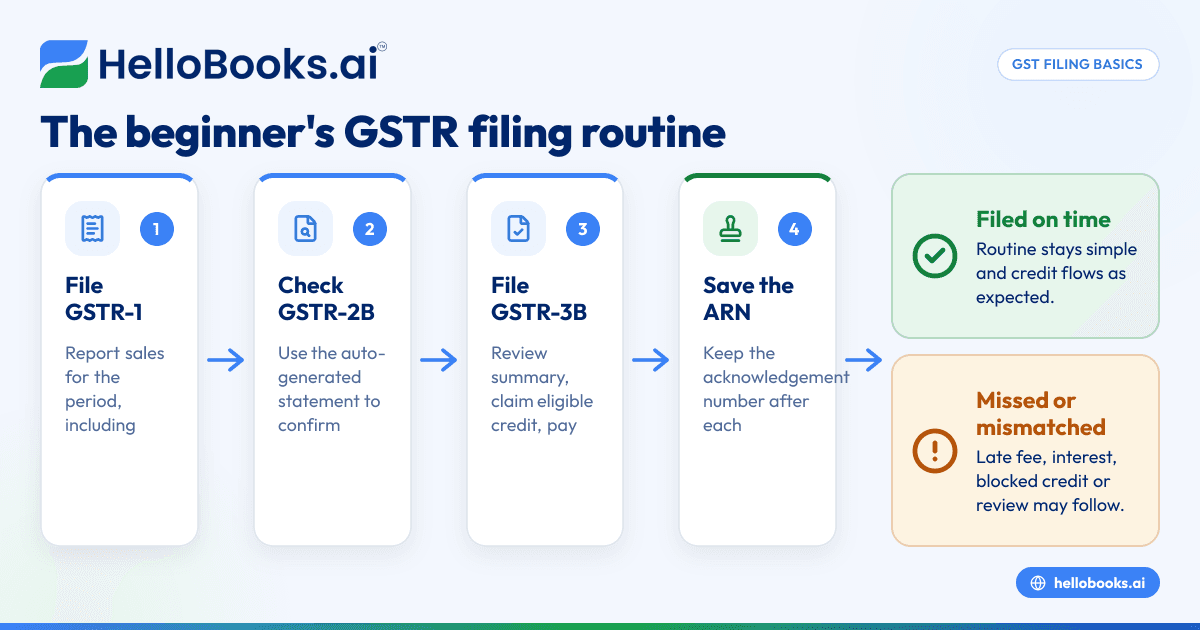
Your GST certificate just landed in your inbox. You feel relieved for about a day, and then a friend asks, "So, have you filed your GSTR-1?" GSTR filing simply means sending your GST returns to the portal so the government knows what you sold, what you bought and how much tax you owe. If you're a regular taxpayer with one GSTIN, you'll mostly file just two of them: GSTR-1 and GSTR-3B.
Wait, how many returns are there?
Search "types of GST returns" and you'll find a list of fifteen-odd forms. That list scares a lot of new registrants. It shouldn't. Most of those forms belong to very specific people: e-commerce operators, government departments, non-resident businesses, input service distributors.
Which ones apply to you depends on three things. Your scheme (regular or composition). Your turnover, which decides whether you can file quarterly and whether the annual return is compulsory. And the kind of business you run.
If you're a shop, a trader, a freelancer or a small service firm on the regular scheme, keep reading. The next bit is about you.
The two you'll file again and again
GSTR-1 is your sales report
GSTR-1 lists everything you sold in the period. Invoices to GST-registered buyers are listed one by one, with the buyer's GSTIN. That's how your buyer gets to claim input tax credit. Sales to ordinary consumers mostly go in as totals, grouped by tax rate and state.
Here's the thing beginners don't realise. Your GSTR-1 isn't just for the government. Your customers depend on it. Miss one B2B invoice and your buyer can't claim credit on it, and believe us, they'll call.
GSTR-3B is where you settle up
GSTR-3B is a short summary. Your sales tax (now auto-filled from GSTR-1 and locked), the credit you're claiming on purchases, any reverse-charge tax, and interest or late fee if you're late. You pay whatever's left and file.
If GSTR-1 tells the story, GSTR-3B is where the money actually moves.
The full GSTR list, for reference
You don't need to memorise this. Bookmark it and come back when someone mentions a form you haven't heard of.
| Form | What it is | Who files it | How often |
|---|---|---|---|
| GSTR-1 | Sales (outward supplies) | Regular taxpayers | Monthly, or quarterly under QRMP |
| IFF | B2B invoice upload facility | QRMP taxpayers, optional | Months 1 and 2 of a quarter |
| GSTR-1A | Fix to the current period's GSTR-1 | Regular taxpayers, optional | Before that period's GSTR-3B |
| GSTR-2A | Live view of suppliers' filings | Nobody files it; auto-generated | Changes all the time |
| GSTR-2B | Fixed statement of available credit | Nobody files it; auto-generated | Monthly, around the 14th |
| GSTR-3B | Summary return and payment | Regular taxpayers | Monthly, or quarterly under QRMP |
| CMP-08 | Tax payment statement | Composition taxpayers | Quarterly |
| GSTR-4 | Annual return | Composition taxpayers | Yearly |
| GSTR-5 | Return for non-residents | Non-resident taxable persons | Monthly |
| GSTR-6 | Return for input service distributors | ISDs | Monthly |
| GSTR-7 | GST TDS return | Government bodies and notified deductors | Monthly |
| GSTR-8 | GST TCS return | E-commerce operators | Monthly |
| GSTR-9 | Annual return | Regular taxpayers (optional below a turnover limit) | Yearly |
| GSTR-9C | Reconciliation statement | Larger taxpayers | Yearly |
| GSTR-10 | Final return | When registration is cancelled | Once |
| ITC-04 | Goods sent for job work | Principals using job workers | Half-yearly or yearly |
Notice that GSTR-2A and GSTR-2B aren't things you file. The portal builds them from what your suppliers report. They still matter a lot, because your credit depends on them.
Should a beginner file monthly or quarterly?
If last year's aggregate turnover was up to ₹5 crore, you can opt into QRMP. Most new businesses qualify.
Under QRMP you file GSTR-1 and GSTR-3B once a quarter instead of every month. You still pay tax monthly, through challan PMT-06 by the 25th, for the first two months of each quarter. There's also an optional IFF, which lets you upload B2B invoices in those first two months so your buyers aren't stuck waiting for credit.
So which should you pick? A freelance copywriter with four clients will probably love QRMP. Fewer filings, less fuss. A wholesaler whose buyers want their credit every month might stay monthly, or use QRMP with IFF. There's no single right answer. It's about who you sell to.
Let's walk through a first month
Meet Priya. She's just registered her design studio in Pune, effective 10 Aug 2026. She sticks to monthly filing. (Priya's illustrative, but her situation is very common.)
In Aug 2026 she raises three invoices to companies in Maharashtra, charging 9% CGST and 9% SGST. She buys a laptop from a registered dealer for ₹84,000 plus GST and gets a proper tax invoice.
Her GSTR-1 for Aug 2026 is due 11 Sep 2026. She lists the three invoices with each client's GSTIN, plus a quick HSN/SAC summary and a count of invoices issued.
Her GSTR-3B for Aug 2026 is due 20 Sep 2026. The sales tax is already filled in from her GSTR-1. She opens GSTR-2B for Aug 2026 and checks that the laptop dealer has reported her purchase. It's there, so she claims the credit, pays the balance and files.
What if she'd had no sales at all in her first month? She'd still file both returns. As nil returns. It takes ten minutes, but skipping it costs money.
The mistakes we see most from first-timers
"No sales, so no return" is the big one. Every period needs a return. Late fees apply to nil returns too, just at a lower daily rate.
Charging the wrong kind of tax comes next. Selling within your state means CGST plus SGST. Selling to another state means IGST. Get it backwards and both your return and your buyer's credit go wrong.
Then there's the missing buyer GSTIN. Forget to put it on the invoice and that sale lands in your return as a B2C sale. Your buyer loses the credit and you lose a bit of goodwill.
Claiming credit too early catches people too. Your supplier has to report the invoice first. Check GSTR-2B before you claim.
And keep your ARNs. Every filed return gives you an acknowledgement number. Save it. Banks, landlords and your CA will ask.
What actually happens if you don't file?
It adds up quietly. There's a late fee for each day you're late, capped by turnover. There's 18% yearly interest on any tax paid late. Keep missing GSTR-3B and the portal can stop you generating e-way bills. Leave it long enough and your registration can be suspended or cancelled.
There's also a hard stop now. Returns become time-barred three years after their due date, and the portal has started enforcing it. If you've already missed a few periods, talk to a CA about the cleanest way to catch up before any of them cross that line.
How HelloBooks helps
HelloBooks is built around exactly this routine. On the Free plan, which is ₹0 with no card and no expiry, you raise GST invoices, record purchase bills and file GSTR-1 and GSTR-3B for one GSTIN directly to the GST portal from inside HelloBooks, as often as you need. GSTR-2B reconciliation is included, so you can see which bills are reflected before you claim credit.
Free covers 2 users and up to 200 transactions a year, which suits many new freelancers and small service businesses. You can invite your CA into the same books, too. Have a look at the GST returns HelloBooks handles, or start with free GST billing if invoices are your first worry.
FAQs
What does GSTR stand for?
It's short for "GST Return". The number after it, like GSTR-1 or GSTR-3B, tells you what the form reports.
Do I have to file if I did no business this month?
Yes. You file a nil return for that period. It's quick, and you can even do it by SMS from your registered mobile number.
Which return comes first after registration?
For monthly filers, GSTR-1 for your first month is usually due first, then GSTR-3B for the same month. QRMP filers file both after their first quarter ends.
Do I file GSTR-2B?
No. The portal generates it from your suppliers' returns. You use it to work out how much credit to claim in GSTR-3B.
I'm under the composition scheme. Do I file GSTR-1?
No. Composition taxpayers file CMP-08 every quarter and GSTR-4 once a year instead. If you're still deciding which scheme to pick, a quick chat with a CA before you register can save you a lot of rework.
Two returns, a fixed routine, and a folder of ARNs. That's really all GSTR filing is for most new businesses.
Start free — GST filing included, no card. Try HelloBooks Free