


Key takeaways
What this article covers, in order:
- Why this comes up / what goes wrong
- Step-by-step
- Example (fictional figures)
- Common mistakes
- Doing this in HelloBooks
- Frequently asked questions
Startup expense tracking in Charlotte means systematically recording every business expense to maintain accurate financial records and control costs. This process helps startups prepare for GST compliance, manage cash flow, and make informed decisions. This article covers why startups struggle with expense tracking, provides a step-by-step guide, includes an example with Indian figures, outlines common mistakes, and explains how HelloBooks can assist.
Why this comes up / what goes wrong
Startups and technology companies in Charlotte often operate with limited accounting resources and fast-paced workflows. For example, a 12-person SaaS startup in Bengaluru or a fintech startup in Gurugram may have many small purchases, supplier bills, and employee reimbursements that need accurate recording. Without a clear system, expenses can be missed, duplicated, or recorded with errors, leading to inaccurate financial statements and difficulties during GST filing.
Many startups still rely on manual methods such as Excel spreadsheets or bill books, which are time-consuming and prone to errors. This makes reconciling expenses with supplier invoices during GSTR-2B reconciliation difficult and can result in incorrect Input Tax Credit (ITC) claims.
Step-by-step
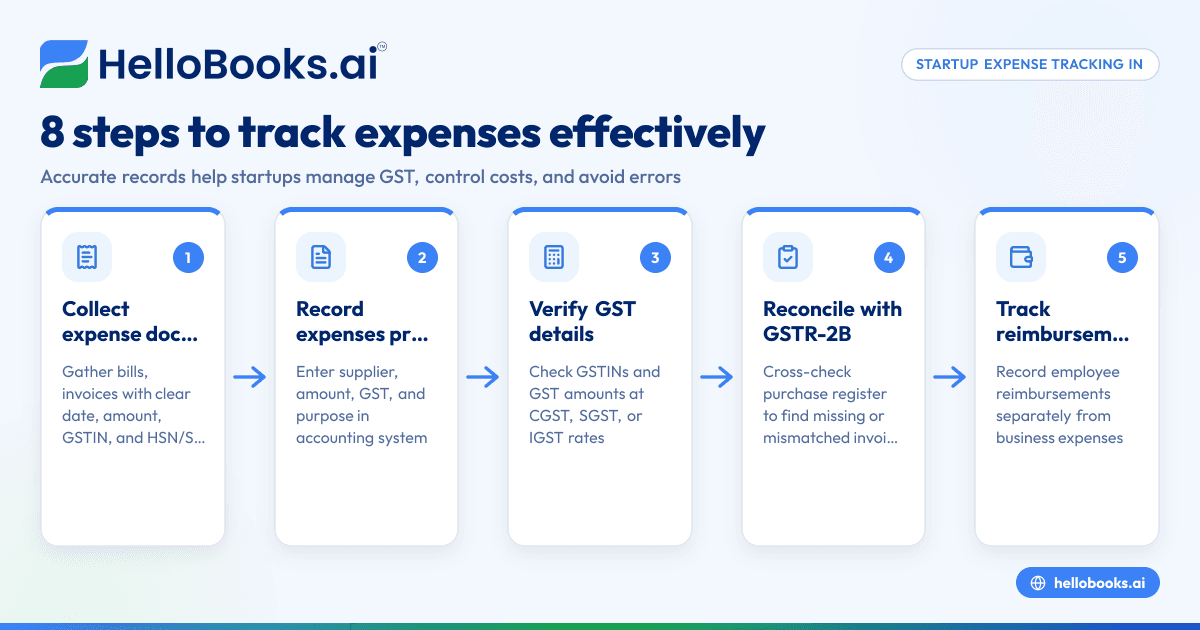
- Collect all expense documents daily: Gather purchase bills, supplier invoices, and receipts. Check that each document is clear and contains necessary details like date, amount, GSTIN, and HSN/SAC codes.
- Record expenses promptly: Enter each expense into your accounting system or spreadsheet, noting the supplier, amount, GST, and purpose. For startups, categorise expenses by type (e.g., office supplies, software subscriptions).
- Verify GST details: Confirm that GSTINs on bills match your suppliers’ registrations. Ensure GST amounts are calculated correctly at the applicable CGST, SGST, or IGST rates.
- Reconcile with GSTR-2B: Cross-check your purchase register against your GSTR-2B to identify missing or mismatched invoices before filing your GSTR-3B. This helps avoid ITC claim errors.
- Track reimbursements and advances: Record any employee reimbursements or advances separately to prevent mixing personal and business expenses.
- Review monthly: At the end of each month, review all recorded expenses to check for duplicates, missing bills, or inconsistencies.
- Maintain digital copies: Scan or photograph all bills and store them securely for easy retrieval during audits.
- Prepare financial reports: Use recorded expenses to generate reports that monitor cash flow and profitability.
Startups seeking software support can explore solutions tailored for Startups and technology companies to simplify these steps.
Example (fictional figures)
Consider a SaaS startup in Bengaluru recording purchase bills for April 2024:
- Office stationery purchase on 05/04/2024: ₹12,000 + 18% GST
- Software subscription on 10/04/2024: ₹48,000 + 18% GST
Calculations:
Stationery GST = ₹12,000 × 18% = ₹2,160
Total stationery bill = ₹12,000 + ₹2,160 = ₹14,160
Software GST = ₹48,000 × 18% = ₹8,640
Total software bill = ₹48,000 + ₹8,640 = ₹56,640
Recording these bills promptly with correct GST details ensures the startup can claim ITC accurately during GSTR-3B filing and reconcile with GSTR-2B.
Common mistakes
- Delaying bill entry: Leads to forgotten or lost bills. Prevent by recording expenses daily.
- Ignoring GST details: Incorrect GSTIN or GST amounts cause ITC claim rejections. Always verify supplier GSTIN and GST calculations.
- Mixing personal and business expenses: Causes accounting confusion. Keep separate records.
- Not reconciling with GSTR-2B: Missed invoices result in ITC loss or penalties. Perform monthly reconciliation.
- Relying solely on manual spreadsheets: Prone to errors and time-consuming. Use digital tools for accuracy.
For better control, startups should explore expense management tools that automate many of these checks.
Doing this in HelloBooks
HelloBooks supports startups by offering OCR for purchase bills, allowing you to capture supplier bills from photos or PDFs instead of manual entry. This reduces data entry errors and saves time. Additionally, HelloBooks provides GSTR-2A/2B reconciliation and ITC tracking, showing which supplier invoices are missing from GSTR-2B before you claim ITC in your GSTR-3B. These features help startups maintain accurate expense records and GST compliance with less effort. Learn more at HelloBooks for India.
Frequently asked questions
How can startups in Charlotte simplify expense tracking?
Startups can simplify expense tracking by adopting digital tools that automate bill capture and GST reconciliation. Regularly collecting bills and reconciling with GSTR-2B helps maintain accuracy.
What are the key GST compliance checks for startup expenses?
Key checks include verifying supplier GSTINs, ensuring GST rates and amounts are correct, and reconciling expenses with GSTR-2B to claim proper ITC.
Can manual spreadsheets work for startup expense tracking?
While possible, manual spreadsheets are prone to errors and time-consuming. Startups benefit from software that automates data entry and reconciliation, improving accuracy.
What should I look for in expense tracking software for startups?
Look for software with OCR for bills, GST reconciliation features, and easy report generation. Integration with GST filing processes is also valuable.
How often should startups reconcile their expenses with GSTR-2B?
Monthly reconciliation before filing GSTR-3B is recommended to catch discrepancies early and avoid ITC claim issues.
Key takeaways
- Track startup expenses daily with clear, complete bills.
- Verify GST details on all supplier invoices.
- Reconcile purchase records with GSTR-2B monthly to ensure accurate ITC claims.
- Avoid mixing personal and business expenses.
- Use digital tools like HelloBooks for OCR bill capture and GST reconciliation.
- Regular review and report generation help startups control costs and comply with GST.
For startups in Charlotte and beyond, effective expense tracking is a foundation for growth and compliance. To see how HelloBooks can help your startup manage expenses and GST filing, Book a 30-minute demo.


