
Key takeaways
What this article covers, in order:
- Key takeaways
- What are sales tax exemption certificates in the United States?
- Why do small businesses struggle with exemption certificate management?
- How do you collect sales tax exemption certificates correctly?
- What should you store with each certificate?
- How often should you review exemption certificates?
Sales tax exemption certificates in the United States are documents that support why you did not charge sales tax on a taxable sale. If you sell to resellers, nonprofits, manufacturers, or other exempt buyers, you need a clean process to collect the right certificate, store it, and match it to each exempt sale.
Key takeaways
- A sales tax exemption certificate supports an untaxed sale, but only if it is complete, valid, and tied to the right customer and transaction.
- Small businesses should collect certificates before or at the time of sale, not months later during an audit.
- A good process includes intake, review, storage, renewal tracking, and reconciliation to invoices and customer records.
- Exempt sales should be reviewed during month-end close so your books, tax reports, and customer tax settings stay aligned.
- Automation helps by flagging missing documents, tracking expiration dates where relevant, and reducing manual lookup work.
- This article is general information, not tax or legal advice. State rules differ, so confirm requirements for the states where you collect sales tax.
What are sales tax exemption certificates in the United States?
A sales tax exemption certificate is a form or document a buyer gives a seller to claim that a purchase is exempt from sales tax. The reason may be resale, a specific exempt use, or a buyer status recognized under state law.
For a small business, the practical issue is simple. If you do not charge sales tax on a sale that would otherwise be taxable, you need support for that decision. During a state sales tax audit, the auditor often asks for proof behind exempt sales. If you cannot produce valid support, the tax can shift back to you.
That is why exemption certificate management is not just a tax task. It also affects invoicing, accounts receivable, customer onboarding, and month-end close. If your sales team marks a customer as tax-exempt but accounting never receives the certificate, you create audit risk and cleanup work.
Common examples include:
- A wholesaler in Chicago selling goods for resale to a retailer
- A manufacturer in Detroit buying qualifying items for an exempt use under state rules
- A nonprofit customer in Houston claiming exemption where state law allows it
- A government agency buying goods without sales tax when properly documented
The exact certificate format, required fields, and rules vary by state. Some states accept multistate forms in some cases. Others require a state-specific form. Some certificates expire. Others remain valid until revoked or facts change. Because of that, your process should be built to handle differences without relying on memory.
Why do small businesses struggle with exemption certificate management?
Most small businesses do not fail because they ignore the issue. They fail because the work gets split across too many systems and people.
The sales rep may receive a PDF by email. Customer support may save it in a shared drive. Accounting may mark the customer exempt in QuickBooks. The warehouse may ship the order. Months later, no one can tell which certificate supported which invoices.
Here are the most common failure points:
Certificates arrive in inconsistent formats
Customers send PDFs, scans, photos, and email text. Some documents are incomplete. Some are unsigned. Some list a legal entity name that does not match the invoice customer.
The customer record is not updated correctly
A certificate may be valid, but the tax setting in your accounting system stays taxable. Or the opposite happens. A customer gets marked exempt before the document is reviewed.
No one tracks expiration or changes
Some certificates need periodic refresh. Even where a certificate does not technically expire, the buyer’s business facts may change. If your team never reviews older records, bad data can sit for years.
Exempt sales are not reconciled
At month-end, many teams reconcile cash, bank activity, and open invoices. They do not reconcile exempt revenue by customer against certificate coverage. That leaves gaps hidden until audit time.
Documents are stored without a retrieval plan
A folder full of files is not a system. You need searchable records by customer name, legal entity, state, certificate type, issue date, and related transactions.
How do you collect sales tax exemption certificates correctly?
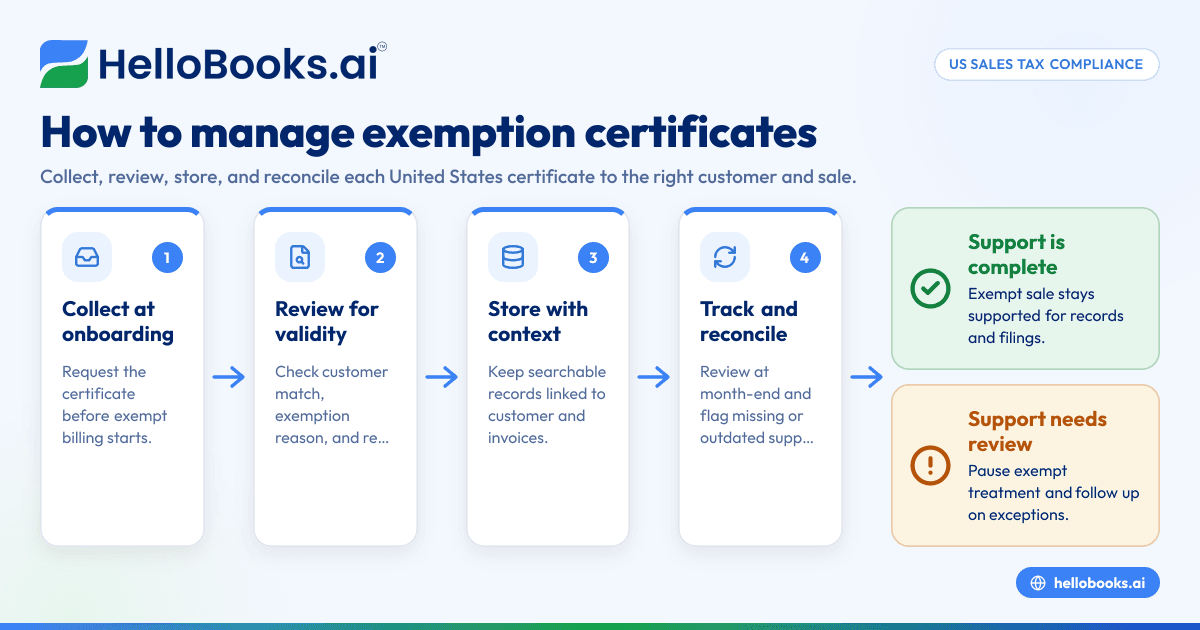
Collect the certificate before you treat the customer as exempt, or at the latest before the first untaxed invoice is finalized. Make the request part of customer setup so sales, operations, and accounting follow one rule.
Start with a standard intake checklist. Ask for the customer’s legal name, billing address, shipping states if relevant, reason for exemption, and the actual certificate or form. Then review the document for completeness before changing tax settings.
A practical intake process looks like this:
- Request the certificate during onboarding Add it to your new customer workflow. If a buyer claims resale or exempt status, ask for the certificate before approving tax-exempt billing.
- Verify the customer identity Match the legal name and address on the certificate to your customer record. If the order comes from a division or DBA, note the relationship clearly.
- Review the reason for exemption Check whether the certificate type matches the nature of the sale. A resale certificate should support resale purchases, not every possible transaction.
- Check required fields Look for missing signatures, dates, registration numbers where required, and jurisdiction details. Incomplete certificates should be rejected or sent back for correction.
- Set customer tax status carefully Do not use one broad “exempt” tag without notes. Record the state, exemption type, effective date, and any expiration or review date.
- Store the file in a searchable system Save the document where accounting can retrieve it quickly. The storage record should link to the customer and ideally to exempt invoices.
If your business sends invoices manually, use a standard note in your billing workflow. If you issue recurring invoices, review the customer tax status before the next billing cycle begins. Tools like invoice software and accounting software in the USA can reduce manual steps, but your internal review rules still matter.
What should you store with each certificate?
Store the certificate itself and the context that proves how you used it. The file alone is often not enough during review or audit.
At minimum, keep these fields in your record:
- Customer legal name
- Customer billing and shipping address
- Internal customer ID
- State or states involved
- Certificate type
- Date received
- Effective date
- Expiration date or review date, if applicable
- Name of reviewer
- Status such as pending, accepted, rejected, expired, or replaced
- Notes on scope or limitations
- Linked invoices or transaction range
This structure matters because exempt sales are not all the same. One customer may be exempt only in one state. Another may have a resale certificate for inventory purchases but not for taxable services. If you only store a PDF in a folder called “tax docs,” your team will make assumptions.
Build a naming and folder rule your team can follow
Keep it simple. For example, store files with a pattern such as customer legal name, state, certificate type, and received date. The goal is consistency, not complexity.
Also control access. The documents may include tax IDs and other business details. Your team should know who can view, edit, approve, and replace records.
How often should you review exemption certificates?
Review them at onboarding, during month-end close, and any time a customer’s facts change. If a certificate has an expiration date or the state requires renewal, track that date and follow up before the next exempt sale.
A one-time collection process is not enough. Customers move, merge entities, open new locations, and change what they buy from you. Your own product mix can change too. A customer that was exempt on one line of business may not be exempt on another.
A useful review calendar includes three layers:
1. Transaction-level review
When a new exempt customer places an order, confirm the certificate is on file and fits the sale type. This is especially important for first-time transactions and unusual orders.
2. Monthly review
During close, compare exempt sales by customer to your certificate records. Look for customers with exempt invoices but no approved document on file.
3. Periodic master-data review
Once or twice a year, review your exempt customer list. Remove stale records, request updates, and confirm the customer tax setup still matches the underlying documents.
This is where ai sales tax workflows can help. They can flag customers with exempt invoices but missing or outdated support, so your team spends time fixing exceptions instead of searching every transaction by hand.
How do you reconcile exemption certificates to invoices and sales tax filings?
Reconcile exempt sales in three layers: customer record, invoice detail, and reporting totals. If those three do not match, your filing risk increases and audit prep gets harder.
Begin with the customer master. Pull a list of customers marked tax-exempt in your billing or accounting system. Then compare that list to your approved certificate records. Every exempt customer should have support, and every support record should match how the customer is coded.
Next, test invoices. For each exempt customer, review a sample or full list of untaxed invoices for the period. Confirm the certificate was valid at the time of sale and applied to the item or transaction type billed.
Finally, compare your invoice totals to the exempt sales amounts reported in your sales tax workpapers or return preparation process. Differences often point to coding errors, duplicate records, or missing documents.
A practical month-end reconciliation process
Use this five-step process each month:
- Export exempt invoices for the period Include invoice number, date, customer, state, amount, and tax charged.
- Match invoices to customer exemption records Confirm there is an approved certificate tied to each exempt customer.
- Check date coverage and scope Make sure the certificate was active when the invoice was issued and applies to that type of purchase.
- Investigate exceptions Flag invoices with missing, expired, incomplete, or mismatched documentation.
- Update records and reserve issues for follow-up Correct customer tax settings, request replacement forms, and document unresolved items before filing.
If you already use bank reconciliation software, add exempt sales review to the same close checklist mindset. The goal is the same: catch issues while the period is still fresh.
What happens if a certificate is missing or invalid?
If you cannot support an exempt sale, the seller may owe the tax, plus possible interest and penalties in an audit. The practical fix is to act fast: pause future exempt billing, request a corrected certificate, and review prior invoices for exposure.
Do not wait for filing season. The longer a missing certificate sits unresolved, the harder it becomes to collect. Staff change jobs. Email threads disappear. Customers delay responses.
Steps to clean up missing certificates
- Identify the affected customers and invoices Build a list by customer, state, invoice amount, and invoice date.
- Contact the customer with a clear request Ask for the correct certificate and explain which legal entity and transaction period need support.
- Temporarily review the tax setting If support is not available, consider whether future sales should be taxed until documents are received.
- Document every follow-up Keep the email trail and notes on your request attempts.
- Escalate unusual cases If the customer insists the sale was exempt but the paperwork does not support it, involve your tax advisor or accountant.
If your records are spread across inboxes and spreadsheets, this cleanup can take days. A centralized system is far easier to search and defend.
Can AI help manage sales tax exemption certificates?
Yes. AI can help classify documents, extract key fields, flag missing data, and surface exceptions during close. It does not replace human review, but it can reduce manual work and make your records easier to search.
The best use of automation is not blind approval. It is structured review. For example, an AI workflow can identify that a certificate file exists, pull the customer name, state, and dates, and compare them to your customer master and invoice list. That gives your team a queue of exceptions to review.
For a small business, the biggest gains usually come from:
- Faster document intake
- Less manual data entry
- Better search across old records
- Exception flags for missing support
- Review reminders for expiring or stale records
- Cleaner month-end reconciliation
This is similar to how AI bookkeeping reduces repetitive accounting work. The system does the heavy lifting on matching and extraction, while a person reviews the edge cases.
If your current process lives in spreadsheets and shared folders, moving to AI accounting software or accounting software for small business can make exemption tracking part of your broader close process rather than a separate scramble.
How should small businesses set up an internal policy?
Write a simple policy that defines who collects certificates, who approves them, where they are stored, and when they are reviewed. A one-page policy is better than a perfect policy no one follows.
Your internal policy should answer these questions:
Who can mark a customer as exempt?
Many businesses let sales request the change, but accounting or finance should approve it after document review.
What documents are acceptable?
List the certificate types your business commonly receives. Note that the exact required form can vary by state and exemption reason.
Where are records stored?
Define one system of record. Avoid duplicate storage across email, local drives, and random folders.
How are exceptions handled?
Set a rule for incomplete, expired, or mismatched certificates. Your team should know whether to hold shipment, bill sales tax, or escalate the account.
When are records reviewed?
Tie review to onboarding, month-end close, and scheduled periodic checks.
A policy is especially useful when your business has multiple locations or entities. Without one, Houston may handle customer setup one way while Chicago handles it another way.
A simple operating checklist for your team
If you want a lightweight process that works, use this checklist:
- Ask for the certificate during customer setup.
- Review it before switching the customer to exempt.
- Save it in one searchable location.
- Record state, type, dates, and reviewer name.
- Link the record to the customer account.
- Reconcile exempt invoices monthly.
- Follow up on missing or stale documents quickly.
- Review the full exempt customer list at least annually.
This is not complicated. It just needs discipline. The businesses that handle exemption certificates well are not always bigger. They are simply more consistent.
Read next
This article covers one part of a bigger topic. For the complete picture, read our guide to sales tax.