
Key takeaways
What this article covers, in order:
- Key takeaways
- What are sales tax due dates in the United States?
- Why do sales tax due dates vary by state?
- What does a monthly sales tax filing calendar look like?
- How can you keep up with multiple state due dates?
- What information do you need before each filing?
Sales tax due dates in the United States depend on your filing frequency and the state where you are registered. Most small businesses file monthly, quarterly, or annually, and each state sets its own deadlines, payment rules, and portal. The safest approach is to build a state-by-state filing calendar, then reconcile sales, exemptions, and tax collected before every due date.
Key takeaways
- There is no single national sales tax return or one nationwide due date in the United States.
- Your sales tax due dates depend on each state, your filing frequency, and sometimes your sales volume.
- Monthly filers often have the highest compliance burden and need a reliable closing routine.
- Missing a due date can trigger penalties, interest, and notices even when little or no tax is due.
- A clear monthly filing calendar reduces errors, late filings, and last-minute cash surprises.
- Good systems for invoicing, reconciliation, and records make sales tax filing much easier.
What are sales tax due dates in the United States?
Sales tax due dates in the United States are the deadlines by which a business must file a state sales tax return and, in most cases, pay the tax it collected. These dates are set by each state tax authority. They are not the same across the country.
That matters for small businesses selling in multiple states. A retailer in Chicago might file monthly in one state, quarterly in another, and have no filing duty at all in states where it is not registered. A manufacturer in Detroit that sells spare parts online might collect sales tax in several states but face different deadlines in each one.
There is another detail many owners miss. Your due date is not always based only on where you make sales. It depends on where you are registered and whether the state has assigned you a monthly, quarterly, or annual filing frequency. Some states also require returns even for periods with no taxable sales.
Because sales tax compliance is state specific, always confirm your deadlines on the official state tax portal where you file. This article is general information, not tax or legal advice.
Why do sales tax due dates vary by state?
Each state administers its own sales and use tax system. That means each state sets its own rules for registration, filing frequency, due dates, prepayments, discounts, and return format. Local taxes may also be reported through the state return, depending on the state.
In practice, that creates three common sources of confusion:
1. Filing frequency is assigned by the state
Many small businesses start as monthly filers if sales tax collections are high enough. Others are assigned quarterly or annual filing. A business can also be moved from one frequency to another based on its tax liability.
A Houston wholesaler might file monthly because it collects more tax every month. A smaller service business selling taxable items only occasionally may be placed on a less frequent schedule. You should not assume the same filing rhythm everywhere.
2. Due dates can fall on different days of the month
Some states want returns by the 20th of the following month. Others use the last day of the month. Some shift the deadline to the next business day if the due date falls on a weekend or holiday. Some require electronic payment by a different cutoff time than the return itself.
This is why a generic spreadsheet reminder often fails. The rule is not just “file every month.” The rule is “file in each state by that state’s due date and payment method.”
3. Zero-tax periods may still require a return
If you are registered for sales tax, you may still need to file even when you had no taxable sales in that state for the period. Businesses often learn this only after receiving a late notice.
That is one reason owners look for AI bookkeeping and workflow tools. The challenge is not only calculating tax. It is remembering every filing obligation consistently.
What does a monthly sales tax filing calendar look like?
A monthly sales tax filing calendar is a working schedule that shows, by state, when your return is due, who prepares it, who reviews it, and when payment is submitted. It should also list the data sources you use, such as your ecommerce platform, point-of-sale system, and bank records.
For a small business, the calendar should cover the full month-end process, not just the filing date. That helps you finish reconciliation before the deadline instead of scrambling on the last day.
A practical monthly calendar template
Use a simple table or checklist with these columns:
- State
- Filing frequency
- Return due date
- Payment due date
- State filing portal
- Sales data source
- Exemption certificate review needed
- Owner or team member assigned
- Internal close date
- Status
Your internal close date should come earlier than the actual filing deadline. For example, if a return is due on 05/20/2026, your internal deadline might be 05/15/2026. That gives you time to fix missing transactions, late refunds, or classification mistakes.
Build your process around the month, not the deadline
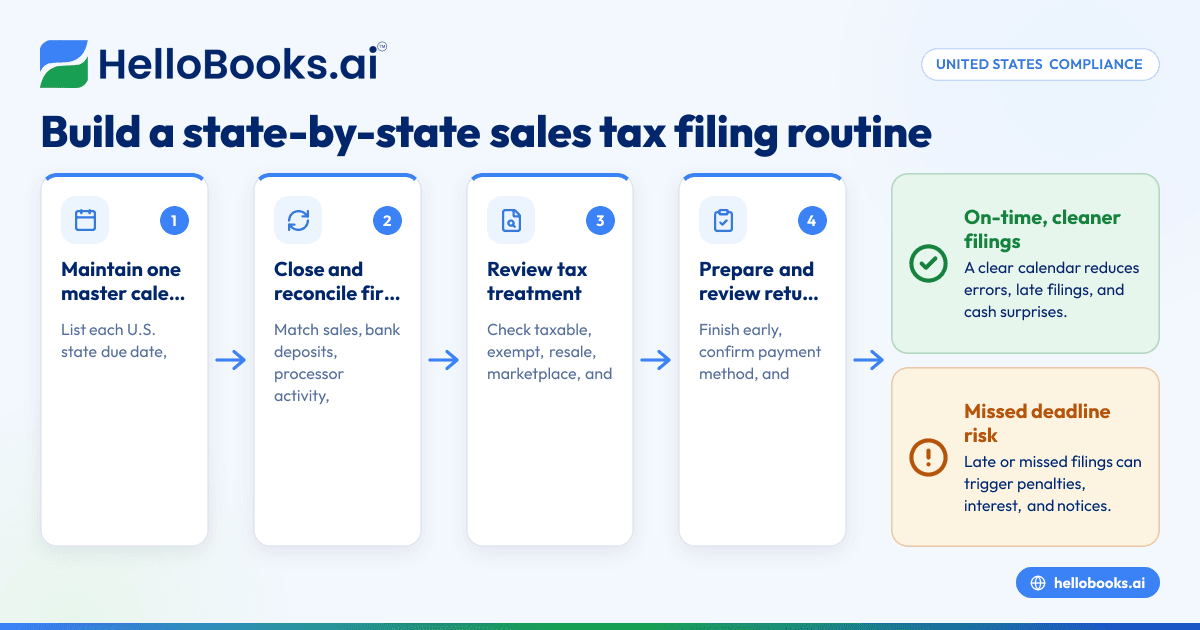
A clean monthly routine often works like this:
- Close your books for the month.
- Reconcile bank deposits and payment processor activity.
- Review gross sales by state.
- Separate taxable, nontaxable, exempt, and resale transactions.
- Confirm returns, discounts, and credit memos.
- Tie sales tax collected to invoices and payments.
- Prepare the return.
- Review the filing and payment.
- Submit before the deadline.
- Save confirmation numbers and return copies.
If your business still sends invoices manually, better invoice software can make taxable sales records easier to track and review.
How can you keep up with multiple state due dates?
Use one master calendar tied to your close process, not scattered reminders. Record each state’s due date, assigned filing frequency, portal login, and internal review date, then update it whenever a state changes your filing schedule.
Many businesses fail here because deadlines live in too many places. One owner keeps dates in email. Another uses a wall calendar. The accountant uses a separate checklist. The result is missed returns or duplicate work.
A better system puts all deadlines into one source of truth. That source should be reviewed at least once a month. It should also include who is responsible for each state return. “The finance team” is too vague. One person should prepare. Another should review if possible.
What to include in your sales tax calendar
Add more than just dates. Include the facts that affect accuracy:
- Whether the state requires e-file or e-pay
- Whether local tax is included on the state return
- Whether a zero return is required
- Whether you sell through a marketplace
- Whether exemptions or resale certificates are common
- Whether payment processor fees create timing differences
This matters because filing on time is only half the job. Filing the wrong taxable amount creates notices later.
Why small businesses miss deadlines
Most late filings come from a short list of causes:
- Sales data was not reconciled in time
- The owner did not know a zero return was required
- A state changed filing frequency
- Login credentials were lost
- The person who usually files was out
- A return was prepared but payment was not submitted
That is where process discipline matters more than memory.
What information do you need before each filing?
You need complete sales records for the filing period, broken down by state and tax treatment. You also need support for exemptions, returns, discounts, and adjustments, plus proof of tax collected and payment confirmations.
That sounds obvious, but many businesses start with the return and then look for backup. The better approach is the reverse. Gather your records first, then prepare the filing.
Review these records every month
Before filing, confirm:
- Gross sales for the period
- Taxable sales by state
- Exempt sales and supporting documents
- Sales for resale
- Shipping charges if taxable in that state
- Returns and refunds
- Sales tax collected
- Marketplace-facilitated sales if relevant
- Prior period adjustments
- Bank and payment processor deposits
If your team spends hours matching payouts and deposits, bank reconciliation software can reduce month-end delays.
Watch for timing differences
Sales tax reporting often goes wrong when records are pulled from mixed dates. For example, your ecommerce report may use order date while your accounting system uses payment date. Refunds may post in a different period. Chargebacks may appear later through Stripe or your merchant account.
Set one rule for reporting periods and use it consistently. Then document exceptions. This is especially important for businesses with high online sales volume.
Can AI help with sales tax deadlines?
Yes, AI can help you organize records, flag missing transactions, and reduce reconciliation work before filing. But ai sales tax tools still need correct state setup, clean source data, and human review before you submit a return.
The real value of automation is upstream. If your books are incomplete, your sales tax return will also be incomplete. A filing calendar works best when your accounting data is current and your month-end close is repeatable.
Where automation helps most
For many small businesses, the biggest sales tax problem is not the return form itself. It is the work that happens before the form:
- Matching bank activity to invoices
- Categorizing expenses and adjustments
- Tracking customer payments
- Closing the month on time
- Finding missing transactions
- Pulling reports quickly
This is where AI accounting software or accounting software in the USA can help support cleaner records.
What AI does not replace
AI does not replace your responsibility to know where you are registered, when returns are due, and whether your sales are taxable in a given state. It also does not replace state-specific review.
Think of automation as a way to reduce manual cleanup. It is not a substitute for checking your obligations.
How should a small business set up a monthly filing routine?
Create a close calendar that ends several days before every state deadline. Assign owners, standardize reports, review exemptions monthly, and save every filed return with proof of payment and confirmation numbers.
That short routine can prevent most avoidable sales tax mistakes. It turns filing from a last-minute task into part of your regular finance process.
A simple 7-step monthly routine
1. Set one owner for compliance
Choose one person to own the calendar. This can be the owner, controller, bookkeeper, or outside accountant. The key is clear responsibility.
2. Pull sales reports on the same day each month
Run your reports after the period closes. Use the same source systems every time. Avoid mixing numbers from multiple report versions.
3. Reconcile before preparing returns
Do not estimate from top-line sales alone. Match invoices, deposits, processor settlements, and refunds first. If the cash does not make sense, the tax numbers may not either.
4. Review taxability and exemptions
Check whether any large sales were exempt, resale, or otherwise nontaxable. Save supporting documentation in one folder by month and state.
5. Prepare returns before the due date
Aim to finish preparation several business days early. That gives you time to solve login problems, research unusual transactions, or correct source data.
6. Submit and document everything
Save PDFs, confirmation numbers, payment references, and copies of workpapers. If a state sends a notice months later, you will need this backup.
7. Review notices quickly
Do not ignore mail or portal notices from a state tax agency. Many issues are easier to resolve when addressed early.
Common mistakes with sales tax due dates united states businesses should avoid
The phrase “sales tax due dates united states” sounds simple, but the real risk is assuming there is one national rule. There is not. Most filing problems come from oversimplifying a state-by-state process.
Mistake 1: Using one default due date for every state
This is the most common error for multi-state sellers. One state may be due on the 20th. Another may be due at month-end. A third may require a different filing frequency altogether.
Mistake 2: Forgetting zero returns
If you are registered, filing may still be required even when you made no taxable sales. Missing a zero return can still trigger notices and penalties.
Mistake 3: Relying on unreconciled sales reports
Gross sales reports alone are not enough. You need to account for refunds, exemptions, timing differences, and collected tax.
Mistake 4: Waiting until the last day
Portal issues, missing logins, and payment cutoffs become expensive when discovered too late. Build in buffer time.
Mistake 5: Not reviewing filing frequency notices
States can change your assigned filing frequency. If you do not update your calendar, you may file the wrong return at the wrong time.
When should you get outside help?
You should get outside help when you are registered in multiple states, receive notices you do not understand, or cannot tie reported sales back to your books. Help is also useful when your business is growing fast and your internal close is slipping.
A good accountant can help you review your filing process, clean up old periods, and build a practical calendar. If you need support, you can find an accountant.
Signs your process needs attention
Watch for these warning signs:
- You are unsure which states require returns
- Sales tax payable does not match collected tax
- You often file after the deadline
- Notices are piling up
- Refunds and exemptions are poorly documented
- No one owns the filing calendar
If any of these sound familiar, your issue is probably process, not effort. Better records and better workflows usually solve more than working longer hours.
Tools that make monthly sales tax filing easier
The best sales tax filing process starts with clean books. That usually means accurate invoicing, current transaction records, and timely reconciliation. If your business still relies on manual exports and spreadsheet cleanup, look at accounting software for small business and expense management software options that reduce month-end busywork.
For many teams, the goal is not to automate every tax judgment. The goal is to make sure the numbers are ready before the deadline. When books are current, sales tax compliance becomes far more manageable.
If you want to simplify bookkeeping, invoicing, reconciliation, and reporting before each filing cycle, book a demo at book a demo or compare options on pricing.
Frequently asked questions
Are sales tax due dates the same in every state?
No. Each state sets its own filing frequencies, deadlines, payment rules, and portal requirements. Always verify your due dates on the official state tax website where you are registered.
Read next
This article covers one part of a bigger topic. For the complete picture, read our guide to sales tax.