


Key takeaways
What this article covers, in order:
- Why this comes up / what goes wrong
- Step-by-step
- Example (fictional figures)
- Common mistakes
- Doing this in HelloBooks
- Frequently asked questions
Sales tax compliance solutions vary widely in features and usability, especially for small businesses managing GST manually or with basic tools. Comparing them means focusing on how accurately they handle GST invoicing, reconcile purchase data with government returns, and support return filing.
Why this comes up / what goes wrong
Many small Indian business owners still maintain records in Excel, Tally, or bill books. This manual bookkeeping often leads to errors such as incorrect GST rates on invoices, missing supplier invoices in returns, and confusion between CGST, SGST, and IGST. These errors cause delayed input tax credit (ITC) claims, penalties, or compliance risks. Business owners look for sales tax compliance solutions that reduce manual data entry, automate reconciliation with GSTR-2A and GSTR-2B, and ensure accurate GST return filing.
Step-by-step
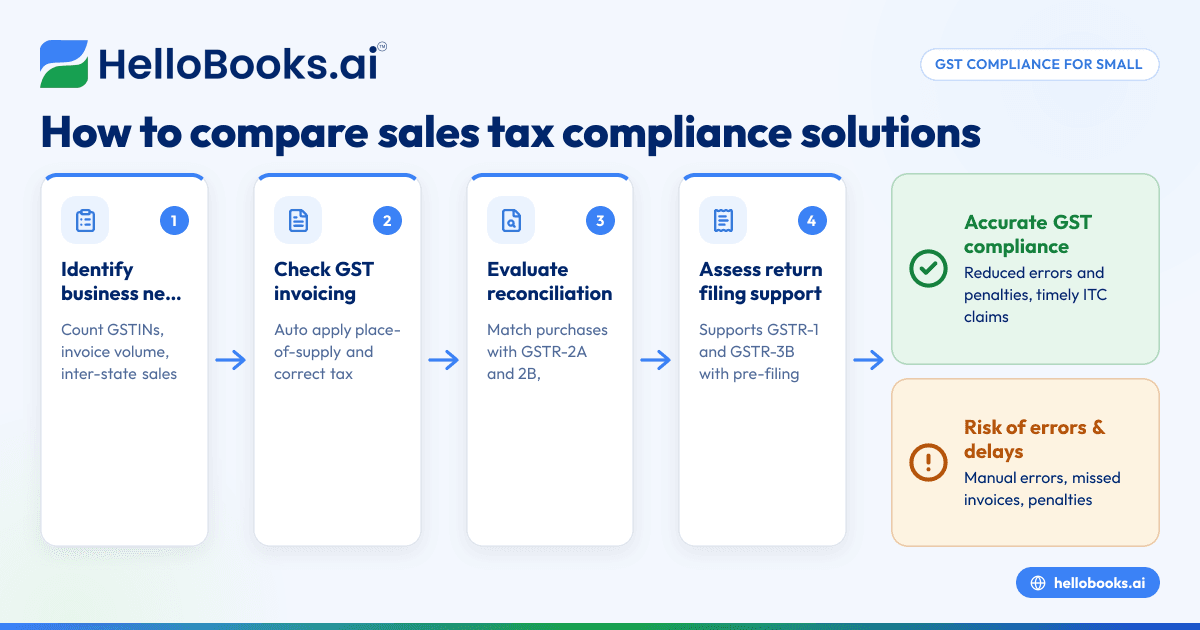
- Identify your business needs: Count your GSTIN registrations, monthly invoice volume, and whether you make inter-state sales.
- Check GST invoicing features: Confirm the solution automatically applies place-of-supply rules and splits tax heads correctly to prevent charging CGST+SGST on inter-state sales or IGST on local sales.
- Evaluate reconciliation capabilities: Look for software that reconciles your purchase register against GSTR-2A and GSTR-2B regularly. It should flag missing, mismatched, or excess-credit invoices and track ITC reversals under Rule 37/42/43.
- Assess GST return filing support: Ensure the solution supports GSTR-1 and GSTR-3B filing with pre-filing validations.
- Review reporting and audit trails: The software should provide clear reports on sales, purchases, and tax liabilities for easy review and audit.
- Consider usability and integration: Check if the solution works with your current bookkeeping, such as Excel or Tally, and offers user-friendly dashboards.
- Compare pricing and plans: Understand which features come with each plan and if multi-GSTIN filing is supported.
For more on GST invoicing and e-invoicing, see GST invoicing and e-invoicing (IRN and QR).
Example (fictional figures)
A Delhi-based business registered under GST sells goods worth ₹1,00,000 on 15/05/2024 to a customer in Maharashtra (an inter-state sale). Assume the GST rate is 18% for illustration.
Sale amount = ₹1,00,000
GST (IGST) = ₹1,00,000 × 18% = ₹18,000
Total invoice value = ₹1,00,000 + ₹18,000 = ₹1,18,000
The software should automatically apply IGST on this inter-state sale, not CGST + SGST.
On the purchase side, the business has supplier invoices totaling ₹50,000. The solution reconciles these against GSTR-2B and flags if any supplier invoices are missing or mismatched before filing GSTR-3B, helping claim accurate ITC.
Common mistakes
- Charging CGST+SGST on inter-state sales: Prevent this by using software that derives place of supply from the buyer's GSTIN and applies tax heads automatically.
- Missing supplier invoices in GSTR-2B reconciliation: Avoid by choosing solutions that track and flag missing or mismatched invoices before ITC claims.
- Manual data entry errors: Reduce errors by selecting software with automated invoice upload and reconciliation features.
- Filing GSTR-3B without verifying ITC reversals: Use tools that track Rule 37/42/43 ITC reversals to prevent excess credit claims.
- Managing multiple GSTINs with separate logins: Simplify compliance by selecting software allowing multi-GSTIN filing from a single login.
Learn more about avoiding these errors at GST invoicing.
Doing this in HelloBooks
HelloBooks provides GSTR-2A/2B reconciliation and ITC tracking, showing which supplier invoices are missing from GSTR-2B before ITC is claimed in GSTR-3B. It also automatically applies place-of-supply and tax head split, preventing common invoice errors such as charging CGST+SGST on inter-state sales or IGST on local sales. For businesses with multiple GSTINs, HelloBooks enables filing all returns from a single login. Learn more at HelloBooks for India and explore its GST return filing features at /gst-return-filing-software.
Frequently asked questions
What is the difference between GSTR-2A and GSTR-2B reconciliation?
GSTR-2A is a dynamic, real-time view of supplier invoices uploaded, while GSTR-2B is a static monthly auto-drafted statement. Reconciling both helps identify missing or mismatched invoices, ensuring accurate ITC claims.
How can I avoid charging wrong GST rates on invoices?
Use software that derives place of supply from the buyer's GSTIN and automatically applies CGST+SGST for intra-state sales and IGST for inter-state sales, reducing manual errors.
Can I file returns for multiple GSTINs from one software login?
Yes, some solutions, including HelloBooks on Pro plans and above, allow you to manage and file returns for multiple GSTINs from a single login.
Is manual reconciliation necessary if I use software?
Software automates much of the reconciliation, but you should still review flagged discrepancies and missing invoices to ensure accuracy before filing.
How does ITC reversal tracking help in compliance?
Tracking ITC reversals under Rule 37/42/43 prevents claiming excess credit and helps maintain compliance with GST laws.
What should I check before choosing a sales tax compliance solution?
Check for automated GST invoicing, reliable reconciliation with GSTR-2A/2B, ITC tracking, support for multiple GSTINs, and ease of use with your existing bookkeeping system.
Key takeaways
- Compare solutions based on automated GST invoicing accuracy, reconciliation with GSTR-2A/2B, and ITC reversal tracking.
- Automated place-of-supply and tax head split prevent common GST invoice errors.
- Reconciliation before filing GSTR-3B avoids penalties and delayed ITC claims.
- Multi-GSTIN filing from one login simplifies compliance for businesses with multiple registrations.
- Using software that integrates with Excel or Tally reduces manual data entry errors.
- HelloBooks offers these features to help small businesses manage GST compliance efficiently.
Choosing the right sales tax compliance solution can save time and reduce errors. For a hands-on look at how HelloBooks can help, Book a 30-minute demo.
This article is general information, not tax or legal advice. Rules change; confirm the current position on gst.gov.in or with your chartered accountant before acting.


