
Key takeaways
What this article covers, in order:
- Key takeaways
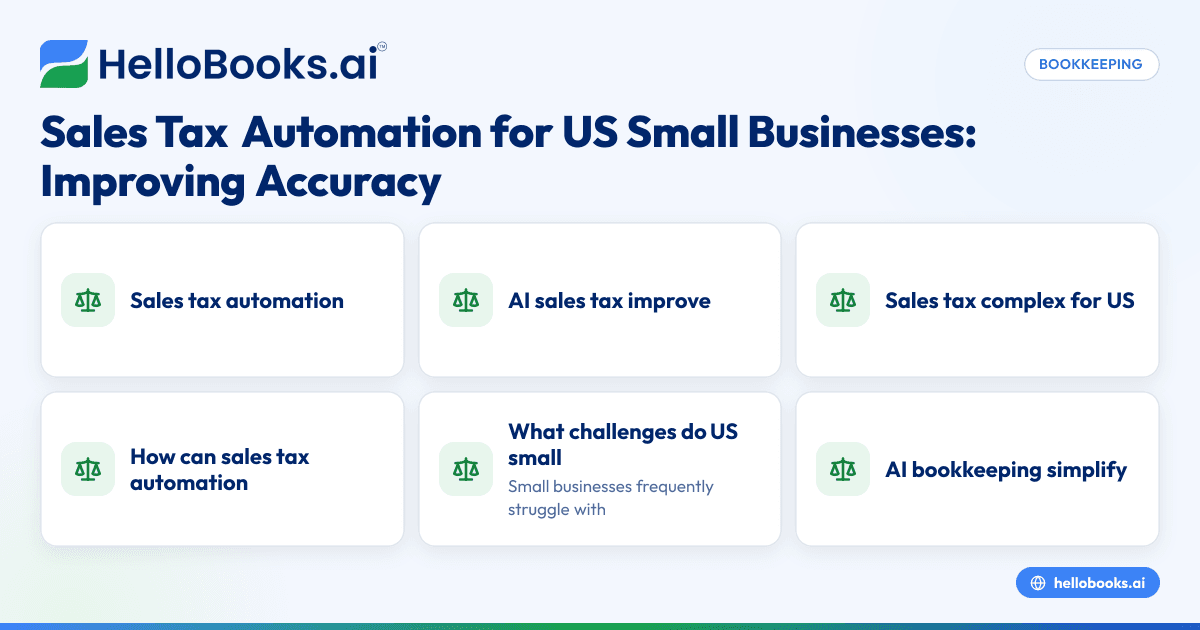
- What is sales tax automation?
- How does AI sales tax improve accuracy and efficiency?
- Why is sales tax complex for US small businesses?
- How can sales tax automation integrate with your existing bookkeeping?
- What challenges do US small businesses face in sales tax compliance?
Sales tax automation uses AI-powered software to handle sales tax calculations, tracking, and reporting automatically. It helps US small businesses reduce errors, save time, and maintain compliance across multiple states by managing complex tax rules efficiently.
Key takeaways
- Sales tax automation uses AI to calculate, track, and report sales taxes accurately and efficiently.
- AI sales tax technology reduces manual data entry and minimizes costly filing errors.
- Compliance with multi-state sales tax rules is simplified through automated software.
- Integrations with invoicing and bank reconciliation streamline bookkeeping workflows.
- US small businesses can benefit from sales tax automation to focus more on growth and less on compliance.
- HelloBooks.ai provides AI-powered bookkeeping that integrates sales tax automation tailored for US businesses.
What is sales tax automation?
Sales tax automation is software that uses AI to automatically calculate the correct sales tax on transactions, track obligations across states, and prepare tax reports or filing documents for US businesses. Managing sales tax manually is challenging due to varying rates, rules, and exemptions in different states and localities.
Automation removes manual calculations and data entry tasks. AI adapts to transaction patterns, applies correct tax rates, and updates changes automatically. This cuts errors, reduces audit risks, and helps maintain compliance more easily.
How does AI sales tax improve accuracy and efficiency?
AI sales tax technology analyzes sales transactions and applies precise tax rates based on jurisdiction, dynamically adjusting for any rate or location changes. This prevents undercharging or overcharging, ensuring compliance and reliable bookkeeping.
It eliminates common mistakes like missing local taxes or misclassifying products. Automated tracking of taxes collected aids faster bank reconciliation. Notifications about tax deadlines help businesses avoid late filings and penalties.
Integrating ai sales tax in bookkeeping saves hours on compliance, letting business owners focus on growth instead.
Why is sales tax complex for US small businesses?
Sales tax complexity arises because over 10,000 tax jurisdictions exist across the US, each with different rates and rules. Businesses must identify where they have nexus (legal tax obligation), apply the correct combined state and local rates, and determine which goods or services are taxable or exempt.
Common challenges include:
- Nexus determination: Legal tax obligations depend on physical or economic presence in a state.
- Variable tax rates: State, county, and city taxes can apply cumulatively.
- Exemptions and holidays: Temporary or product-specific tax breaks complicate calculations.
- Digital goods regulation: Tax rules for digital products vary widely.
- Remote sales reporting: E-commerce sellers must track sales tax owed in multiple states.
Manual systems like spreadsheets increase risks of errors and penalties, making automation necessary.
How can sales tax automation integrate with your existing bookkeeping?
Sales tax automation performs best when built into your invoicing and bank reconciliation tools. Solutions like HelloBooks.ai can:
- Automatically add correct sales tax to invoices based on customer location.
- Match payments and taxes collected to bank transactions.
- Generate tax reports broken down by tax jurisdiction.
- Prepare data or forms needed for state tax filings.
- Keep tax rate tables updated without manual effort.
This integration reduces data duplication, speeds workflows, and offers real-time sales tax insights.
What challenges do US small businesses face in sales tax compliance?
Small businesses frequently struggle with:
- Keeping up with changing tax rates and rules.
- Correctly classifying products for taxability.
- Determining nexus and when to register in each state.
- Completing timely monthly or quarterly filings.
- Managing tax obligations across online and offline sales.
Noncompliance can lead to fines and audits. Overcollection from customers can harm relationships. AI sales tax tools address these challenges by automating calculation and filing tasks.
How does AI bookkeeping simplify multi-state sales tax for online sellers?
AI bookkeeping integrates with platforms like Shopify or payment services like Stripe to automate multi-state sales tax calculation. It detects customers’ shipping addresses to apply the right tax rates and exemptions, then records accurate tax amounts on transactions.
This removes manual nexus tracking and reduces rate errors, while providing consolidated reports necessary for filing returns or audits.
What does it cost to implement AI sales tax automation?
AI sales tax is usually part of a broader AI bookkeeping or accounting software subscription. Pricing depends on transaction volume, number of states supported, and feature sets.
Most vendors provide tiers designed for small businesses. Though it is an investment, automating sales tax compliance can save costs by minimizing penalties and reducing bookkeeping hours. Visit HelloBooks.ai pricing to learn about plans suited for US small businesses.
How to start automating sales tax with AI bookkeeping now?
Start automating sales tax by following these steps:
- Evaluate your current sales tax process to find manual tasks and errors.
- Choose AI bookkeeping software that includes sales tax automation and integrates with your invoicing.
- Set up tax profiles for your customers and products, specifying nexus states and exemptions.
- Automate invoice creation so sales tax is calculated dynamically per sale.
- Use reconciliation features to match bank deposits with sales and tax collected.
- Review generated sales tax reports for accuracy and to support filings.
Switching from spreadsheets or legacy tools is straightforward with the right platform. AI automation both saves time and improves financial reliability.
Why choose HelloBooks.ai for sales tax automation?
HelloBooks.ai is tailored for small US businesses needing accurate, automated AI accounting. Features include:
- Fully automated AI bookkeeping that handles US sales tax rules.
- Integrated invoice software with dynamic tax calculation.
- Continuous tax rate updates to maintain compliance.
- Powerful bank reconciliation software to verify data against transactions.
- Clear dashboards showing detailed sales tax liabilities.
- Affordable plans for startups and growing firms. See pricing for details.
With HelloBooks.ai, reduce error rates and free up time for growth.
Sales tax automation powered by AI transforms small business bookkeeping in the US. Explore how HelloBooks.ai can simplify your tax compliance and boost accuracy.
Book a demo now at book a demo and discover the future of sales tax management.
Frequently asked questions
What is the difference between sales tax automation and traditional bookkeeping?
Sales tax automation uses AI to automatically calculate and track tax obligations, eliminating manual lookup and data entry. Traditional bookkeeping often relies on spreadsheets or general accounting software requiring manual tax calculations.
Can AI sales tax software handle multi-state compliance?
Yes. AI sales tax software detects nexus states, applies correct local and state rates, and generates detailed reports for multiple jurisdictions, helping businesses comply nationwide.
Will sales tax automation replace accountants?
No. Automation reduces repetitive tasks, allowing accountants to provide strategic guidance and tax planning. It complements the accountant’s role by improving data accuracy.
How often do sales tax rates change, and does AI software update automatically?
Sales tax rates can change often at state or local levels. Good AI sales tax software automatically updates tax rate databases regularly to ensure compliance without manual input.
Is automating sales tax filings included in AI bookkeeping software?
Many AI tools prepare tax reports or draft filings but leave final submission to the business or accountant. Automated filings may be available in some solutions, but always verify the features.
How can I ensure my sales tax records are audit-ready?
Using AI bookkeeping with integrated sales tax automation creates clear, complete digital records. Detailed transaction logs and audit trails make compliance easier during reviews.
Read next
This article covers one part of a bigger topic. For the complete picture, read our guide to sales tax.