
Key takeaways
What this article covers, in order:
- Explained: 3-Way Matching between Purchase Order vs GRN vs Bill
- Overview
- Key Documents and Roles
- How 3-Way Matching Works
- Typical Errors and Solutions
- Best Practices for Accurate Matching
Explained: 3-Way Matching between Purchase Order vs GRN vs Bill
Overview
Three-way matching involves comparing three critical documents in order to verify a purchase. The aim is to confirm that goods or services match with orders and invoices. That check helps prevent duplicate invoices, payment errors and even fraud. A lot of teams do this check manually and find it time-consuming and inaccurate to do so. A process with clarity is risk reducing and accelerates payment cycles.
Key Documents and Roles
Knowledge of the documents clarifies and expedites matching. Every document plays a role in the process and needs to include clear information. Teams need to be aware of where to look for quantities, prices and delivery dates. Transparent ownership of each step ensures matching is consistent and auditable. This documentation is instrumental when teams have to justify their choices to auditors.
Purchase Order (PO)
The purchase order details what the buyer ordered and agreed to pay. It specifies quantities, unit prices, delivery conditions and approval authority. The PO guides the receiving team and defines the amount expected on the invoice. Approvers check the PO to see if spending is within budgets and contracts. Accurate POs avoid slow or mismatched matches.
Goods Received Note (GRN)
A goods received note is a record of what actually arrived on-site or at the warehouse. On the GRN, staff count the items and note any damage or short supply. This note connects the physical receipt to the PO and later the invoice. Timely GRNs prevent disputes about when goods arrived or whether they were damaged. Solid GRN entries allow teams to confidently match quantities and dates.
Supplier Bill (Invoice)
The supplier invoice requests payment and shows goods shipped or services rendered. Invoices should include the PO number and a description of items or services provided. Accounts payable verifies this bill with the PO and GRN for consistency. Correct invoices expedite approval and payments. Insufficient details on an invoice often lead to questions or holds.
How 3-Way Matching Works
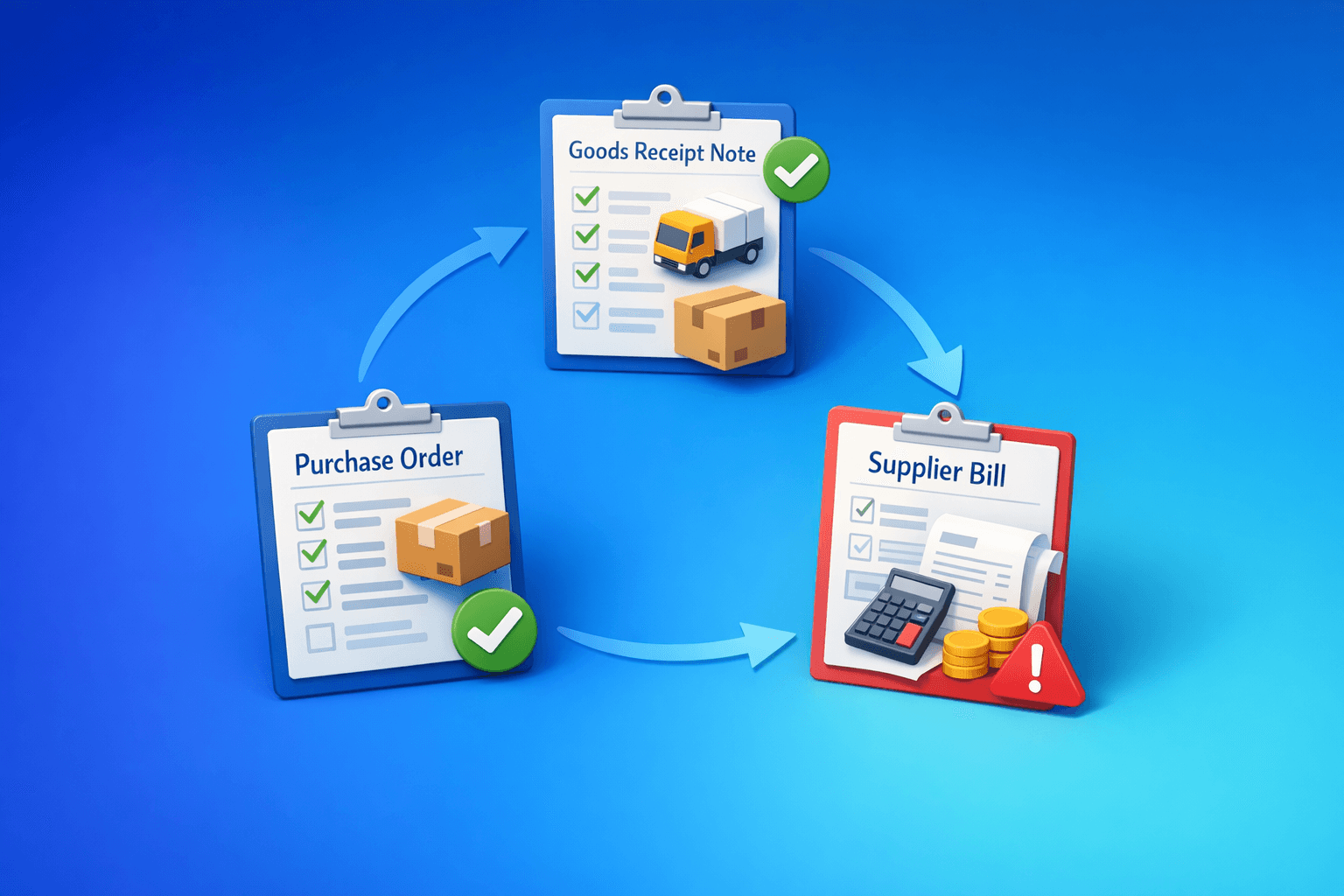
Three-way matching validates agreement between the PO, the GRN and the supplier bill. The procedure verifies merchandise descriptions, amounts, charges and totals. When all three documents agree, authorization of payments becomes more trusted. If any detail differs, it flags an exception and halts payment. Rules are clear around tolerance levels and roles.
- Issue PO numbers for each document
- Check received amounts against ordered quantities
- Verify that invoice amounts align with agreed prices
The pragmatic matching workflow starts with automated or manual comparison. Different flags route items for review by procurement or receiving teams. Teams notice discrepancies, gather supporting notes and document decisions. Then they update their systems and release funds after obtaining proper approvals. This creates a clear trail to help with future audits and supplier discussions.
Typical Errors and Solutions
Common exceptions include mismatched quantities, incorrect prices or wrong document references. Causes include partial deliveries, pricing mistakes or incorrect PO numbers on invoices. Teams must monitor exceptions, reach out to suppliers and update records with accurate information. Some mismatches get resolved quickly while others need a credit note or a revised invoice. Recording the decisions prevents the same problem from recurring.
Best Practices for Accurate Matching
Establish consistent rules about who can approve exceptions and what documentation is necessary. Train the receiving teams to generate correct GRNs and to note defects immediately. Keep orders detailed and remind suppliers to reference PO numbers on invoices. Maintain open communication between procurement, receiving and accounts payable teams. Reduce errors and resolve issues more quickly with simple, repeatable steps.
- PO needed on each supplier bill
- Immediately log GRN details after receiving
- Set approval limits for exceptions
Conclusion
Three-way matching combines the PO, the GRN and the supplier bill to validate them. This practice minimizes payment mistakes, enhances controllability and enables auditability. Well-defined roles, prompt records and intuitive rules allow teams to address mismatches more speedily. Big data analytics instills confidence that payments correlate with actual deliveries and agreed prices. Long-term good matching practices lower cost and curb supplier disputes.