
Key takeaways
What this article covers, in order:
- Why this comes up / what goes wrong
- Step-by-step
- Example (fictional figures)
- Common mistakes
- Doing this in HelloBooks
- Frequently asked questions
A payroll system with pension contribution tracking automates employee salary processing while accurately calculating and deducting pension contributions such as EPF. This reduces manual errors, ensures compliance with statutory requirements, and maintains clear records for audits and employee reference.
Why this comes up / what goes wrong
Many small-business owners in India manage payroll manually using spreadsheets, Tally, or bill books. Tracking pension contributions like EPF manually often causes errors in deduction amounts, missed payments to the Employees' Provident Fund Organisation (EPFO), and compliance risks. Incorrect pension tracking can lead to employee dissatisfaction and penalties from authorities. As businesses grow, manual tracking becomes time-consuming and error-prone, increasing the need for a payroll system that integrates pension contribution tracking.
Step-by-step
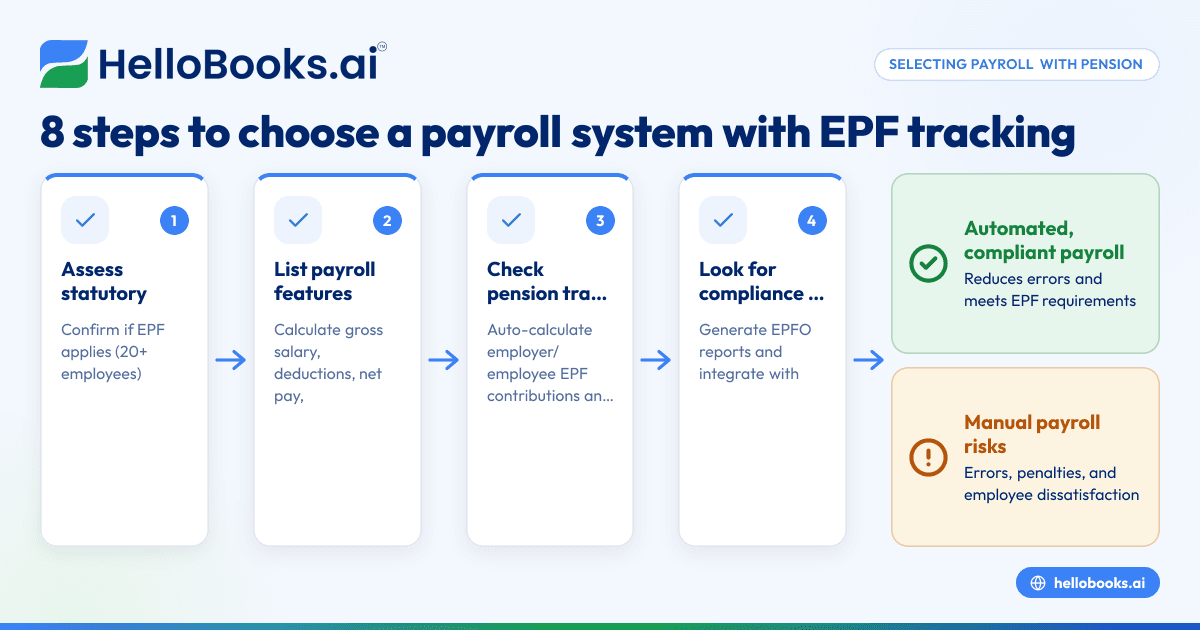
- Assess statutory requirements: Confirm if your business is required to contribute to pension schemes like EPF, typically mandatory for establishments with 20 or more employees. Check current contribution rates and payment deadlines.
- List required payroll features: The system should calculate gross salary, deductions (including pension), net pay, and generate payslips with detailed breakdowns.
- Check pension contribution tracking: Ensure the system automatically calculates both employer and employee pension contributions, tracks payments, and maintains records for EPFO filings.
- Look for compliance support: The system should generate reports required for EPFO submissions and ideally support integration with government portals.
- Evaluate ease of use: Choose software with a user-friendly interface suitable for your accounting or finance team.
- Verify data security: The software must protect sensitive employee data with adequate security measures.
- Consider integration with accounting tools: If you use GST invoicing or bank reconciliation software, check if the payroll system exports data for seamless accounting and financial management.
- Request demos and trial versions: Test shortlisted systems to confirm pension tracking accuracy and overall payroll functionality.
Example (fictional figures)
A small IT firm with 10 employees pays each a monthly gross salary of ₹50,000. Assume the EPF contribution rate is 12% for both employer and employee.
Employee gross salary = ₹50,000
Employee EPF contribution = ₹50,000 × 12% = ₹6,000
Employer EPF contribution = ₹50,000 × 12% = ₹6,000
Total EPF contribution per employee = ₹6,000 + ₹6,000 = ₹12,000
For 10 employees:
Total employee EPF = ₹6,000 × 10 = ₹60,000
Total employer EPF = ₹6,000 × 10 = ₹60,000
Total EPF contribution = ₹60,000 + ₹60,000 = ₹1,20,000
The payroll system should automatically calculate these amounts, deduct ₹6,000 from each employee's salary, add ₹6,000 as employer contribution, and generate payslips showing these details.
Common mistakes
- Manual calculation errors: Use software that automates pension contribution calculations to avoid mistakes.
- Missing statutory updates: Select a system that updates pension rates and rules automatically to stay compliant.
- Incomplete record-keeping: Ensure the payroll system maintains detailed records of each employee's contributions and payments.
- Ignoring integration needs: Avoid isolated payroll systems by choosing one that can export data for accounting tools to maintain coherent financial records.
- Not verifying compliance reports: Regularly review generated reports for EPFO filings to prevent penalties.
- Overlooking employee communication: Use payroll systems that generate clear payslips including pension deductions to maintain transparency.
Doing this in HelloBooks
HelloBooks offers GSTR-2A/2B reconciliation and ITC tracking, which helps you reconcile your purchase register against GSTR-2A and 2B nightly. It flags missing or mismatched invoices before GSTR-3B filing, ensuring accurate input tax credit claims. While HelloBooks does not provide payroll or pension tracking features, its GST invoicing and reconciliation capabilities support your overall financial management. Learn more about GST invoicing and e-invoicing (IRN and QR) in HelloBooks.
Frequently asked questions
Can a payroll system handle EPF and pension contributions automatically?
Yes, payroll systems designed for Indian businesses typically automate EPF and pension contribution calculations based on current rates and statutory requirements. This reduces manual errors and saves time.
Is pension contribution tracking mandatory for all small businesses?
Pension contribution tracking under the EPF scheme is mandatory for establishments with 20 or more employees. Smaller businesses may have voluntary or different pension arrangements. Check your eligibility and compliance requirements.
How often should pension contributions be paid and reported?
Employers must deposit EPF contributions monthly and file returns with the EPFO according to statutory deadlines. Payroll systems should facilitate generating reports for timely payment and filing.
Can payroll systems integrate with GST invoicing and accounting software?
Some payroll systems offer data export features to connect with GST invoicing and accounting software, helping streamline financial management. For GST compliance, you can use dedicated tools like HelloBooks with features such as GSTR-2A/2B reconciliation and ITC tracking.
What documents are important for pension contribution compliance?
Payslips showing pension deductions, EPF payment challans, and EPFO returns are essential. Payroll systems should generate and store these documents for audit and employee reference.
Key takeaways
- A payroll system with pension contribution tracking automates EPF calculations and deductions.
- Accurate pension tracking ensures compliance and avoids penalties.
- Choose software that updates statutory rates and supports EPFO reporting.
- Integration or data export features help maintain coherent financial records.
- Regularly verify payroll reports and maintain clear employee payslips.
- Testing and demos help select the right payroll system for your business.
For small businesses aiming to improve GST compliance alongside payroll, HelloBooks offers features like GSTR-2A/2B reconciliation and ITC tracking to support your financial processes.
Book a 30-minute demo at HelloBooks to explore how it can fit your business needs.