
Key takeaways
What this article covers, in order:
- Key takeaways
- What is a month-end close checklist?
- Why month-end close matters for small businesses in India
- Ideal month-end close timeline for a small business
- Month-end close checklist for small businesses in India
- 1. Lock the period and gather all source data
A month-end close checklist is a step-by-step list your finance team follows to finalise the books for a month. For small businesses in India, it helps you catch missing entries, reconcile bank and GST data, review receivables and payables, and produce reliable financial reports on time.
If your books live across spreadsheets, Tally exports, bank statements and WhatsApp invoices, month-end can become messy very quickly. A clear checklist reduces errors, shortens close time and gives you numbers you can actually use.
Key takeaways
- A month-end close checklist helps small businesses in India close books faster and with fewer errors.
- The checklist should cover bank reconciliation, invoices, expenses, GST review, receivables, payables and final reports.
- Most small businesses should aim to close the previous month within 5 to 10 working days.
- Common mistakes include posting entries late, skipping reconciliations and ignoring GST mismatches.
- A standard process, clear owners and the right accounting software in India can make month-end much easier.
What is a month-end close checklist?
A month-end close checklist is a repeatable process used to verify, record and review all financial activity for a month. It ensures that sales, purchases, bank transactions, expenses, taxes, receivables and payables are complete and correct before reports are shared.
For a small business in India, month-end close is not just an accounting routine. It affects cash flow planning, GST accuracy, vendor payments and management decisions. If your owner asks, “What was our profit in August?” the answer is only useful if the books are properly closed.
A good checklist does three things:
- It standardises the close process every month.
- It assigns clear responsibility to each person.
- It creates a timeline so work does not drag on.
This matters even more if your business operates across multiple bank accounts, UPI collections, branch offices or city-level teams in places like Mumbai, Pune or Bengaluru. When transactions come from many sources, errors multiply unless you have a disciplined close.
Why month-end close matters for small businesses in India
Many small businesses treat month-end as optional. They update books when GST returns are due, when the CA asks, or when a loan application needs numbers. That approach creates stress and weak reporting.
A proper month-end close gives you practical benefits:
Better cash flow visibility
You can see how much money is actually available after adjusting for unpaid invoices, vendor dues and recorded expenses. This is important if you collect through UPI, Razorpay or bank transfers and make frequent supplier payments.
Cleaner GST records
If you review sales, purchase entries and tax classifications monthly, it becomes easier to spot errors before return filing. If your business uses GST return filing software, monthly review becomes faster, but the process still needs discipline.
Faster decision-making
You can compare monthly revenue, gross margin, overheads and collections without waiting until quarter-end or year-end.
Fewer year-end surprises
When books are closed properly every month, the audit and tax season become far smoother. You spend less time fixing old entries and chasing missing bills.
Ideal month-end close timeline for a small business
There is no single legal deadline called “month-end close” in India. It is an internal finance process. Your ideal timeline depends on transaction volume, team size and complexity.
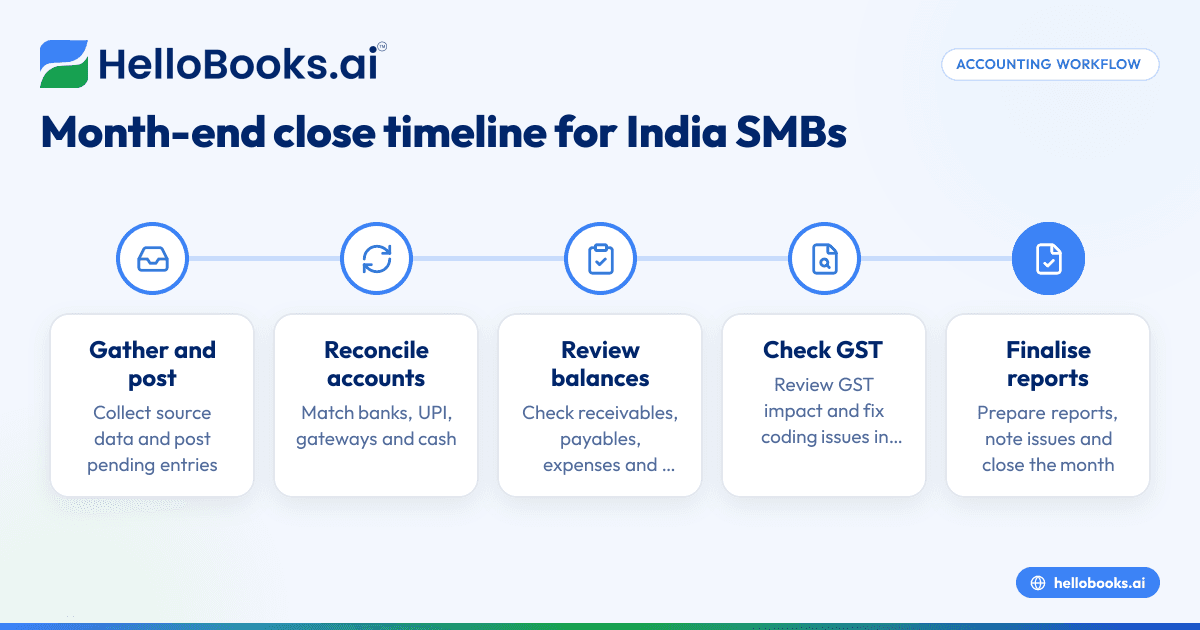
For most small businesses, a practical target looks like this:
- Day 1 to Day 2: Collect all transaction data and post pending entries.
- Day 3 to Day 4: Reconcile banks, payment gateways and cash accounts.
- Day 5 to Day 6: Review receivables, payables, expenses and accruals.
- Day 7 to Day 8: Review GST impact, correct coding issues and finalise adjustments.
- Day 9 to Day 10: Prepare and review management reports.
If you are a very small business with one bank account and low transaction volume, you may finish in 3 to 5 working days. If you run multiple branches, inventory-heavy operations or services across states, 7 to 10 working days is more realistic.
The key is consistency. A close that finishes in 7 working days every month is better than a close that takes 3 days one month and 20 days the next.
Month-end close checklist for small businesses in India
Use the checklist below as a practical monthly workflow. You can tailor it for your business size and sector.
1. Lock the period and gather all source data
Start by defining the period you are closing, such as 01/08/2026 to 31/08/2026. Then collect all source data before posting adjustments.
Gather:
- Sales invoices
- Credit notes and debit notes
- Purchase bills
- Expense receipts
- Bank statements
- Payment gateway statements
- UPI collection reports
- Petty cash records
- Payroll summaries
- Loan statements
- GST reports, where relevant
If your team sends bills on WhatsApp or email, create one rule for submission. Month-end goes wrong when documents arrive after review has already started.
What to check
- Are all sales for the month raised?
- Are dispatches or services delivered but not invoiced?
- Are all vendor bills collected?
- Are staff reimbursements submitted?
- Are any cash expenses missing support?
2. Record all pending sales and income entries
Next, make sure revenue for the month is complete.
This includes:
- Customer invoices raised during the month
- Advances received and their correct treatment
- Credit notes for returns or discounts
- Other income such as interest or commissions, if applicable
For service businesses, check work completed but not yet invoiced. For trading businesses, check dispatch records versus invoices. For businesses using invoice software, this step is usually easier because invoice data is centralised.
Common issue
Many businesses record collections properly but miss invoices raised offline or through branch teams. This leads to underreported revenue and weak receivables tracking.
3. Record all purchase and expense entries
Enter all supplier bills and expenses for the month. This includes raw materials, rent, internet, software, travel, freight, professional fees and marketing costs.
Also review:
- Employee reimbursements
- Recurring subscriptions
- Rent and utility invoices
- Courier and logistics bills
- Merchant fee deductions from payment gateways
For small businesses, this is often where the biggest gaps appear. Teams may pay by UPI or company card but forget to submit the bill. If you use expense management software, you can reduce this problem, but someone still needs to review missing proofs.
Accruals to consider
If a service was received in the month but the bill has not arrived, you may need an accrual entry. Common examples are audit fees, consulting charges, internet bills or rent adjustments.
This is general information, not tax or legal advice. Speak to your accountant for the right tax treatment and recognition in your case.
4. Reconcile bank accounts, UPI and payment gateways
Bank reconciliation is one of the most important parts of the month end close checklist. If this step is skipped, your books may look correct on paper but still be wrong.
Match every bank transaction to the books, including:
- Customer receipts
- Vendor payments
- Bank charges
- Interest income
- Loan EMI deductions
- Refunds
- Failed or reversed entries
Also reconcile:
- UPI collections
- Razorpay or other gateway settlements
- Cash deposits and withdrawals
- Transfers between bank accounts
If your business has multiple collection channels, settlement timing differences are common. A sale recorded on 30/08/2026 may settle to the bank on 01/09/2026. That is normal, but it must be tracked clearly.
Using bank reconciliation software can reduce manual matching effort, especially when transaction volume grows.
What to investigate immediately
- Unmatched receipts
- Duplicate payments
- Bank charges not recorded
- Old unreconciled entries
- Suspense account balances
5. Review accounts receivable
Now review what customers owe you. This turns your books into a useful cash flow tool.
Check:
- Customer-wise ageing
- Overdue invoices
- Credit notes pending adjustment
- Advance receipts not allocated
- Disputed invoices
- Collections received but not posted properly
For example, if a distributor in Pune paid ₹2,40,000 but the receipt is sitting unallocated, your debtor ageing will be wrong. That can lead to unnecessary follow-up calls and poor cash planning.
Questions to ask
- Which invoices are overdue by 30, 60 or 90 days?
- Are any invoices raised incorrectly?
- Are any customers consistently short-paying?
- Do old balances need write-off or escalation?
6. Review accounts payable
Next, check what you owe suppliers and service providers.
Review:
- Vendor-wise ageing
- Unrecorded bills
- Duplicate vendor entries
- Advance payments to suppliers
- Debit notes not adjusted
- Payment due dates
This step helps avoid both late fees and duplicate payments. It also improves vendor relationships. If a supplier in Mumbai says an invoice is unpaid, you should be able to verify the exact position quickly.
Watch for these errors
- Paying the same bill twice
- Booking a payment without the bill
- Leaving old advances uncleared
- Missing TDS-related review, where applicable to your business
7. Check GST classification and tax data
For Indian businesses, this is a critical review area. Even if return filing happens later, month-end is the right time to catch problems early.
Review:
- Output GST on sales invoices
- Input GST on eligible purchases
- Intra-state versus inter-state treatment
- Credit notes and debit notes
- HSN or SAC use, where relevant
- E-invoicing records, if applicable to your business based on current rules
If you issue many B2B invoices, or your team creates invoices from multiple locations, GST coding errors can spread quickly. Monthly checks reduce the risk of mismatches later.
If relevant, compare books with GST working files and your invoicing records. Businesses with larger transaction volumes may benefit from e-invoicing software to reduce manual effort and mismatches.
Common GST mistakes at month-end
- Wrong GST rate applied
- Wrong place of supply
- Purchase booked without proper GST breakup
- B2B sale treated as B2C
- Credit notes not adjusted in the same reporting workflow
8. Post payroll, loans and recurring journal entries
Do not forget the entries that are not triggered by a bill or bank transaction.
These may include:
- Salary and payroll entries
- Employer contributions, where applicable
- Depreciation
- Prepaid expense adjustments
- Interest on loans
- EMI principal versus interest split
- Amortisation of annual contracts
- Accrued expenses
Many small businesses miss these entries because they focus only on cash movement. But profit and loss accuracy depends on these adjustments.
9. Review inventory and cost of goods sold, if applicable
If you sell physical products, inventory review is essential. Without it, gross profit may be wrong.
Check:
- Opening and closing stock
- Goods received but not booked
- Goods sold but not adjusted in stock
- Damaged or obsolete inventory
- Branch transfers
- Variance between physical stock and book stock
A wholesaler in Bengaluru may show strong sales, but if stock shrinkage is not recorded, margins will look better than reality.
Keep this practical
You do not need a full warehouse audit every month. But you do need a consistent stock review process and a way to investigate large variances.
10. Review the financial statements
Once all key entries and reconciliations are complete, review the reports.
At minimum, check:
- Profit and loss statement
- Balance sheet
- Cash flow view or bank movement summary
- Debtor ageing
- Creditor ageing
- GST summary, if relevant
Look for unusual movements:
- Revenue unusually high or low
- Expense categories that jumped sharply
- Negative balances in the wrong places
- Old suspense balances
- Large round-number journal entries
- Receivables or payables that do not make sense
This final review is where finance turns accounting data into management insight.
11. Document issues and close the month
Do not just fix the month. Improve the process for next month.
Create a short note covering:
- Open items still pending
- Entries passed after review
- Reconciliation exceptions
- Teams that submitted documents late
- Process changes needed
Then close the month internally so old transactions are not edited casually. A controlled process matters whether you use spreadsheets, Tally or AI accounting software.
Common mistakes in the month-end close process
Even businesses with a checklist make avoidable mistakes. Here are the most common ones.
1. Starting too late
If the team begins collecting bills on the 10th of the next month, delays are guaranteed. Build habits during the month, not after it ends.
2. Treating bank balance as final truth
A healthy bank balance does not mean the books are accurate. Unrecorded liabilities and pending receipts can distort the picture.
3. Ignoring small unreconciled items
A ₹350 charge or a ₹1,200 mismatch may look minor. But dozens of small unresolved items create messy books over time.
4. Depending on one person
If only one accountant knows the full process, month-end becomes risky. Use a checklist with owners and backups.
5. Not reviewing GST monthly
Waiting until filing time creates avoidable stress. Small classification errors become bigger reconciliation problems later.
6. Posting without supporting documents
Entries without bills, statements or explanations are difficult to defend and harder to review later.
How to make your month-end close faster
A faster close does not mean rushing. It means reducing avoidable manual work.
Standardise the process
Use one checklist every month. Keep owners and deadlines clear.
Collect documents continuously
Do not wait until month-end for expense bills and sales records.
Reduce duplicate data entry
If your team re-enters invoice and bank data across multiple tools, errors increase. A single system for bookkeeping, invoicing and reconciliation helps. Businesses moving away from older setups often look for a Tally alternative when they want simpler workflows.
Automate repetitive matching
Bank matching, recurring entries and invoice capture are good candidates for automation. That is where AI bookkeeping can save finance teams significant time.
Use a close calendar
Set internal due dates for sales, expenses, reimbursements and reconciliations. Share it with every team that affects the books, not just finance.
A simple monthly close ownership example
Here is a practical way to assign work in a small business:
- Sales/admin team: Submit all invoices, credit notes and dispatch records by Day 1.
- Operations/procurement: Submit vendor bills and goods receipt information by Day 2.
- HR/admin: Submit payroll and reimbursement data by Day 3.
- Accounts team: Complete bank reconciliation and ledger posting by Day 5.
- Finance lead or owner: Review reports, exceptions and cash position by Day 8.
- Management: Approve final month close by Day 10.
Even a two-person finance setup can follow this structure in a simplified way.
A disciplined month-end close gives you cleaner books, better cash visibility and fewer compliance surprises. If you want to see how HelloBooks can help you manage bookkeeping, invoicing, GST workflows and reconciliations in one place, you can book a demo or compare options on our pricing page.
Frequently asked questions
How long should a month-end close take for a small business in India?
For many small businesses, 5 to 10 working days is a practical target. A very small business may close faster, while a business with inventory, multiple branches or many transactions may need more time.