
Key takeaways
What this article covers, in order:
- Why this comes up / what goes wrong
- Step-by-step
- Example (fictional figures)
- Common mistakes
- Doing this in HelloBooks
- Frequently asked questions
For small Indian businesses looking for accounting and inventory software, it is important to choose a solution that simplifies bookkeeping, manages inventory in real time, and supports GST compliance. The right software should reduce manual data entry, help with GST invoicing and filing, and keep your stock updated automatically.
Why this comes up / what goes wrong
Many small business owners in India start with spreadsheets, Tally, or manual bill books to manage accounts and inventory. Over time, these methods become inefficient, error-prone, and time-consuming. Manual reconciliation of invoices, stock counts, and GST returns can lead to mistakes, missed deadlines, and penalties. Businesses often struggle to keep closing stock figures accurate without a separate register, which affects financial reports and tax filings. This search arises because owners want software recommendations that fit Indian GST rules and their business size.
Step-by-step
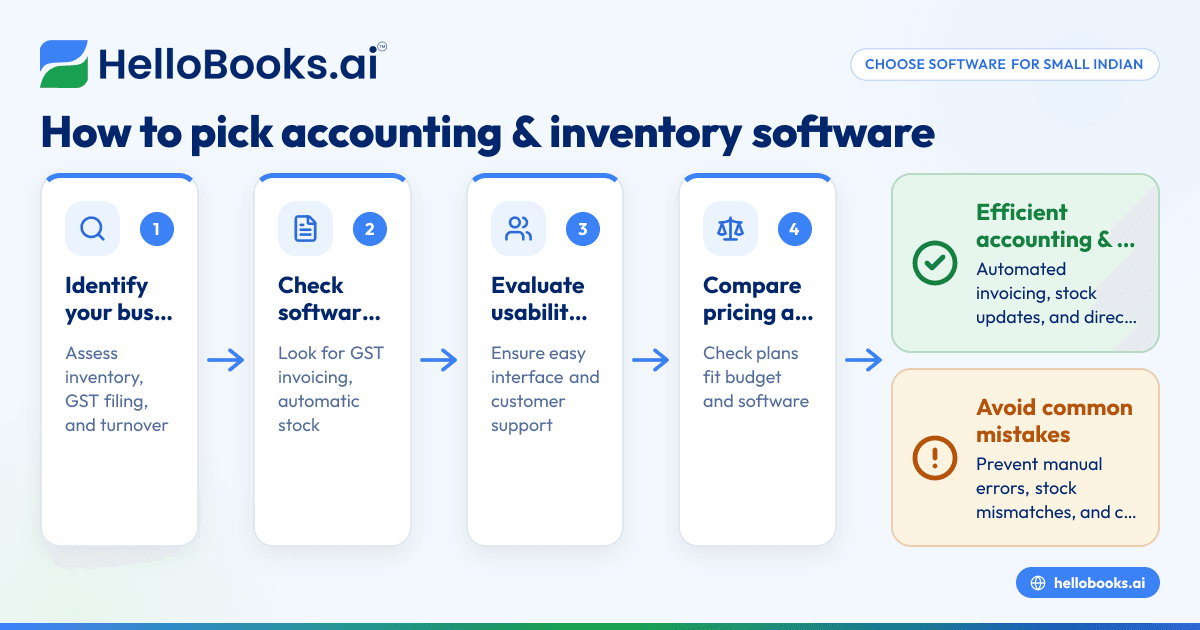
- Identify Your Business Needs
- Check if you need inventory management with real-time stock updates or just basic accounting.
- Determine your GST filing requirements (single GSTIN or multiple GSTINs).
- Consider your turnover to know if you must comply with e-invoicing (₹5 crore threshold).
- Check Software Features
- Look for GST invoicing capabilities including generation of tax invoices with mandatory particulars such as GSTIN, HSN/SAC codes, tax rates, and signatures [cgst-rule-46/rule46-particulars].
- Ensure inventory management updates stock automatically with every sale and purchase to keep closing stock current without a separate register [inventory management].
- Verify if the software supports e-invoicing with IRN and signed QR codes if your turnover exceeds ₹5 crore [e-invoicing].
- Confirm GSTR-1 and GSTR-3B direct filing from invoices to avoid manual JSON uploads [gst-filing].
- Evaluate Usability and Support
- Choose software with an easy-to-use interface suited for non-accountants.
- Check if customer support is available to help with GST compliance questions.
- Compare Pricing and Scalability
- Review pricing plans to ensure they fit your budget.
- Consider if the software can scale with your business, e.g., adding multi-warehouse inventory or manufacturing features as you grow.
- Test with a Trial or Demo
- Use trial versions to enter sample transactions.
- Check if reports, invoices, and GST returns generate correctly.
- Plan Your Data Migration
- Prepare your existing data in spreadsheets or Tally for import if supported.
- Back up your data before switching.
Example (fictional figures)
ABC Traders is a small business in Mumbai with a turnover of ₹6 crore in FY 2023-24. They need accounting and inventory software that supports e-invoicing and GST filing.
- Total sales in July 2024: ₹12,00,000
- GST rate assumed: 18%
GST calculation:
₹12,00,000 × 18% = ₹2,16,000 (GST on sales)
Invoice creation:
- The software generates a tax invoice with supplier and recipient GSTIN, HSN codes, taxable value, and GST amount [cgst-rule-46/rule46-particulars].
- IRN and QR code are generated automatically for e-invoicing [e-invoicing].
Inventory update:
- ABC Traders sells 100 units of Item A. Stock reduces automatically by 100 units in the software [inventory management].
GST filing:
- GSTR-1 and GSTR-3B are built from recorded invoices and filed directly from the software, matching the sales figures [gst-filing].
This process reduces manual work and errors.
Common mistakes
- Choosing software without GST compliance features
- Prevent by verifying GST invoicing and filing capabilities before purchase.
- Ignoring inventory updates leading to stock mismatches
- Prevent by selecting software with automatic stock movement on sales and purchase.
- Not checking e-invoicing support when turnover exceeds ₹5 crore
- Prevent by confirming if IRN and QR code generation is included.
- Overlooking multi-GSTIN or multi-warehouse needs
- Prevent by assessing future business growth and selecting scalable software.
- Failing to test software with real data
- Prevent by using free trials or demos to ensure the software meets your needs.
- Not backing up existing data before migration
- Prevent by preparing and backing up data carefully.
Doing this in HelloBooks
HelloBooks offers inventory management where stock moves with every sale and purchase, keeping the closing stock figure current without a separate register. For businesses with turnover over ₹5 crore, HelloBooks generates the IRN and signed QR at the time of saving B2B invoices, saving time compared to manual portal uploads. It also builds GSTR-1 and GSTR-3B returns directly from recorded invoices and files them to GSTN, ensuring figures match issued invoices. Learn more about HelloBooks features on inventory management, GST invoicing, and HelloBooks for India.
Frequently asked questions
What features should I look for in accounting and inventory software for GST compliance?
Look for GST invoicing with all mandatory invoice particulars, e-invoicing support if your turnover exceeds ₹5 crore, real-time inventory updates, and direct filing of GSTR-1 and GSTR-3B returns from recorded invoices.
Is e-invoicing mandatory for all small businesses?
E-invoicing is mandatory for businesses whose aggregate turnover exceeds ₹5 crore in any financial year from 2017-18 onwards, effective 1 August 2023 [einvoice-threshold-5cr/einv-5cr-from-2023-08-01]. Businesses below this threshold are exempt but may choose to adopt it voluntarily.
Can I manage inventory without separate stock registers?
Yes, software with integrated inventory management updates stock automatically with every sale and purchase, eliminating the need for separate registers and reducing errors.
How does direct GST return filing help my business?
Direct filing of GSTR-1 and GSTR-3B from your invoices reduces manual data entry, ensures your returns match your books, and saves time by avoiding JSON export and upload.
Should I consider scalability when choosing software?
Yes, if you plan to grow, choose software that supports multi-warehouse inventory, batch tracking, or manufacturing features to avoid switching later.
Can I try HelloBooks before buying?
HelloBooks offers a Free plan with 200 transactions a year and GSTR-1 and GSTR-3B filing for one GSTIN, allowing you to test its features before upgrading.
Key takeaways
- Choose software that handles GST invoicing with all mandatory details and supports e-invoicing if applicable.
- Inventory management integrated with sales and purchases keeps stock accurate without extra registers.
- Direct filing of GSTR-1 and GSTR-3B from invoices saves time and reduces errors.
- Test software with your data and check scalability for future growth.
- Back up existing data before migrating to new software.
- HelloBooks offers these features with plans suitable for small Indian businesses.
To start managing your accounting and inventory efficiently, consider [starting on the Free plan]( /in/pricing) with HelloBooks, which supports up to 200 transactions a year and GST filing for one GSTIN.