
Key takeaways
What this article covers, in order:
- Do this before you log in
- Which GSTR-1 tables will you actually use?
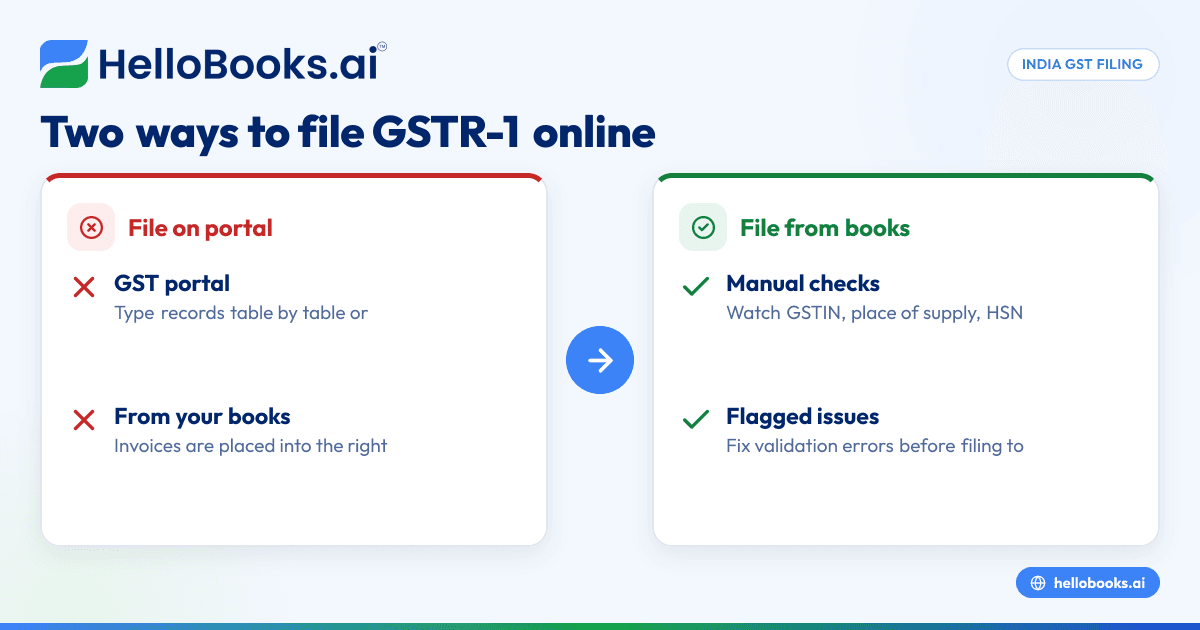
- Route 1: Filing on the GST portal yourself
- Route 2: Filing from your books
- A real-looking month: Ramesh in Jaipur
- Why GSTR-1 matters more than it used to
It's the evening of the 10th. You've got 23 invoices for the month, a GST portal tab that keeps logging you out, and GSTR-1 due tomorrow. Breathe. You can file GSTR-1 for free in two ways: by hand on the GST portal, or from accounting software that files to the portal straight from your invoices. We'll walk through both, section by section.
Do this before you log in
Honestly, most GSTR-1 headaches start before you open the portal. Spend fifteen minutes on this list and the filing itself gets much easier.
- [ ] Every sale for the period is recorded, including cash and marketplace sales.
- [ ] Each B2B invoice has the buyer's correct 15-character GSTIN.
- [ ] Place of supply is right on every invoice.
- [ ] Every line has an HSN or SAC code.
- [ ] Credit notes and debit notes issued this period are recorded and linked to the original invoice.
- [ ] Advances received for services are noted, if you had any.
- [ ] Your invoice number series has no unexplained gaps.
- [ ] Your registered mobile number is with you. You'll need the OTP.
That place-of-supply line deserves a second look. It decides whether you charge IGST or CGST plus SGST, and it's the single most common reason we see returns go wrong.
Which GSTR-1 tables will you actually use?
GSTR-1 looks intimidating because it has so many tables. You'll use only a few.
| Table | What goes in it |
|---|---|
| 4A, 4B (B2B) | Invoices to registered buyers, listed one by one; includes reverse-charge supplies |
| 5 (B2CL) | Inter-state invoices to unregistered buyers above the value limit (₹1 lakh per invoice under current rules; confirm on the portal) |
| 6A | Exports, with or without IGST |
| 6B, 6C | Supplies to SEZ units and deemed exports |
| 7 (B2CS) | All other B2C sales, as totals by rate and place of supply |
| 8 | Nil-rated, exempt and non-GST supplies |
| 9B | Credit and debit notes |
| 11 | Advances received and adjusted |
| 12 | HSN summary, split into B2B and B2C |
| 13 | Documents issued: invoice ranges, totals, cancellations |
| 14, 15 | Supplies through e-commerce operators |
A freelancer billing only Indian companies may touch just tables 4A, 12 and 13. A chemist selling to walk-in customers mostly lives in 7, 12 and 13. Don't let the rest worry you.
Route 1: Filing on the GST portal yourself
It's free and needs nothing but a browser. It's perfectly fine when you've got a handful of invoices.
Open the return. Log in, go to Services, then Returns, then Returns Dashboard. Pick the financial year and period and click Prepare Online under GSTR-1. QRMP filers pick the quarter. In the first two months of a quarter, you'll see the IFF tile instead.
Say no to nil, if you had sales. The portal may ask whether you're filing a nil return first.
Add invoices table by table. In B2B, click Add Record and type in the buyer's GSTIN, invoice number, date, value, place of supply, rate and taxable value. Then do it again for the next invoice. And the next. For B2CS, you enter rate-wise totals per state.
If you've got a lot of invoices, the portal's free offline tool lets you fill an Excel template and upload a JSON file. It saves typing, but you'll spend time on the download-fill-convert-upload loop instead.
Don't skip tables 12 and 13. The HSN summary needs your sales by HSN/SAC code. The documents table needs your invoice number range, total issued and any cancelled. People forget these all the time, and then wonder why their return gets flagged.
Generate the summary and preview. Click Generate GSTR-1 Summary, then Preview. Download the draft PDF and compare its totals with your sales register. If the numbers don't match, stop and find out why.
File it. Tick the declaration, pick the authorised signatory and file with EVC (an OTP to your registered mobile and email) or DSC. Companies have to use DSC, and the portal only shows you the options your GSTIN is allowed. You'll get an ARN on screen when it goes through. Screenshot it, save it, email it to yourself.
Route 2: Filing from your books
If your invoices already live in software that files directly, most of the above disappears.
You open the GSTR-1 screen for the month or quarter. The software has already placed each invoice in B2B, B2CL, B2CS, exports, credit notes, HSN summary and documents issued. You look at what it's flagged, usually a GSTIN that fails validation, a missing HSN code, or a place of supply that doesn't match the tax charged. You fix those, glance at the totals and file. The ARN comes back and gets saved against the period.
The real benefit isn't speed, though that's nice. It's that the same invoice record feeds both your books and your return. They can't drift apart.
A real-looking month: Ramesh in Jaipur
Ramesh sells handicrafts from a small shop in Jaipur and files monthly. He's an illustrative example, but his Sep 2026 is a pretty normal one.
He has six invoices to registered shops in Rajasthan, so CGST and SGST. Two invoices to registered shops in Delhi, with IGST. One invoice of ₹1,40,000 to an unregistered buyer in Mumbai, which is inter-state B2C above the limit. Counter sales of ₹62,000 to tourists, at 12%. And one credit note to a Delhi shop that sent back a cracked lamp.
His GSTR-1 for Sep 2026 is due 11 Oct 2026. Eight invoices go into 4A. The Mumbai invoice goes into table 5. The counter sales go into 7 as one line. The credit note goes into 9B. Then the HSN and documents tables.
Two days after filing, he notices one Rajasthan invoice has a wrong digit in the GSTIN. Annoying, but fixable. He can correct it through GSTR-1A before filing his Sep 2026 GSTR-3B, or amend it in a later GSTR-1.
Why GSTR-1 matters more than it used to
From the July 2025 tax period onwards, the sales liability in GSTR-3B comes straight from GSTR-1, IFF and GSTR-1A, and you can't edit it. Whatever you report in GSTR-1 is what you'll pay in GSTR-3B. Miss an invoice and you underpay, with interest to follow. Report one twice and you overpay until you fix it.
Your buyers also see your invoices in their Invoice Management System, where they can accept or reject each one. If a buyer rejects an invoice, pick up the phone. Something on it probably needs correcting.
Errors you'll run into, and what to do
| What you see | What to do |
|---|---|
| "Invalid GSTIN" on a B2B record | Check the GSTIN using Search Taxpayer on the portal, then correct it |
| Tax type doesn't match place of supply | Inter-state is IGST; intra-state is CGST + SGST. Fix the invoice |
| HSN summary doesn't match invoice totals | Make sure every invoice line has an HSN/SAC code |
| Forgot an invoice after filing | Add it through GSTR-1A before GSTR-3B, or in the next GSTR-1 |
| Filed for the wrong period | Filed returns can't be deleted; correct it through amendments in a later GSTR-1 |
Exports under LUT, SEZ supplies or a pile of old amendments are where it's worth having a CA look before you file.
How HelloBooks helps
HelloBooks builds GSTR-1 from the invoices you raise in it and files directly to the GST portal from inside HelloBooks. No JSON, no re-upload. GSTR-1 filing is unlimited on the Free plan for one GSTIN, at ₹0, with no card and no expiry.
Your invoices carry HSN/SAC codes and place of supply from the start, which keeps the HSN table and the tax split honest. Free includes 2 users and up to 200 transactions a year, and you can invite your CA into the same books. There's a screen-by-screen walkthrough on the GSTR-1 filing page, and our HSN and SAC guide helps if you're unsure about codes.
FAQs
When is GSTR-1 due?
Monthly filers file by the 11th of the next month, so 11 Nov 2026 for Oct 2026. QRMP filers file by the 13th after the quarter, so 13 Jan 2027 for the Oct–Dec 2026 quarter. Check the portal for extensions.
Can I file GSTR-1 without any software?
Yes. You can type invoices straight into the portal, or use the free offline tool for bulk uploads. Software mostly saves time and typing errors.
Can I revise GSTR-1 once it's filed?
Not revise, but correct. Use GSTR-1A for the same period before you file that period's GSTR-3B, or report the amendment in a later GSTR-1.
Do I file GSTR-1 if I had no sales?
Yes, as a nil GSTR-1. You can do it on the portal or by SMS from your registered mobile.
Is an OTP enough to file, or do I need a DSC?
Proprietors, partnerships and most other taxpayers can file with EVC (OTP). Companies have to use a DSC. The filing screen shows which options your GSTIN can use.
File by the 9th or 10th if you can. The portal's much friendlier when the rest of India isn't on it.
Start free — GST filing included, no card. Try HelloBooks Free