


Key takeaways
What this article covers, in order:
- Why this comes up / what goes wrong
- Step-by-step
- Example (fictional figures)
- Common mistakes
- Doing this in HelloBooks
- Frequently asked questions
To calculate IFTA fuel tax, you need to track miles traveled and fuel purchased in each member jurisdiction, then multiply fuel consumption by the tax rates applicable in those jurisdictions. This ensures you pay the correct amount of fuel tax based on where you operated your vehicle. This article explains why this calculation matters for small-business owners, provides a clear step-by-step method, a detailed example with Indian Rupees for clarity, common mistakes to avoid, and how HelloBooks supports accurate tax compliance.
Why this comes up / what goes wrong
Small-business owners operating commercial vehicles across multiple states or provinces must comply with the International Fuel Tax Agreement (IFTA). They need to report miles driven and fuel bought in each jurisdiction. Without a clear method, errors happen: miscalculating miles or fuel, mixing up tax rates, or missing jurisdictions. This leads to incorrect tax payments, penalties, or lost credits. Many still use manual spreadsheets or paper logs, which increase errors and time spent reconciling fuel tax. This guide helps owners calculate IFTA fuel tax accurately and efficiently.
Step-by-step
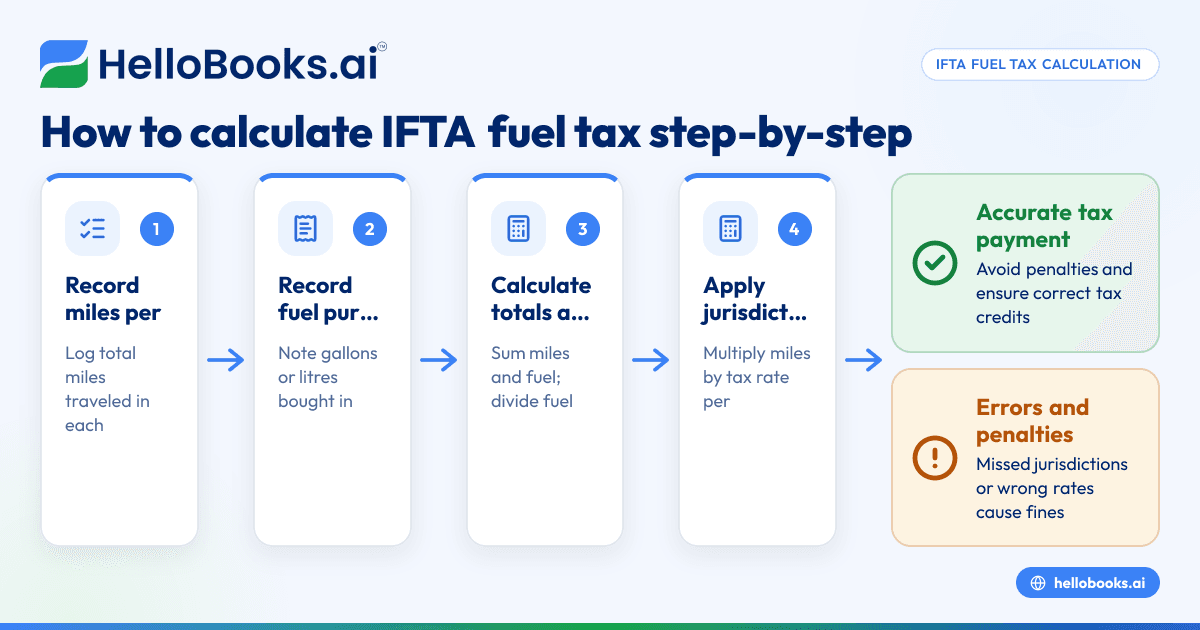
- Collect miles driven per jurisdiction: Record the total miles your vehicle traveled in each state or province during the reporting period.
- Record fuel purchased per jurisdiction: Note the total gallons or litres of fuel purchased in each jurisdiction, including receipts.
- Calculate total miles and total fuel: Add all miles driven and fuel purchased across all jurisdictions.
- Compute average fuel consumption: Divide total fuel purchased by total miles driven to get average fuel consumption per mile.
- Apply jurisdictional tax rates: For each jurisdiction, multiply miles driven by the tax rate per mile (tax rate is fuel tax per gallon or litre divided by average fuel consumption). This calculates tax owed or credit due.
- Sum taxes owed and credits: Add all jurisdictional taxes owed and subtract credits for fuel purchased in those jurisdictions.
- File the IFTA report: Submit calculations and supporting documents to your base jurisdiction as required.
- Check for errors: Verify calculations, ensure no jurisdiction is missed, and reconcile with purchase invoices.
This stepwise approach prevents common errors and ensures compliance. For more on managing invoices and tax details, see GST invoicing.
Example (fictional figures)
Assume a vehicle operated in two states, State A and State B, in April 2024.
- Miles driven: State A = 6,000 miles; State B = 4,000 miles
- Fuel purchased: State A = 500 litres; State B = 300 litres
- Fuel tax rates: State A = ₹3.00 per litre; State B = ₹2.50 per litre
Step 1: Total miles = 6,000 + 4,000 = 10,000 miles
Step 2: Total fuel = 500 + 300 = 800 litres
Step 3: Average fuel consumption = 800 litres ÷ 10,000 miles = 0.08 litres per mile
Step 4: Calculate tax per mile for each state
State A tax per mile = ₹3.00 × 0.08 = ₹0.24
State B tax per mile = ₹2.50 × 0.08 = ₹0.20
Step 5: Calculate tax owed
State A tax owed = 6,000 miles × ₹0.24 = ₹1,440
State B tax owed = 4,000 miles × ₹0.20 = ₹800
Step 6: Calculate credits for fuel purchased
State A credit = 500 litres × ₹3.00 = ₹1,500
State B credit = 300 litres × ₹2.50 = ₹750
Step 7: Net tax
Total tax owed = ₹1,440 + ₹800 = ₹2,240
Total credit = ₹1,500 + ₹750 = ₹2,250
Net tax = ₹2,240 - ₹2,250 = -₹10 (credit due)
This means you have a ₹10 credit to carry forward or claim.
Common mistakes
- Mixing miles and fuel units: Always ensure miles are in miles and fuel in litres or gallons consistently. Prevent by double-checking units before calculations.
- Omitting jurisdictions: Forgetting to record miles or fuel in a state leads to incorrect tax. Prevent by maintaining detailed logs and cross-checking with GPS or trip records.
- Using incorrect tax rates: Tax rates vary by jurisdiction and change periodically. Prevent by verifying current rates from official sources before calculating.
- Not reconciling fuel purchases to invoices: Missing or incorrect invoices cause errors. Prevent by organizing and matching all fuel receipts to calculations.
- Calculating tax per litre instead of per mile: IFTA tax is based on miles driven, not just fuel volume. Prevent by following the step to calculate tax per mile using average fuel consumption.
- Failing to file on time: Delays can lead to penalties. Prevent by setting reminders and preparing reports early.
For managing tax rates and invoices efficiently, consider tools like HelloBooks for India.
Doing this in HelloBooks
HelloBooks offers GSTR-2A/2B reconciliation and ITC tracking, which helps you reconcile your purchase register against GSTR-2A and 2B nightly. It flags missing, mismatched, and excess-credit invoices, and tracks ITC reversals before you file your GSTR-3B. This ensures your tax credits are accurate and complete.
It also automates place-of-supply and tax head split, deriving place of supply from the buyer's GSTIN. This removes the common invoice error of charging CGST+SGST on inter-state sales or IGST on local sales, helping maintain compliance.
Learn more about how HelloBooks can help with your GST invoicing and compliance needs at GST invoicing and e-invoicing (IRN and QR).
Frequently asked questions
What is IFTA fuel tax?
IFTA fuel tax is a tax on fuel used by commercial vehicles that operate in multiple jurisdictions. It ensures tax is paid fairly based on miles driven and fuel purchased in each jurisdiction. This prevents double taxation or tax evasion.
How do I find the correct tax rates for each jurisdiction?
Tax rates are published by each jurisdiction's transportation or revenue department. Check official government websites or your base jurisdiction's resources to get the latest rates before calculating.
Can I use any software to help with IFTA fuel tax calculation?
Yes, many accounting and compliance software solutions assist with tracking miles, fuel, and tax rates. HelloBooks offers GST invoicing and reconciliation features that help with tax accuracy and compliance.
What records do I need to keep for IFTA fuel tax?
Keep detailed logs of miles driven per jurisdiction, fuel purchase receipts, and tax rate documentation. These support your calculations and are required for audits.
Is IFTA fuel tax calculation different for Indian businesses?
IFTA is a North American agreement, so Indian businesses use different GST and tax compliance rules. However, the principles of tracking fuel and tax by jurisdiction are similar. For GST compliance in India, using HelloBooks can help manage tax correctly.
Key takeaways
- Track miles driven and fuel purchased separately for each jurisdiction.
- Calculate average fuel consumption to convert fuel tax rates to tax per mile.
- Multiply miles by tax per mile to find tax owed per jurisdiction.
- Subtract fuel purchase credits from tax owed to find net tax or credit.
- Keep detailed records and verify tax rates before filing.
- Use HelloBooks for GST invoicing, reconciliation, and tax accuracy.
To get started with easier tax and invoice management, Book a 30-minute demo of HelloBooks today.
This article is general information, not tax or legal advice. Rules change; confirm the current position on gst.gov.in or with your chartered accountant before acting.


