


Key takeaways
What this article covers, in order:
- Why this comes up / what goes wrong
- Step-by-step
- Example (fictional figures)
- Common mistakes
- Doing this in HelloBooks
- Frequently asked questions
A financial audit cost varies widely based on the size and complexity of your business, the volume of transactions, and the auditor’s experience. Small businesses in India can expect to pay anywhere from ₹50,000 to ₹2,00,000 or more. This article explains why you might be searching for audit costs, guides you step-by-step on evaluating audit services, provides a worked example with fictional figures, points out common mistakes to avoid, and describes how HelloBooks can assist with financial reports used in audits.
Why this comes up / what goes wrong
Small-business owners often look for financial audit costs when preparing for mandatory or voluntary audits. Audits are essential for compliance, securing loans, or attracting investors. However, many owners struggle to estimate audit costs because fees vary by auditor, business size, and the audit scope. Without clear cost expectations, owners risk overspending or hiring auditors who do not meet their needs. They may also waste time on manual bookkeeping and reconciliation, increasing audit complexity and cost.
Many small businesses keep their books in spreadsheets, Tally, or bill books, which can lead to errors and delays when auditors review records. This increases the time auditors spend verifying transactions and reconciling GST returns, raising the audit fee. Understanding audit costs helps business owners plan budgets and choose the right auditor for their needs.
Step-by-step
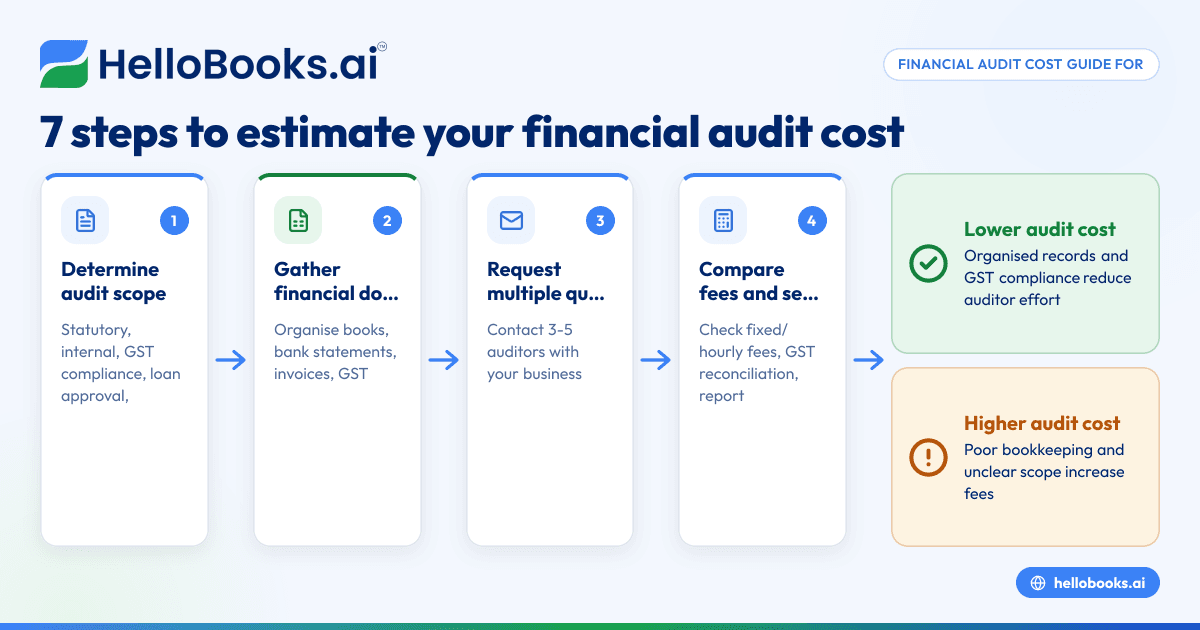
- Determine the audit scope: Identify whether the audit is statutory, internal, or for a specific purpose like loan approval. Check if the audit includes GST compliance and reconciliation.
- Gather your financial documents: Collect books, bank statements, invoices, GST returns, and any inventory records. Well-organised records reduce audit time and cost.
- Request quotes from multiple auditors: Contact 3-5 auditors or firms, providing details about your business size, turnover, and audit scope.
- Compare audit fees and services: Check if the fees are fixed or hourly, what is included (e.g., GST reconciliation, report preparation), and turnaround time.
- Check auditor credentials: Verify qualifications, experience with businesses in your industry, and familiarity with GST invoicing and returns.
- Clarify additional costs: Ask about extra charges for issues like delayed documents or complex reconciliations.
- Make a decision: Choose the auditor balancing cost, expertise, and service quality.
Using software for GST invoicing and reconciliation can improve bookkeeping accuracy and reduce audit costs. See more about GST invoicing here.
Example (fictional figures)
Assume a small manufacturing business with a turnover of ₹1,20,00,000 in FY 2023-24 needs a statutory audit in March 2024. The auditor quotes a fee based on turnover bands:
- Base fee for turnover up to ₹1,00,00,000 = ₹60,000
- Additional fee for turnover above ₹1,00,00,000 (₹20,00,000 × 1%) = ₹20,000
- GST reconciliation and report = ₹15,000
Total audit cost = ₹60,000 + ₹20,000 + ₹15,000
= ₹95,000
This example assumes an illustrative rate and scope. Actual fees may vary.
Common mistakes
- Not clarifying the audit scope: Leads to unexpected charges. Prevent by detailing requirements upfront.
- Ignoring auditor experience: Can cause delays or poor-quality reports. Verify credentials.
- Poor bookkeeping: Increases audit time and cost. Maintain organised records and use tools for GST invoicing and reconciliation.
- Not comparing multiple quotes: May overpay. Always get at least 3 quotes.
- Delaying audit preparation: Causes rush fees. Start early and keep documents ready.
- Assuming audit fees include all services: Confirm if GST filing, e-invoicing, or inventory checks are extra.
Doing this in HelloBooks
HelloBooks provides financial reports including monthly Profit & Loss and receivables ageing derived from the same entries used for GST. This ensures your books and GST returns agree, simplifying audit preparation. You can manage GST invoicing, e-invoicing, and bank statement reconciliation in one place, reducing errors and saving time. Learn more about HelloBooks for India here.
Frequently asked questions
How much does an audit cost for a small business in India?
Audit fees typically range from ₹50,000 to ₹2,00,000 depending on turnover, business complexity, and audit scope. Small businesses with simpler operations pay less, but exact fees vary by auditor.
What factors affect the cost of a financial audit?
Turnover size, number of transactions, audit scope (statutory, GST compliance), auditor experience, and quality of bookkeeping all impact audit costs.
Can I reduce audit costs by using software?
Yes. Using software like HelloBooks for GST invoicing and reconciliation can keep your books accurate and organised, reducing auditor effort and fees. See more about GST invoicing here.
Is it necessary to get multiple quotes for an audit?
Yes. Comparing multiple auditors helps you find the best balance of cost, expertise, and service quality.
What documents should I prepare for an audit?
Prepare financial statements, bank statements, GST returns, invoices, purchase bills, and inventory records. Organised documents speed up the audit.
Does the audit cost include GST filing and e-invoicing?
Not always. Confirm with your auditor if GST filing, e-invoicing, or other compliance services are included or charged separately.
Key takeaways
- Financial audit costs vary widely but typically start around ₹50,000 for small Indian businesses.
- Audit fees depend on turnover, audit scope, and auditor experience.
- Well-maintained books and GST compliance reduce audit complexity and cost.
- Always request multiple quotes and clarify what services are included.
- Using HelloBooks helps keep your financial reports and GST returns aligned, simplifying audits.
To understand how HelloBooks can help you maintain accurate financial reports and prepare for audits, book a 30-minute demo today.
This article is general information, not tax or legal advice. Rules change; confirm the current position on gst.gov.in or with your chartered accountant before acting.


