Key takeaways
What this article covers, in order:
- What can AI bookkeeping automate for busy accounting teams?
- How do I choose the right AI bookkeeping software for my SME?
- What does "AI busy accounting" really mean for my team?
- Common gaps busy accounting teams often miss in their workflows
- How can AI bookkeeping help me with GST compliance?
- What are the practical steps to implement AI bookkeeping without disrupting current workflows?
Busy accounting teams in Indian SMEs often struggle with the flood of data entry, bank reconciliations, GST compliance, and expense tracking. This checklist helps you identify where AI bookkeeping can save time and reduce errors, letting your team focus on strategic tasks rather than repetitive work.
What can AI bookkeeping automate for busy accounting teams?
- [ ] Automate data entry from invoices and receipts to reduce manual typing errors and save hours. AI bookkeeping extracts key details like amounts, dates, and GSTINs, automatically populating your books. For example, a Bengaluru-based supplier can send digital invoices directly to your system, which then auto-fills purchase records without manual input.
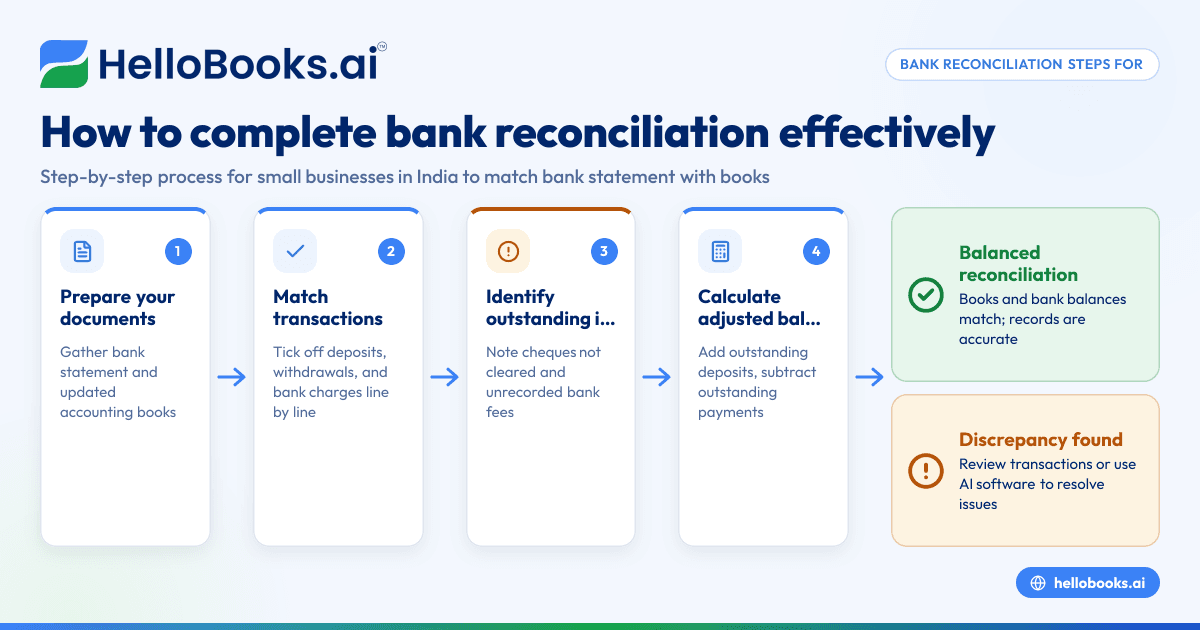
- [ ] Streamline bank reconciliation by matching transactions quickly and flagging discrepancies. This cuts down the tedious task of comparing bank statements with ledgers. Imagine your Pune office receives dozens of UPI payments daily through Razorpay; AI tools can match these payments to invoices, highlighting any unmatched transactions instantly.
- [ ] Generate GST-compliant invoices and e-invoices to ensure accuracy and compliance with latest government rules. Automated software can create and track e-invoices, reducing the risk of late filing penalties. Since e-invoicing is mandatory for businesses with turnover above ₹20 crore (from FY 2023-24), AI tools can ensure your invoices are generated in the correct format and submitted on time.
- [ ] Manage expense claims digitally with approvals and audit trails. This speeds up reimbursements and keeps records organised for audits. For instance, your sales team in Mumbai can upload travel receipts via WhatsApp, which the AI system recognises and routes for approval, eliminating lost paper slips.
- [ ] Prepare draft financial reports and summaries for quick review. AI tools can analyse your data and highlight trends or anomalies without manual number crunching. A finance lead in a tier-2 city like Indore could quickly see monthly sales dips or GST input credit mismatches flagged automatically, enabling faster corrective action.
How do I choose the right AI bookkeeping software for my SME?
Choosing the right AI bookkeeping software means matching your business needs with the tool’s capabilities:
- Compliance support: Ensure it supports GST return filing, e-invoicing, and e-way bills as per Indian regulations. For example, software that integrates with the GSTN portal simplifies monthly returns.
- Integration with payment gateways: Make sure it works with UPI, Razorpay, or your bank feeds to automate transaction recording.
- Ease of use: Your accounting team should find it intuitive without extensive training. Look for vendor demos or trial versions.
- Automation scope: Prioritise software that automates your biggest pain points, such as invoice data capture or bank reconciliation.
- Local support: Choose providers familiar with Indian tax laws and compliance deadlines.
For example, a Pune-based manufacturer might select software that automates invoice creation, supports multi-state GST, and syncs with their existing Tally system, acting as a Tally alternative with AI features.
What does "AI busy accounting" really mean for my team?
"AI busy accounting" means deploying artificial intelligence to handle routine, time-consuming accounting tasks. Instead of your team spending hours on manual data entry or reconciling dozens of transactions, AI automates these processes, reducing errors and freeing your staff for more value-add activities like financial analysis or business planning.
Consider this practical example: your team receives 500 invoices a month from suppliers and clients across Mumbai and Bengaluru. Traditionally, staff manually enter these into spreadsheets or Tally, often leading to data entry errors and delayed reconciliation. With AI bookkeeping, invoices can be scanned or received digitally, and the software automatically extracts and posts the details into your books. Bank payments received through UPI or Razorpay are matched to invoices without manual intervention. This automation reduces errors and accelerates month-end closing by days.
AI does not replace accountants but acts as a powerful assistant. It handles repetitive, low-value tasks to free your team’s time for higher-level work like budgeting, forecasting, and business growth analysis.
Common gaps busy accounting teams often miss in their workflows
- [ ] Not automating invoice processing leads to repeated manual entry errors and delays. Many teams still rely on manual typing from paper or email invoices, which wastes time and risks mistakes that affect GST filings.
- [ ] Relying on spreadsheets for bank reconciliation increases chances of mismatches and missed transactions. Spreadsheets are error-prone and hard to maintain with growing transaction volumes, especially for businesses operating in tier-2 or tier-3 cities with limited accounting staff.
- [ ] Overlooking digital expense management results in lost receipts and audit difficulties. Without digital trails, expense claims become a bottleneck, delaying reimbursements and complicating audits.
These gaps cause unnecessary workload and risk compliance issues, especially under the Indian GST regime where accuracy and timely filing are critical.
How can AI bookkeeping help me with GST compliance?
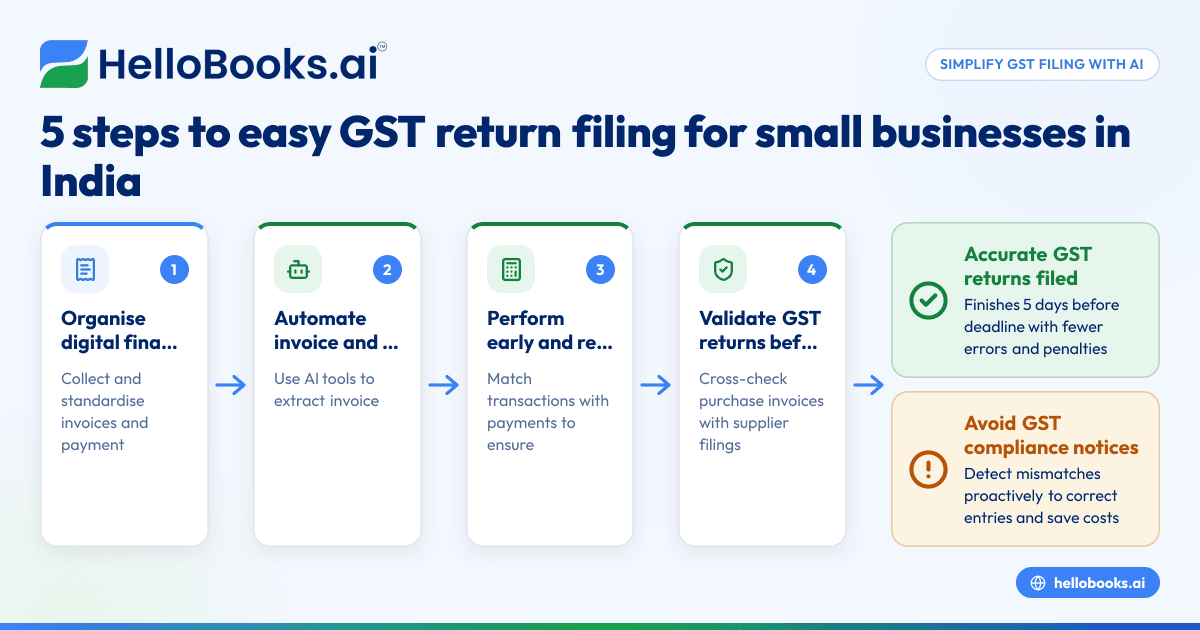
Indian GST compliance demands timely, accurate filing of returns, correct input tax credit claims, and adherence to e-invoicing and e-way bill mandates. AI bookkeeping software tailored for Indian SMEs helps by:
- Generating GST-compliant invoices with correct HSN codes and tax rates.
- Automatically tracking input tax credits from supplier invoices for accurate claims.
- Preparing data to upload into your GST return filing software, reducing manual errors.
- Alerting you to mismatches or missing invoices that could cause GST audits or penalties.
- Managing e-invoicing submissions as per government mandates, centralising invoice reporting.
- Supporting e-way bill generation and tracking for goods movement compliance.
For example, a wholesaler in Ahmedabad using AI bookkeeping can generate e-invoices that are auto-submitted to the Invoice Registration Portal, with instant validation. This prevents common errors like incorrect GSTIN or invoice numbering, avoiding costly penalties.
While AI bookkeeping can greatly ease GST compliance, remember it is not a substitute for professional tax advice. Always consult your accountant or tax consultant for filing and legal questions.
What are the practical steps to implement AI bookkeeping without disrupting current workflows?
- Identify pain points: List your team’s repetitive tasks that consume time and cause errors, such as invoice data entry or bank reconciliation.
- Choose software that fits: Pick AI bookkeeping software that integrates with your existing tools (like Tally or spreadsheets) and supports your compliance needs.
- Pilot one module at a time: Start with automating invoice capture or bank reconciliation to build confidence and minimise disruption.
- Train your team: Conduct hands-on sessions so staff understand new workflows and how AI tools assist them.
- Integrate bank feeds and payment gateways: Connect your accounts with UPI, Razorpay, or bank APIs to automate transaction imports.
- Monitor and adjust: Review the accuracy of AI data entry and reconciliation regularly, and tweak settings or workflows as needed.
- Expand usage gradually: Once comfortable, automate expense management, GST invoice generation, and financial reporting.
A worked example: A Pune-based e-commerce SME started by automating invoice data entry using AI bookkeeping. Within a month, they reduced manual entry time by 70%. Next, they integrated bank reconciliation software to match payments and receipts automatically. By the third month, they added GST e-invoicing automation, ensuring compliance without extra work. This phased approach minimized disruption and let their finance team see quick wins.
AI bookkeeping is not a complete replacement for accountants but a powerful assistant that lightens the load. For busy accounting teams in Indian SMEs, it means fewer mistakes, faster closing cycles, and more time to focus on business growth.
If you want to see how AI bookkeeping can transform your finance team's productivity, you can book a demo or compare plans tailored for Indian businesses.
Related reading
- AI bookkeeping
- How AI Bookkeeping Software Fully Supports Indian SMEs in Managing Complex GST Return Filing
- How Chartered Accountants in Maharashtra Can Use AI Bookkeeping to Simplify Manufacturing Finances
Read next
This article covers one part of a bigger topic. For the complete picture, read our guide to busy accounting.