
Key takeaways
What this article covers, in order:
- Think of it like a shop's bill book and its cash box
- The side-by-side comparison
- How the two returns connect now
- Where does your buyer come in?
- And what about your purchases?
- What happens when they don't match?
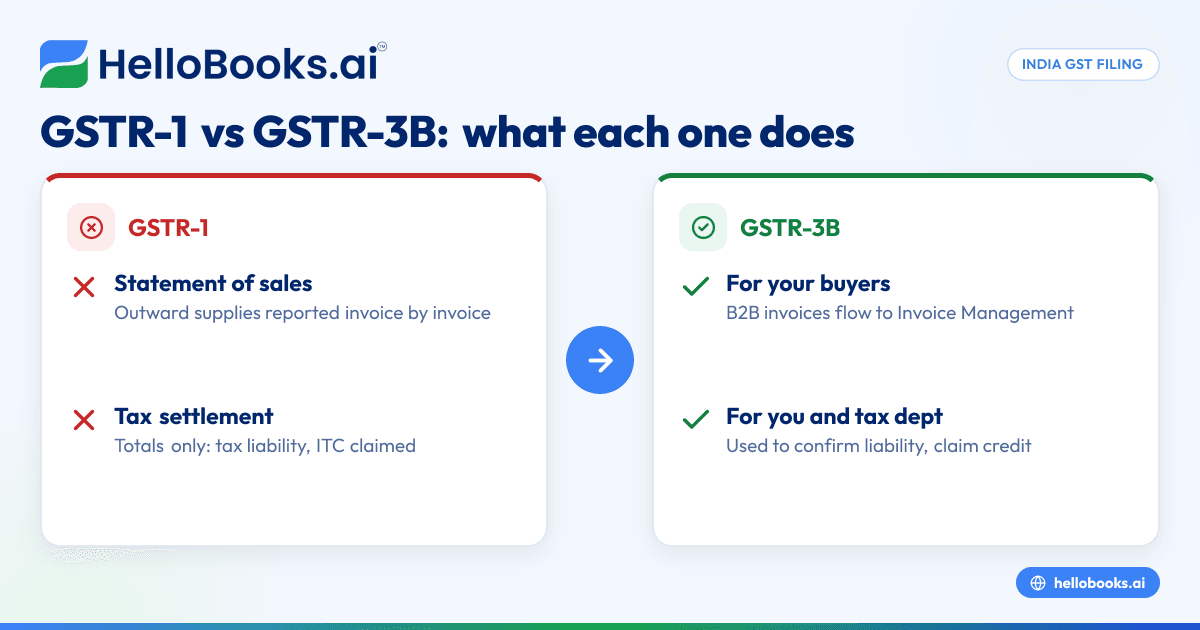
"If I'm already telling them my sales in GSTR-1, why do I have to tell them again in GSTR-3B?" Almost every first-time filer asks this. Fair question. The short answer: GSTR-1 is the detailed list of what you sold, invoice by invoice, so your buyers can claim credit. GSTR-3B is the summary where you work out your net tax, claim your own credit and actually pay. One is a statement. The other is a settlement.
Think of it like a shop's bill book and its cash box
Picture Mehul's stationery shop in Ahmedabad. His bill book has a carbon copy of every bill he's written this month. That's GSTR-1. Anyone looking at it can see who bought what, at what rate, on which date.
At month-end, Mehul opens the cash box and works out how much tax he owes, how much he can set off against GST he paid on his own purchases, and what's left to pay. That's GSTR-3B. It doesn't care about individual bills. It cares about totals and the money.
Both have to agree with each other. If the bill book says ₹4 lakh of sales and the cash box reckoning says ₹3 lakh, something's wrong, and someone will eventually ask about it.
The side-by-side comparison
| GSTR-1 | GSTR-3B | |
|---|---|---|
| What it is | Statement of outward supplies | Summary return with tax payment |
| Level of detail | Invoice-wise for B2B; summaries for most B2C | Totals only |
| Covers purchases? | No | Yes, through ITC claimed |
| Includes tax payment? | No | Yes |
| Monthly due date | 11th of next month | 20th of next month |
| QRMP due date | 13th after the quarter (IFF optional in months 1 and 2) | 22nd or 24th after the quarter, by state |
| Who relies on it | Your buyers (their GSTR-2B is built from it) | You and the tax department |
| Can it be corrected? | Through GSTR-1A (same period, before GSTR-3B) or amendments in a later GSTR-1 | Not directly; sales come locked from GSTR-1 |
| Late fee if late | Yes, per day with caps | Yes, per day with caps, plus interest on late tax |
How the two returns connect now
This is the part that changed recently, and many older articles haven't caught up.
From the July 2025 tax period, Table 3 of GSTR-3B, which holds your sales liability, is filled automatically from GSTR-1, IFF and GSTR-1A and is locked. You can't overwrite it. The inter-state breakup in Table 3.2 got the same treatment from the Nov 2025 tax period.
There's an ordering rule too. Under Section 39(10), the portal won't accept GSTR-3B for a period until GSTR-1 for that period is filed. And under Rule 59(6), you can't file GSTR-1 if the previous period's GSTR-3B is still pending. So the sequence is always: last period's GSTR-3B, then this period's GSTR-1, then GSTR-1A if you need it, then this period's GSTR-3B.
What this means in practice is simple. GSTR-1 now decides your tax. GSTR-3B mostly confirms it, adds your credit, and collects the cash.
Where does your buyer come in?
GSTR-1 isn't really for you. It's for the people you sell to.
When you report a B2B invoice in GSTR-1, it shows up in your buyer's Invoice Management System and then in their GSTR-2B. That's the only way they can claim credit for the GST you charged them. Your GSTR-3B doesn't show up anywhere for them.
That's why a buyer will chase you about GSTR-1 but never about GSTR-3B. If you file GSTR-1 late, or leave out their invoice, or get their GSTIN wrong, their credit is stuck. In a wholesale business, that can cost you a customer.
And what about your purchases?
GSTR-1 has nothing to do with your purchases. Your purchases come in through GSTR-3B, in Table 4, where you claim input tax credit.
The credit figure is auto-filled from your GSTR-2B, which is built from your suppliers' GSTR-1. So in a way, your GSTR-3B depends on two GSTR-1s: yours for sales, and your suppliers' for credit.
What happens when they don't match?
Before the locking, people sometimes reported higher sales in GSTR-1 than they paid tax on in GSTR-3B. Sometimes it was a genuine timing issue. Sometimes not.
To catch this, Rule 88C lets the portal send a DRC-01B intimation when the liability in GSTR-1 exceeds what was paid in GSTR-3B beyond a set limit. You then have to either pay the difference with interest, or explain why it isn't payable. Until you respond, the portal can block your next GSTR-1.
With Table 3 now locked, outright mismatches are rarer. But they can still creep in through amendments across periods, reverse-charge entries and corrections made after filing. Treat any DRC-01B seriously and reply on time. If the amounts are large or the reason is complicated, let a CA draft the reply.
A month in the life: one invoice through both returns
Let's follow one invoice, purely as an illustration.
On 8 Sep 2026, Neha, a freelance web developer in Kochi, bills a Bengaluru company ₹80,000 plus 18% IGST (₹14,400). She's a monthly filer.
On 10 Oct 2026, she files GSTR-1 for Sep 2026. The invoice goes into Table 4A with the client's GSTIN.
Around 14 Oct 2026, the invoice appears in the client's GSTR-2B for Sep 2026, so the client can claim ₹14,400 credit.
On 18 Oct 2026, Neha opens GSTR-3B for Sep 2026. Table 3.1(a) already shows ₹80,000 taxable value and ₹14,400 IGST, carried from her GSTR-1. She checks her own credit in Table 4: ₹3,600 IGST on a new monitor, sitting in her GSTR-2B. She pays ₹10,800 in cash and files.
Same invoice, two returns, two different jobs.
Common confusions, cleared up
"I filed GSTR-3B, so my sales are reported." Not quite. Your buyers only see GSTR-1. And now you can't file GSTR-3B without GSTR-1 anyway.
"I can fix a sales error in GSTR-3B." Not any more. Use GSTR-1A before GSTR-3B, or a later GSTR-1.
"Nil sales means I skip GSTR-1." No. You file a nil GSTR-1 and a nil GSTR-3B.
"QRMP means I pay quarterly." No. QRMP means you file quarterly. You still pay monthly through PMT-06 in the first two months.
How HelloBooks helps
Because HelloBooks builds both returns from the same invoices and bills, GSTR-1 and GSTR-3B start from the same numbers. You file GSTR-1 first, then GSTR-3B, both directly to the GST portal from inside HelloBooks. GSTR-2B reconciliation is built in for the credit side, and any interest or late fee on GSTR-3B is shown as the GST portal's own figure before you file.
All of this is on HelloBooks Free: ₹0, no card, no expiry, unlimited GSTR-1 and GSTR-3B filing for one GSTIN, 2 users and up to 200 transactions a year. Read more on the GSTR-1 filing and GSTR-3B filing pages.
FAQs
Which is filed first, GSTR-1 or GSTR-3B?
GSTR-1. The portal won't accept GSTR-3B for a period until GSTR-1 for that period is filed, and GSTR-3B's sales figures are pulled from it.
Is GSTR-3B enough if I only sell to consumers?
No. B2C businesses still file GSTR-1, mostly as summaries by rate and state, along with the HSN and documents tables.
Can GSTR-1 and GSTR-3B show different sales figures?
Table 3 of GSTR-3B now comes locked from GSTR-1, IFF and GSTR-1A, so they should agree. Differences can still arise from amendments or reverse-charge entries, and large gaps can trigger a DRC-01B intimation.
Does GSTR-1 include input tax credit?
No. GSTR-1 is only about your sales. Credit is claimed in GSTR-3B, based on your GSTR-2B.
Do both returns have late fees?
Yes. Both attract a daily late fee with turnover-based caps. GSTR-3B also carries interest on any tax paid late.
Get GSTR-1 right and GSTR-3B mostly takes care of itself. That's really the whole trick.
Start free — GST filing included, no card. Try HelloBooks Free