
Key takeaways
What this article covers, in order:
- Key takeaways
- What is the GST return filing process in India?
- Who needs to file GST returns?
- Documents and data you need before filing
- Step-by-step GST return filing process
- Common mistakes small businesses make
GST return filing is the process of reporting your sales, purchases, tax collected and input tax credit under GST to the government in India. For small businesses, the process becomes much easier when you organise invoices, reconcile books regularly and file the right return on time.
Key takeaways
- The GST return filing process starts with clean records, not with the return form itself.
- You need to identify which GST returns apply to your business based on registration type and turnover.
- Sales invoices, purchase bills, credit notes and payment records should match your books before filing.
- Reconciliation helps you catch missing invoices, wrong GST amounts and input tax credit issues early.
- Filing on time reduces the risk of late fees, interest and follow-up notices.
- Using GST return filing software can reduce manual work for growing businesses.
What is the GST return filing process in India?
The GST return filing process is the regular submission of GST-related details to the GST portal by a registered business in India. These details usually include outward supplies, inward supplies, tax liability, input tax credit and tax payment.
In simple terms, GST return filing tells the government three things. First, how much you sold. Second, how much GST you collected or need to pay. Third, how much input tax credit you want to claim based on your purchases.
For many small businesses, the hard part is not clicking “file” on the portal. The hard part is collecting accurate data from invoices, bank entries, UPI payments, expense bills, credit notes and accounting records. If you keep books in spreadsheets or update Tally once a month, errors can build up fast.
That is why the best way to handle the gst return filing process is to treat it as a monthly routine. Keep invoices updated, review transactions weekly and reconcile before due dates. This saves time at month-end and helps avoid avoidable mistakes.
Who needs to file GST returns?
Any business registered under GST in India generally needs to file applicable returns, even if there is no business activity in a period. The exact return depends on the type of registration and scheme.
Common cases include:
- Regular taxpayers
- Businesses under the composition scheme
- Input Service Distributors, where applicable
- Taxpayers who need to report tax deducted or collected at source, where relevant
- E-commerce and special category cases, depending on the business model
For a typical small business, the most common situation is regular registration or composition registration.
Regular GST taxpayers
If your business is registered as a regular taxpayer, you usually need to report outward supplies, summarise tax liability and complete periodic return filing as applicable under current GST rules. You may also need to pay tax after adjusting eligible input tax credit.
This often applies to traders, service providers, manufacturers and D2C brands in cities like Mumbai, Pune or Bengaluru. It also applies to wholesalers supplying across states.
Composition taxpayers
If your business is under the composition scheme, the filing pattern is different from regular taxpayers. Composition businesses pay tax at a prescribed rate under the scheme and cannot collect tax from customers in the same way regular taxpayers do.
Because GST rules can change over time, always confirm the exact return applicability and due dates for your registration category on the GST portal or with your accountant. This article is general information, not tax or legal advice.
Documents and data you need before filing
Before you start the gst return filing process, collect all the data that affects GST. Filing becomes much easier when everything is in one place.
Keep these records ready
You should normally have:
- Sales invoices for the return period
- Purchase invoices and expense bills
- Debit notes and credit notes
- Advance receipts, if relevant to your business
- GSTIN-wise customer and vendor details
- Tax rate details on each invoice
- Export or interstate supply details, if applicable
- Bank statements
- UPI, Razorpay or other payment records
- Previous return summaries, if adjustments are needed
For service businesses, WhatsApp confirmations and email approvals are common in daily work. But those are not enough for GST filing. You still need proper tax invoices and supporting entries in your books.
Why this step matters
If invoices are missing or entered wrongly, your return can be wrong even if the portal accepts it. A wrong return can lead to extra tax payment, blocked input tax credit or future notices.
For example, a small marketing agency in Bengaluru may receive vendor invoices late. If those bills are not recorded correctly, the agency may miss eligible input tax credit for the month. A retailer in Pune may collect payment through UPI but forget to record one invoice, which understates sales.
Step-by-step GST return filing process
Below is a practical workflow for small businesses. The exact return form and portal screens may vary based on your type of registration, but the filing logic stays broadly similar.
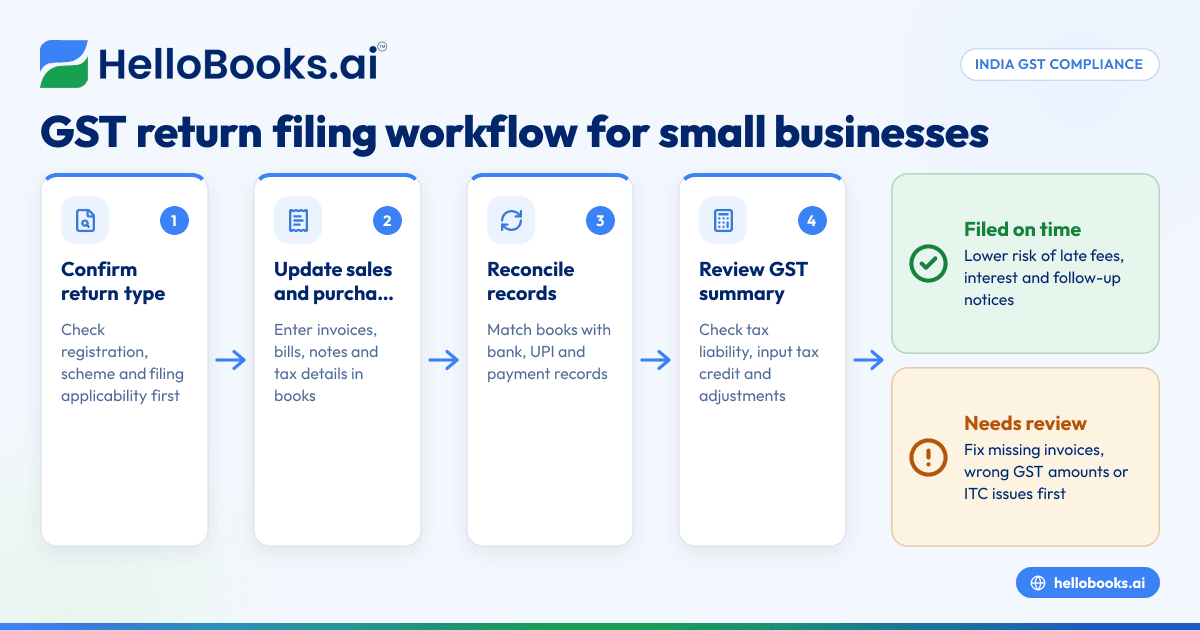
Step 1: Identify the return you need to file
Start by confirming which return applies to your business for that period. Do not assume all GST-registered businesses file the same return.
Check:
- Your registration type
- Whether you are a regular or composition taxpayer
- Whether you had any transactions in the period
- Whether special reporting applies to your business model
This first step prevents wasted effort. Many filing mistakes happen because the team starts preparing the wrong return.
Step 2: Update sales entries for the period
Enter all sales invoices for the relevant tax period into your accounting system. Include invoice number, date, customer GSTIN where applicable, place of supply, taxable value and GST amounts.
Pay special attention to:
- B2B invoices
- B2C sales summaries, where relevant
- Interstate supplies
- Exports, if applicable
- Credit notes for returns or discounts
If your sales team works from spreadsheets and WhatsApp, confirm that every final invoice is also entered in the books. This is a common gap in fast-growing SMEs.
Using invoice software can help standardise invoice creation and reduce duplicate or missing invoice numbers.
Step 3: Record purchases and expenses properly
Next, record all purchase invoices and business expenses that may affect input tax credit. This includes raw materials, inventory purchases, office expenses and service bills.
At this stage, check:
- Vendor name and GSTIN
- Invoice number and date
- Taxable value
- GST rate and tax amount
- Whether the expense is eligible for input tax credit based on the nature of the purchase
Do not claim input tax credit casually from every expense bill. If you are unsure about eligibility, ask your accountant before filing.
Step 4: Reconcile books with payment records
Now match your accounting entries with bank transactions, UPI collections and other payment channels. This step helps you find missing sales, duplicate entries and unrecorded expenses.
For example:
- A customer may have paid through UPI, but the invoice was never posted
- A supplier bill may be in the books twice
- A refund may be recorded in the bank but not as a credit note
- A Razorpay settlement may include fees that were not recorded correctly
This is where bank reconciliation software becomes useful for businesses with high transaction volume.
Step 5: Reconcile GST data before filing
Before filing the return, reconcile GST-specific data. This means checking whether the GST values in your books are complete and internally consistent.
Review:
- Total taxable sales
- CGST, SGST and IGST amounts
- Credit notes and debit notes
- Input tax credit from purchase invoices
- Reverse charge cases, if any apply to your business
- Amendments from earlier periods, if required
The aim is simple. The return should reflect the truth of your books, and your books should reflect the truth of your business.
Step 6: Prepare the return summary
Once your records are clean, prepare a summary for the filing period. This should show your outward supplies, tax liability, eligible input tax credit and net tax payable.
A simple internal review sheet can include:
- Gross sales
- Taxable sales
- Total output GST
- Total eligible input tax credit
- Net GST payable
- Adjustments, if any
This summary helps the business owner or finance lead review numbers before submission. For a business doing ₹20 lakh to ₹2 crore in annual turnover, this one-page review can prevent many filing errors.
Step 7: File the return on the GST portal
After review, upload or enter the required data on the GST portal, as applicable to your return type. Then verify the tax amounts and complete the filing process.
Before the final submission:
- Recheck the period
- Recheck GSTIN
- Recheck tax values
- Confirm any tax payment requirement
- Keep acknowledgement and filing reference details safely stored
Do not leave filing to the last day. Portal traffic, missing invoices and approval delays can create unnecessary stress.
Step 8: Save records and track follow-up actions
Filing is not the end of the process. Save the filed return copy, challan details, working papers and reconciliation notes. These records matter during audits, assessments and future corrections.
Also track:
- Late vendor invoices
- Mismatches to be corrected next period
- Tax payments made
- Missing expense proofs
- Customer invoice amendments, if needed
This habit is especially important for businesses with multiple branches or teams in different cities.
Common mistakes small businesses make
Even disciplined businesses make GST mistakes when records are spread across people and tools. Here are the most common issues in the gst return filing process.
1. Filing from incomplete books
Some businesses file returns before all invoices are entered. This creates mismatches between books and returns. Later, the accounts team spends extra time fixing old periods.
2. Ignoring reconciliation
If you do not reconcile sales, purchases and bank transactions, errors stay hidden. A mismatch found after filing is harder to fix than one found before filing.
3. Claiming input tax credit without review
Not every GST shown on a bill is automatically claimable. You need to review invoice details and applicability carefully.
4. Missing credit notes
Sales returns, discounts and cancellations should be reflected properly. If credit notes are ignored, tax liability may be overstated.
5. Waiting until the due date
This creates pressure and increases the chance of mistakes. A better approach is to close records in stages through the month.
A practical monthly GST workflow for small businesses
A simple routine can make filing much easier. You do not need a large finance team to stay on top of GST.
Weekly routine
Every week:
- Post all sales invoices
- Upload purchase bills
- Review bank and UPI receipts
- Record credit notes and refunds
- Follow up on missing vendor invoices
Month-end routine
At month-end:
- Freeze the transaction period
- Reconcile sales and receipts
- Reconcile purchases and expenses
- Review GST ledger balances
- Prepare return summary
- Get owner or accountant approval
- File and save records
This process works well for traders, agencies, consultants, distributors and online sellers. It also works for firms still moving from spreadsheet-based bookkeeping to AI bookkeeping.
How software can simplify the GST return filing process
Manual filing is possible for a very small volume of transactions. But once your business grows, spreadsheet-led filing becomes risky.
Software helps in three ways.
1. Cleaner data capture
Good systems help capture invoices, expenses and tax details in a consistent format. That means fewer missing fields and fewer manual corrections later.
If your business still runs accounting in disconnected tools, moving to accounting software in India can make GST prep much easier.
2. Faster reconciliation
A major part of GST work is checking whether data matches. Software reduces manual matching work across invoices, expenses and bank entries.
This is useful for businesses receiving many small payments through UPI or payment gateways.
3. Better audit trail
When returns are filed, you should be able to trace every number back to books and supporting documents. A proper accounting workflow improves that audit trail.
For businesses outgrowing Tally-heavy manual routines, a Tally alternative may be worth evaluating if the main pain point is speed and visibility.
When should you involve an accountant?
Many small business owners can manage basic record collection and internal review. But you should involve an accountant when:
- Your GST treatment is not straightforward
- You sell across states
- You have multiple GST registrations
- You are unsure about input tax credit eligibility
- You need help with corrections or notices
- Your turnover and transaction volume have grown quickly
If you do not already have a reliable expert, you can find an accountant when the compliance workload starts affecting operations.
Final checklist before you file
Use this short checklist each period:
- All sales invoices entered
- All purchase invoices entered
- Credit and debit notes recorded
- Bank and UPI transactions reconciled
- GST values reviewed
- Return type confirmed
- Tax payment calculated
- Final review completed
- Return filed
- Acknowledgement saved
A clear checklist reduces dependency on memory. It also helps when different team members handle billing, accounts and approvals.
If your business is spending too much time on bookkeeping and GST prep, HelloBooks can help streamline invoicing, bookkeeping and reconciliation in one workflow. You can book a demo to see how it works, or compare options on the pricing page.
Frequently asked questions
What is the first step in the GST return filing process?
The first step is identifying which GST return applies to your business and the filing period. After that, collect complete sales, purchase and payment data before preparing the return.
Can I file GST returns if there were no sales in the month?
In many cases, a registered business may still need to file the applicable return even if there was no business activity in that period. Always check the return requirement for your registration type on the GST portal or with your accountant.
What records should I keep for GST filing?
You should keep sales invoices, purchase bills, credit notes, debit notes, bank statements, payment records and reconciliation workings. These records help support the numbers reported in your return.
Why is reconciliation important before filing GST returns?
Reconciliation helps you find missing invoices, duplicate entries, wrong GST amounts and unrecorded receipts or expenses. Without reconciliation, you may file incorrect numbers and face extra work later.
Is GST filing possible through accounting software?
Yes, many businesses use AI accounting software or bookkeeping tools to prepare cleaner records and speed up GST-related work. Software does not replace judgment, but it can reduce manual entry and improve accuracy.
How often should a small business review its GST data?
A monthly review is the minimum practical standard for most small businesses. A weekly review is even better if you have many invoices, UPI receipts or frequent vendor bills.