
Key takeaways
What this article covers, in order:
- GST rate on two-wheelers
- Finding the right HSN code for two-wheelers
- Input tax credit angle
- How HelloBooks helps
- Frequently asked questions
Looking for the GST rate and HSN code for two-wheelers in India? This guide explains the slab, the HSN code, and the input-tax-credit angle.
GST rate on two-wheelers
GST in India is a destination-based tax split into CGST and SGST for sales within a state and IGST for inter-state sales. Following the rate overhaul effective 22 September 2025, most goods and services sit in a simplified two-slab structure (5% and 18%), with a higher 40% rate reserved for a short list of luxury and "sin" items, and essentials kept exempt.
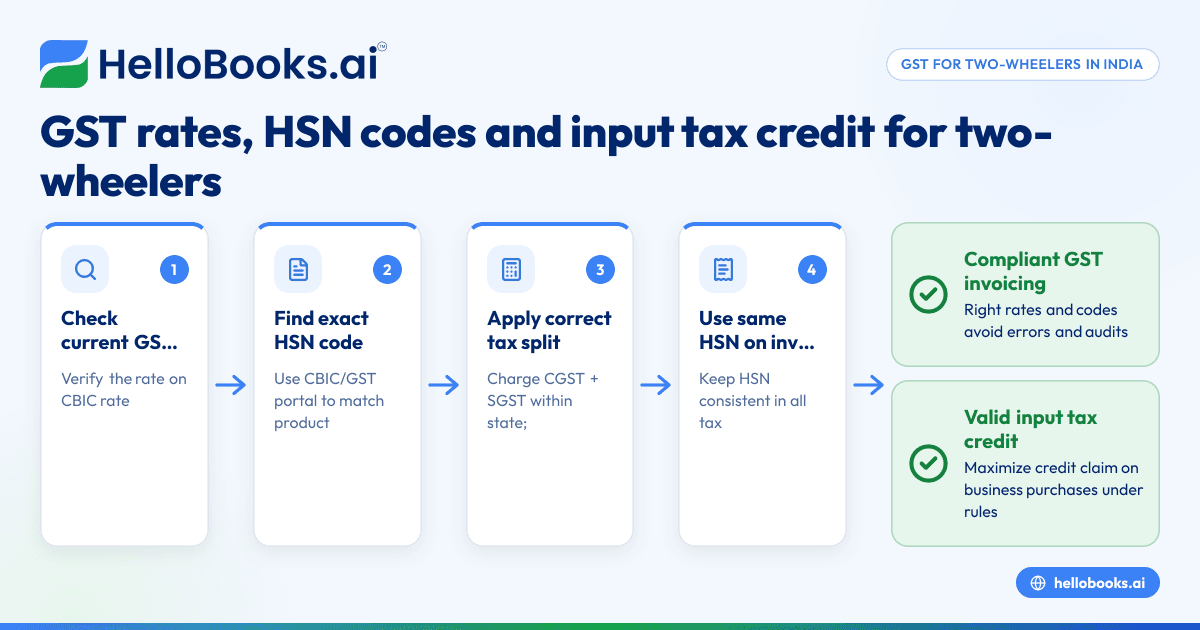
Bikes and scooters are taxed by engine capacity, with cess on larger engines. Rates change at GST Council meetings, so always confirm the current figure for your exact HSN or SAC code on the CBIC rate finder or the GST portal before you print it on an invoice.
Finding the right HSN code for two-wheelers
Every product has a Harmonised System of Nomenclature (HSN) code that decides its GST rate. Search your product description on the CBIC HSN/rate finder or the GST portal, match the 4-, 6- or 8-digit code to what you actually sell, and use that same code on every invoice so your returns stay consistent.
- Use the correct HSN code for two-wheelers on every tax invoice.
- Charge CGST + SGST within your state and IGST for inter-state sales.
- Keep the rate consistent between your GSTR-1 and GSTR-3B.
- Confirm the current rate before each price change — slabs are revised at GST Council meetings.
Input tax credit angle
If you buy two-wheelers for business use and resupply it, you can usually claim input tax credit on your purchase, provided the invoice appears in your GSTR-2B and all the standard conditions are met. Credit is blocked where the purchase is for personal use or falls under the Section 17(5) blocked-credit list.
How HelloBooks helps
HelloBooks is built for exactly this kind of GST work. HelloBooks is free GST accounting software for Indian businesses: you can raise GST-compliant invoices with the correct HSN or SAC code, track input tax credit against your GSTR-2B, and file unlimited GSTR-1 and GSTR-3B returns from one dashboard.
- GST-ready invoicing with automatic CGST / SGST / IGST split and HSN or SAC codes.
- GSTR-2B reconciliation so you only claim the input tax credit you are actually entitled to.
- GSTR-1 and GSTR-3B filing free, with GSTR-9 generated ready to file and e-invoicing on higher plans.
- Due-date reminders so a late fee never catches you by surprise.
Thousands of founders, freelancers and accountants in India run their books on HelloBooks — you can start free, with no credit card.
Frequently asked questions
What is the GST rate on two-wheelers in India?
Two-wheelers is taxed under India's GST slab structure (mostly 5% or 18% after the 22 September 2025 rate changes, with exempt essentials and a 40% demerit rate for a few items). Always confirm the current rate for your exact HSN code on the CBIC rate finder, as rates change at GST Council meetings.
What HSN code should I use for two-wheelers?
Match your exact product description to the HSN code on the CBIC/GST portal HSN finder, then use that code on every invoice. HelloBooks lets you save the code against the item so it is applied automatically.
Can I claim input tax credit on two-wheelers?
Yes, for genuine business purchases that meet the input-tax-credit conditions and appear in your GSTR-2B — unless the item falls under the Section 17(5) blocked-credit list.