Key takeaways
What this article covers, in order:
- What does the law actually want on the invoice?
- How many HSN digits do I need?
- What does a correct one look like?
- CGST and SGST, or IGST?
- When do I have to issue it?
- How many copies?
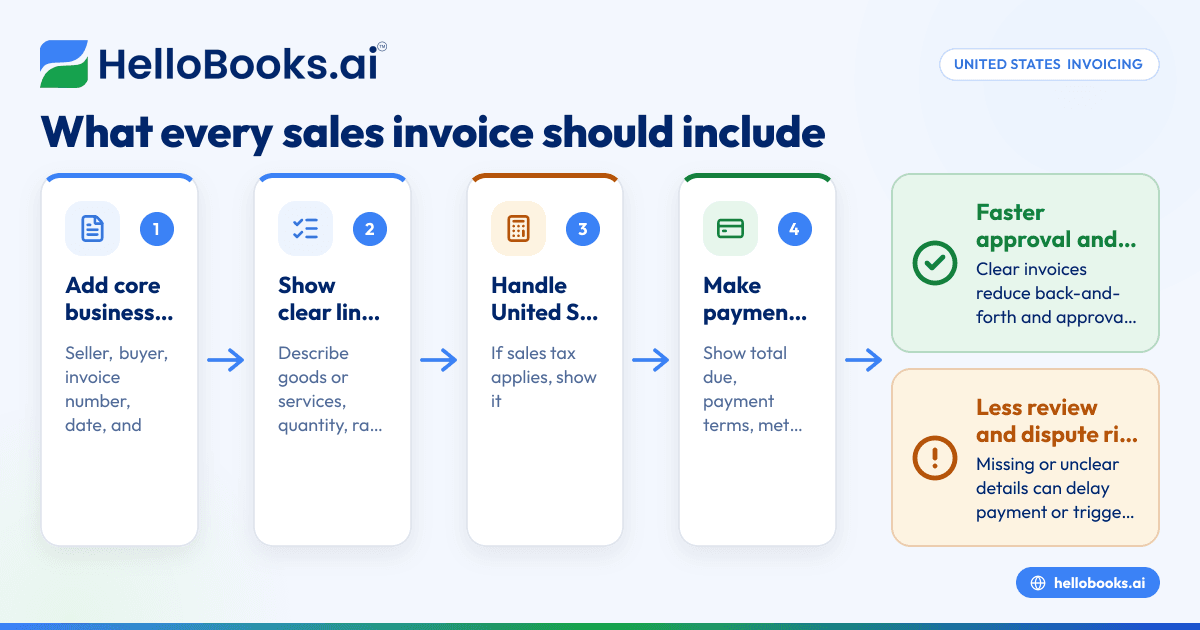
Your biggest customer's accounts team emails back: "Invoice not valid for ITC, please reissue." Annoying, and it usually comes down to one missing line. A valid GST tax invoice needs your name, address and GSTIN, a unique serial number, the date, the buyer's details (with GSTIN if they're registered), HSN or SAC codes, a description and quantity, the taxable value, the tax rate and amount split into CGST/SGST or IGST, the place of supply, a reverse-charge line, and a signature. That list comes from Rule 46 of the CGST Rules.
There's no official template. Design it however you like, put your logo wherever you want. The fields, though, aren't optional.
What does the law actually want on the invoice?
Think of it in four blocks. Who you are, who bought, what was sold, and the tax on it.
Who you are. Your legal name, address and GSTIN. Then a serial number that runs consecutively and is unique for the financial year, up to 16 characters. Letters, numbers, hyphens and slashes are all allowed, so "PUN/26-27/0143" is fine. You can run separate series for branches or document types. And the date of issue.
Who bought. If the buyer is registered, their name, address and GSTIN. If they're unregistered and the taxable value is ₹50,000 or more, you still need their name and address, plus the delivery address with the state name and state code.
What was sold. The HSN code for goods or SAC code for services, a description, quantity and unit for goods (40 NOS, 12 KGS, that sort of thing), the total value, and the taxable value after any discount.
The tax. The rate and amount of CGST, SGST or UTGST, IGST, and cess if it applies. For inter-state supplies, the place of supply with the state name. The delivery address if it's different from the place of supply. A line saying whether tax is payable on reverse charge, even when the answer is "No". And finally a signature, or a digital signature if you issue the invoice electronically.
Two extras apply only to some businesses. If e-invoicing covers you, the IRN and QR code. And if your aggregate turnover is above ₹500 crore, a dynamic QR code on B2C invoices.
How many HSN digits do I need?
| Turnover in the previous FY | HSN/SAC digits |
|---|---|
| Up to ₹5 crore | 4 digits on B2B invoices (optional on B2C) |
| Above ₹5 crore | 6 digits on all invoices |
Get it right on the invoice and your GSTR-1 HSN summary takes care of itself. There's more on this in our HSN and SAC guide.
What does a correct one look like?
Here's a plain example. Sharma Electricals in Mumbai selling to an interiors firm in Thane. Both in Maharashtra, so CGST plus SGST.
TAX INVOICE                                   ORIGINAL FOR RECIPIENT
-------------------------------------------------------------------
Sharma Electricals                    Invoice No: SE/26-27/0142
14, Lamington Road, Mumbai 400007     Date: 05 Oct 2026
GSTIN: 27ABCDE1234F1Z5                Place of supply: Maharashtra (27)
-------------------------------------------------------------------
Bill to: Rao Interiors Pvt Ltd        Ship to: Site Office, Thane
GSTIN: 27PQRSX5678K1Z2                Maharashtra (27)
-------------------------------------------------------------------
# Description          HSN   Qty    Rate    Taxable   CGST   SGST
1 LED panel 18W        9405  40 NOS  450.00 18,000.00 9% 1,620 9% 1,620
2 Copper wire 2.5 sqmm 8544  10 RLS 1,850.00 18,500.00 9% 1,665 9% 1,665
-------------------------------------------------------------------
Taxable value: 36,500.00   CGST: 3,285.00   SGST: 3,285.00
Invoice total: ₹43,070.00 (Rupees Forty-three thousand seventy only)
Tax payable on reverse charge: No
                                       For Sharma Electricals
                                       (Authorised Signatory)
The names, GSTINs and rates are made up for illustration. GST rates were restructured from 22 Sep 2025, so check the current rate for your HSN on the CBIC site before you set up your item master.
CGST and SGST, or IGST?
This trips people up more than anything else on the invoice. It depends on the place of supply, not on where your buyer's head office sits.
Same state as you? CGST plus SGST, split equally. Different state? IGST at the full rate.
It's not a cosmetic error either. Charge CGST and SGST on what was really an inter-state sale and you've paid tax to the wrong government. You'll pay IGST and then wait on a refund for the wrong tax, which is slow and tedious. So whenever the buyer or delivery is outside your state, pause for two seconds on that field.
When do I have to issue it?
| Supply | Deadline |
|---|---|
| Goods | On or before removal, or on delivery where nothing moves |
| Services | Within 30 days of supply |
| Services by banks, NBFCs and insurers | Within 45 days |
| Continuous supply | As per the payment schedule or account statement in the contract |
Issuing late doesn't push your tax liability back. The time of supply rules can make tax due anyway, and then you're looking at interest.
How many copies?
For goods, three: Original for Recipient, Duplicate for Transporter and Triplicate for Supplier. If you generate an IRN under e-invoicing, you can drop the transporter's copy. For services, two: original for the recipient and duplicate for you.
Do I always need a tax invoice?
No. It depends on what you're doing.
| Document | Use it when |
|---|---|
| Tax invoice | A regular registered business makes a taxable supply |
| Bill of supply | Exempt supplies, or any sale by a composition dealer |
| Revised invoice | For supplies between your registration's effective date and the date the certificate was issued |
| Credit or debit note | To lower or raise the value or tax on an earlier invoice |
| Receipt voucher | An advance received for services |
| Self-invoice and payment voucher | You pay tax under reverse charge to an unregistered supplier |
| Delivery challan | Goods move without a sale, like job work or goods on approval |
For counter sales under ₹200 to unregistered customers who don't ask for a bill, you can issue one consolidated invoice at the end of the day.
When does e-invoicing kick in?
If your aggregate turnover crossed ₹5 crore in any financial year since FY 2017-18, your B2B invoices need an IRN and signed QR code from the Invoice Registration Portal. All the Rule 46 fields still apply; the IRN sits on top. Larger businesses (₹10 crore and above) also face a time limit for reporting invoices to the IRP, currently 30 days from the invoice date, but confirm that on the e-invoice portal. Our e-invoicing page has more.
The mistakes we see most
Reusing a serial number in the same year, or restarting numbering in Aug 2026 because someone changed the template. Don't.
A typo in the buyer's GSTIN. The invoice lands in a stranger's GSTR-2B, your customer loses credit, and you're filing an amendment.
No place of supply on an inter-state invoice. Tax-inclusive prices with no breakup. A composition dealer printing "Tax Invoice" and charging GST, which they can't do. And leaving out the reverse-charge line because "it's always No anyway".
Quick check before you hit send
- [ ] Right financial-year series and next number
- [ ] Buyer's GSTIN verified on the GST portal
- [ ] HSN or SAC with the correct digits
- [ ] Rate checked against the current notification
- [ ] Place of supply set, and CGST+SGST vs IGST chosen correctly
- [ ] Taxable value is net of discount
- [ ] Reverse-charge line is there
- [ ] Signed or digitally signed
- [ ] IRN and QR, if e-invoicing applies to you
If your invoices involve exports, SEZ supplies or mixed taxable and exempt items, a quick review with your CA is worth the time.
How HelloBooks helps
When you create an invoice in HelloBooks, the Rule 46 fields are part of the form: your GSTIN, sequential numbering, buyer GSTIN, HSN/SAC, the tax split and place of supply. Those invoices then feed your GSTR-1, which you can file directly to the GST portal from inside HelloBooks on the Free plan for one GSTIN. Invoices on Free carry a small "Powered by HelloBooks" badge. E-invoicing and e-way bills are on Pro at ₹499/month. See the free GST billing software page for more.
FAQs
Is there a government GST invoice template?
No. The rules list the fields, not the design. Add your logo, bank details, UPI QR and payment terms as you like.
Can the invoice number have letters in it?
Yes. Letters, numbers, hyphens and slashes, up to 16 characters, unique for the financial year.
Do I need a GSTIN for a B2C sale?
No. For unregistered buyers you need their name, address and delivery address with state only when the taxable value is ₹50,000 or more.
Does a computer-generated invoice need a signature?
It needs to be signed or digitally signed. Most businesses issuing electronically use a digital signature. If you're unsure about your setup, ask your CA.
I charged the wrong rate. Now what?
Issue a credit note if you overcharged or a debit note if you undercharged, linked to the original invoice, and report it in GSTR-1.
Get the template right once and you'll stop getting those "please reissue" emails.
Start free — GST filing included, no card. Try HelloBooks Free