


Key takeaways
What this article covers, in order:
- GST billing and GST filing are not the same job
- Where billing apps help, and where the gap usually appears
- What an India business should compare before choosing software
- A realistic month in a billing-only workflow
- A filing-first workflow changes where errors are caught
- E-invoice, IRN and e-way bill are separate from billing too
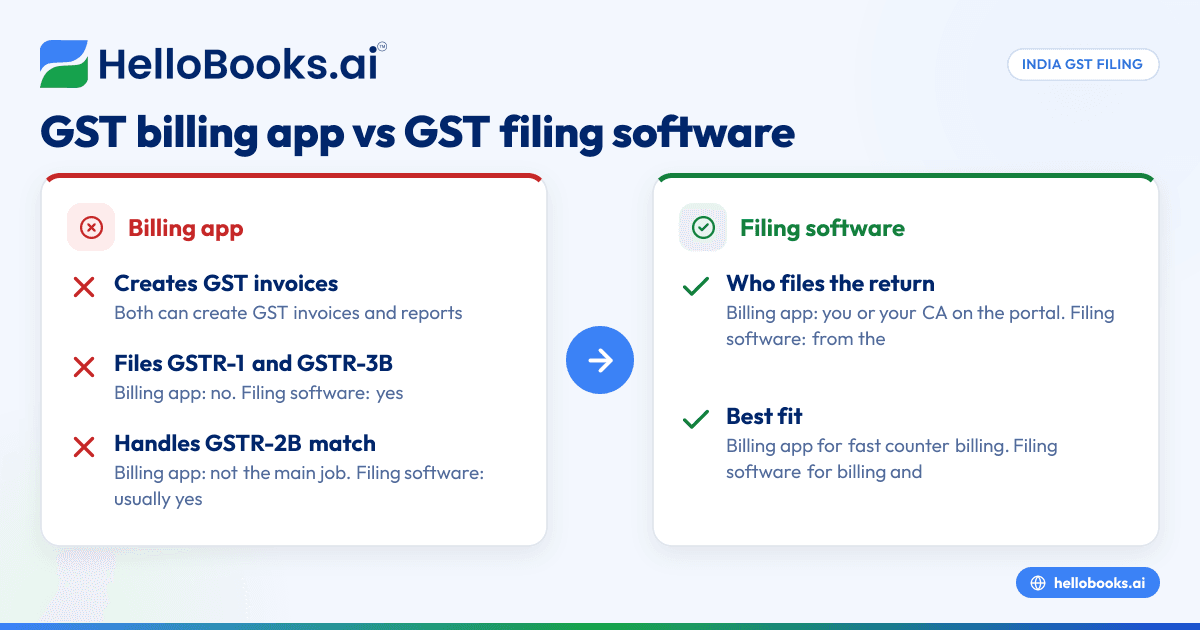
India businesses often discover this too late: a GST billing app helps you issue invoices, but that does not automatically mean your GSTR-1 and GSTR-3B are filed on the GST portal. In practice, billing and filing are two separate jobs under the GST law administered by CBIC through GSTN. If you use an app mainly for invoices and stock, you may still need your CA or another system for return filing, GSTR-2A/2B reconciliation, ITC tracking, and portal submission.
GST billing and GST filing are not the same job
For an Indian business, billing is the operational side of GST. You create a tax invoice with the supplier and buyer details, GSTIN where applicable, HSN or SAC, place of supply, and the right tax head split between CGST, SGST, or IGST. These invoice fields come from the GST rules framed under the Central Goods and Services Tax Act, 2017 and related state GST laws, with the official framework published by the Central Board of Indirect Taxes and Customs (CBIC) and implemented on the GST portal run by GSTN.
Filing is different. Filing means your sales and purchase data are classified into return tables, compared against what appears on GSTN records such as GSTR-2A or GSTR-2B, used to track input tax credit, and then submitted as returns on the GST portal. Whether a business files monthly or under another permitted cycle, the current return structure, instructions, and due dates are published on the official GST portal and CBIC notifications.
That difference matters because many owners say, "My app does GST," when what they really mean is, "My app prints GST bills."
Where billing apps help, and where the gap usually appears
A billing-first app is often enough for the front counter or field sales. It can be useful if your immediate need is to raise invoices fast, manage inventory, record collections coming by UPI, NEFT, RTGS, or IMPS, and keep a basic sales summary in rupees.
The gap appears at month-end. Someone still has to:
- prepare return-ready sales summaries in the right GST buckets
- check whether purchase invoices are reflected in GSTR-2A or GSTR-2B before ITC is claimed
- review reverse charge, TDS or TCS treatment where relevant
- validate place of supply and interstate versus intrastate classification
- file GSTR-1 and GSTR-3B on the GST portal
If your present workflow is "invoice in one app, then export to Excel or PDF, then send to the CA on WhatsApp, then wait for a challan amount," that is a sign you have billing software, not a full filing workflow.
What an India business should compare before choosing software
Do not compare tools only by whether they can print an invoice. For GST in India, the practical comparison is about continuity from invoice to return.
Look for these questions instead:
- Does the system create GST invoices with the correct place-of-supply logic and tax head split?
- If e-invoicing applies to your business under the current threshold notified under the GST law by CBIC and published on the GST portal, can it generate the IRN and signed QR from the invoice workflow?
- Can it prepare and directly file GSTR-1 and GSTR-3B, or are you still moving data out to another person or portal process?
- Can it compare purchase entries with GSTR-2A or GSTR-2B for ITC tracking?
- If you dispatch goods, can it raise the e-way bill from invoice data instead of making staff type the same details twice?
- Can it handle more than one GSTIN if your firm operates in multiple states?
- Can your accountant and operations team both use it without passing one laptop around?
That is the real divide between a billing app and GST filing software in India.
A realistic month in a billing-only workflow
Consider an illustrative, invented trader in Coimbatore selling electrical items across Tamil Nadu and occasionally to Karnataka. The numbers below are purely illustrative and invented, and they leave out many real-life adjustments such as credit notes, debit notes, exempt supplies, blocked credits, and industry-specific treatment.
Suppose in one month the trader records sales of ₹12 lakh in the app and purchases of ₹8 lakh. During the month, staff issue invoices, track stock, and record payments received in the bank. Everything feels under control.
Then the month closes.
The owner exports a report and sends it to the CA. The CA reviews whether local sales should have been split into CGST and SGST and whether interstate sales should have carried IGST according to place-of-supply rules under the GST law published by CBIC. The CA separately downloads GSTR-2B from the GST portal to see which supplier invoices are reflected on GSTN. A few purchase bills sent by photo on WhatsApp are missing from GSTR-2B, so those credits may need review before being reflected in GSTR-3B according to the current instructions published on the GST portal. Only after that reconciliation does the owner learn the likely tax payment.
This workflow can function. Many India businesses still run exactly this way. But it creates delay, dependence on exported reports, and a risk that the invoice books, purchase records, and filed returns drift apart.
A filing-first workflow changes where errors are caught
Now take the same illustrative, invented business, still leaving out many real-world adjustments. Instead of treating filing as a separate month-end project, the business records invoices, purchase bills, and bank receipts in one accounting flow.
A system like HelloBooks is useful here not because it is "all-in-one" as a slogan, but because the same sales data used to issue GST invoices can also flow into GSTR-1 and GSTR-3B filing. Purchase bills can be captured with OCR from a PDF or phone photo, then checked against GSTR-2A or GSTR-2B so missing supplier uploads are visible before the owner assumes ITC is available. If the business has one GSTIN in Tamil Nadu and another in Karnataka, the records can stay under one login without mixing the two registrations.
In practice, that means errors move earlier in the month. Place-of-supply mistakes show up while invoicing. A purchase invoice missing on GSTN shows up during reconciliation, not after filing pressure begins. Collections seen in an uploaded bank statement can be matched with invoices without retyping every line. By the time the owner reviews GSTR-3B, the return is being checked rather than assembled from scratch.
E-invoice, IRN and e-way bill are separate from billing too
Another India-specific point gets missed in generic software comparisons: e-invoice and e-way bill are not just prettier invoice formats.
Where e-invoicing applies, the requirement comes from the GST framework notified under the CGST Act and related rules, with current applicability thresholds and technical specifications published by CBIC and on the GST portal. A normal invoice PDF is not the same as an e-invoice carrying a valid IRN and signed QR. If your business is within the currently notified applicability criteria, you need software that handles that compliance process properly. The present threshold and notifications should always be checked on official CBIC and GST portal sources because they can change over time.
Likewise, if your movement of goods requires an e-way bill under the applicable GST and e-way bill rules published by CBIC and the official portal, typing consignment details separately increases error risk. It is far better when the e-way bill can be raised from invoice data already recorded.
For some businesses, this alone changes the software decision. A billing app may be fine for a local retailer with simple transactions. A distributor moving goods interstate, generating e-invoices where applicable, and managing multiple dispatches may need billing, e-invoicing, e-way bill generation, and return filing tied together.
What this means if you currently rely on Tally and spreadsheets
A lot of Indian businesses are not starting from zero. They may be invoicing in one app, keeping books in Tally, sending purchase bills on WhatsApp, and asking the CA to do final GST work.
That patchwork is common because each piece solved one immediate problem. But it can create duplicate entry and version confusion:
- one sales number in the billing app
- another adjusted number in Excel
- a separate purchase register built from PDFs
- a different receivables balance in Tally
- final return values only visible on the GST portal
If your business is in that stage, the question is not whether you must throw everything away. It is whether the next system can fit Indian practice better: import or connect with Tally while you transition, accept OCR-based purchase capture, reconcile using uploaded bank statements, produce financial reports from the same records used for GST, and allow your accountant plus internal staff to work together.
That is where accounting software for Indian businesses and a Tally alternative become part of the GST conversation, not a separate purchase decision.
When a billing app is enough, and when filing software becomes necessary
A billing app may be enough if all of the following are true:
- your invoice volume is manageable
- your transactions are simple and mostly local
- your CA already handles filing efficiently
- you are comfortable exporting data every cycle
- you do not need strong GSTR-2A/2B reconciliation inside the same system
- e-invoice or e-way bill requirements do not add complexity beyond your current process
Filing software becomes necessary when at least some of these start happening:
- you want GSTR-1 and GSTR-3B filed directly from recorded books
- you want ITC tracking based on GSTR-2A/2B rather than guesswork
- you sell across states and place-of-supply errors are recurring
- you need IRN and signed QR generation where e-invoicing applies under current CBIC notifications
- you dispatch goods often and want e-way bill generation from invoice details
- you run multiple GSTINs
- you want management reports and GST returns to come from the same data
For those cases, GST return filing software is the category to evaluate, not just a billing tool.
How HelloBooks fits this specific India use case
For this exact question, the relevant point about HelloBooks is not that it can make invoices look professional. It is that an India business can issue GST invoices with the correct CGST, SGST, or IGST split, use place-of-supply logic during invoicing, and then carry the same records into direct GSTR-1 and GSTR-3B filing instead of rebuilding returns from exports.
If the business falls under the currently notified e-invoicing applicability published by CBIC and the GST portal, HelloBooks can generate the IRN and signed QR as part of the invoice workflow. If goods movement requires compliance under the e-way bill system, the e-way bill can be generated from invoice data rather than entered again. Purchase invoices can be pulled in using OCR, then checked against GSTR-2A or GSTR-2B for ITC tracking. For teams that still reconcile collections manually, uploaded bank statements can be matched with books using AI-assisted reconciliation for India. Businesses moving off Tally gradually can also evaluate migration or connector-based workflows instead of a sudden switch.
That matters because the real comparison is not "Which app prints bills?" It is "Which system reduces handoff between invoice, books, reconciliation, and filed GST returns?"
You can also explore smart invoicing, e-invoicing software, e-way bill software, bank reconciliation software, or check the India product overview at HelloBooks India. If you want commercial details, use pricing, and if you want to test fit before deciding, book a demo.
Before you choose, verify the legal facts from official India sources
Because GST compliance details can change, verify all current rates, thresholds, due dates, and filing instructions from official sources before acting. In India, that means the GST portal operated by GSTN, CBIC notifications and guidance under the Central Goods and Services Tax Act, 2017 and related rules, and where relevant, other laws such as the Income-tax Act, 1961 for TDS matters, the Companies Act, 2013 and MCA filings for corporate compliance, RBI directions for payment-system context, and the Digital Personal Data Protection Act, 2023 for data-handling obligations. Software can reduce manual work, but legal responsibility still sits with the business.
If your present setup already works and your CA is happy, a billing app may be sufficient. If you want fewer Excel exports, earlier error detection, cleaner ITC tracking, and direct filing of GSTR-1 and GSTR-3B, then you are no longer shopping for a billing app alone. You are shopping for GST filing software built for how India businesses actually operate.


