


Key takeaways
What this article covers, in order:
- Why this comes up / what goes wrong
- Step-by-step
- Example (fictional figures)
- Common mistakes
- Doing this in HelloBooks
- Frequently asked questions
In Tamil Nadu, the e way bill is mandatory for the movement of goods when the taxable value is ₹50,000 or more and the recipient is unregistered. If the recipient is registered, the e way bill must be generated regardless of the consignment value. This rule applies to both intra-state and inter-state transport of taxable goods.
Why this comes up / what goes wrong
Small business owners in Tamil Nadu often struggle to determine when an e way bill is necessary. They may keep records in spreadsheets, Tally, or physical books but remain unsure about the threshold that triggers e way bill compliance. Without generating the e way bill on time, consignments can be stopped by authorities, leading to delays and penalties. Confusion about invoice details and transporter information further complicates compliance. Understanding the exact limits and steps ensures smooth goods movement and avoids financial setbacks.
Step-by-step
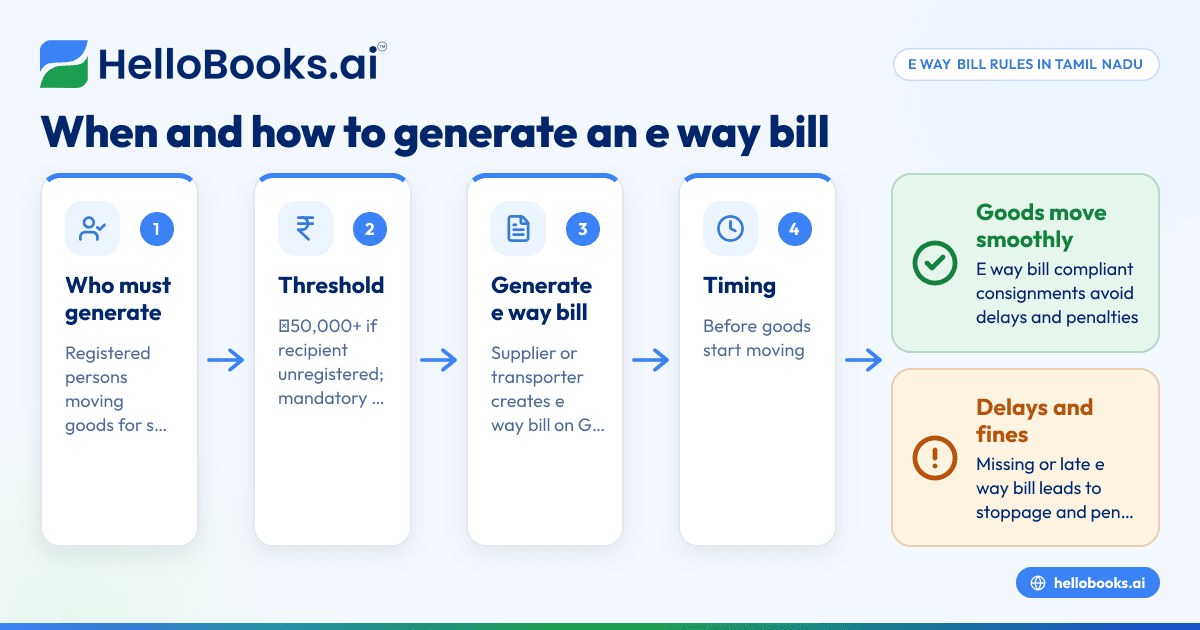
- Who must generate an e way bill: Any registered person in Tamil Nadu who causes the movement of goods for supply or other reasons (like returns) must generate an e way bill if the consignment meets the threshold.
- Threshold/limit:
- When the recipient is unregistered and the taxable value of goods transported is ₹50,000 or more, an e way bill is mandatory.
- For registered recipients, an e way bill is required regardless of the consignment value.
- What must be done: The supplier or transporter must generate the e way bill electronically on the GST e way bill portal before the goods start moving. The e way bill must include details such as consignor and consignee GSTIN, invoice number, HSN codes, vehicle number, and transport document.
- By when: The e way bill must be generated before the commencement of movement of goods.
- Additional notes: If the delivery address is different from the place of supply, it must be mentioned in the e way bill. The validity of the e way bill depends on distance and mode of transport.
For invoice compliance, Rule 46 mandates that tax invoices must contain the supplier’s and recipient’s GSTIN, HSN or SAC codes, description, quantity, taxable value, tax rates and amounts, place of supply, delivery address if different, and other particulars. See GST invoicing for more details.
Example (fictional figures)
A small electronics business in Coimbatore sells goods worth ₹75,000 to an unregistered buyer in Salem on 15/11/2023.
- Taxable value = ₹75,000 (above ₹50,000 threshold)
- Recipient is unregistered
- E way bill must be generated before transport
Calculation:
₹75,000 ≥ ₹50,000 (threshold for unregistered recipient)
Therefore, the business must generate an e way bill from the GST portal before dispatch.
Common mistakes
- Not generating e way bill for consignments above ₹50,000 to unregistered recipients
- Prevention: Always verify the recipient’s GST registration status and consignment value before transport.
- Generating e way bill after goods have started moving
- Prevention: Generate the e way bill before the commencement of movement to avoid penalties.
- Incorrect or incomplete invoice details affecting e way bill creation
- Prevention: Use GST-compliant invoicing with correct HSN codes and GSTINs. The GST invoice validator can help verify invoice details.
- Omitting vehicle or transporter details in the e way bill
- Prevention: Enter accurate transport details promptly to ensure the e way bill is valid.
- Ignoring the validity period of the e way bill leading to invalid transport
- Prevention: Track e way bill validity based on distance and renew if necessary.
Doing this in HelloBooks
HelloBooks simplifies e way bill generation by creating the e way bill directly from the invoice record, so consignment details do not need to be typed twice. For businesses exceeding the ₹5 crore e-invoicing threshold, HelloBooks also generates the IRN and signed QR code automatically when saving B2B invoices, saving time and reducing errors. Use HelloBooks for India to manage your GST invoicing and e way bills efficiently.
Frequently asked questions
What is the e way bill limit in Tamil Nadu?
The e way bill must be generated for goods with a taxable value of ₹50,000 or more when the recipient is unregistered. For registered recipients, an e way bill is required regardless of value.
Who is responsible for generating the e way bill?
Either the supplier or the transporter can generate the e way bill. It must be done before the goods start moving.
Can I transport goods below ₹50,000 without an e way bill?
Yes, if the recipient is unregistered and the consignment value is below ₹50,000, an e way bill is not mandatory unless the goods are restricted or notified.
What details are required on the e way bill?
The e way bill must include consignor and consignee GSTIN, invoice number, HSN code, vehicle number, and transport document details.
Is e way bill required for both inter-state and intra-state transport?
Yes, the e way bill rules apply to both inter-state and intra-state movement of goods exceeding the threshold.
Key takeaways
- E way bill is mandatory in Tamil Nadu for goods over ₹50,000 to unregistered recipients.
- For registered recipients, e way bill is required regardless of value.
- The e way bill must be generated before goods movement.
- Accurate invoice details and GSTINs are essential for compliance.
- Use tools like the GST invoice validator and e way bill software to avoid errors.
- HelloBooks integrates GST invoicing and e way bill creation to ease compliance.
To learn how HelloBooks can help you generate e way bills and GST invoices efficiently, book a 30-minute demo today.


