
Key takeaways
What this article covers, in order:
- Key takeaways
- What Delaware small-business owners need to know first
- Does Delaware have sales tax for small businesses?
- What should a Delaware small business track instead of sales tax?
- Why clean books matter more in Delaware than many owners think
- How do I keep books clean if Delaware does not charge sales tax?
Delaware small businesses do not collect a state or local sales tax on most retail sales. That is the key fact. Instead, many Delaware businesses need to track gross receipts, keep clean income records, and understand when taxes or registrations apply in other states if they sell beyond Delaware.
Key takeaways
- Delaware does not impose a state sales tax on retail sales.
- Small-business owners in Delaware should focus on clean revenue tracking, gross receipts tax awareness, and strong bookkeeping.
- If you sell into other states, you may still have sales tax obligations there.
- Good books start with clear invoices, matched deposits, categorized expenses, and regular reconciliation.
- Automation can reduce manual work, especially for invoicing, expense capture, and bank matching.
- This article is general information, not tax or legal advice.
What Delaware small-business owners need to know first
If you searched for Delaware sales tax small business, the short answer is simple: Delaware is known as a no-sales-tax state. For many small-business owners in Wilmington, Dover, and Newark, that removes one common layer of tax administration at the point of sale.
But that does not mean there is nothing to track.
You still need clean books. You still need to record every sale. You still need to separate taxable issues from non-tax issues, such as income, gross receipts, owner draws, contractor payments, and out-of-state sales tax obligations.
For a small-business owner, the real risk is not usually “forgetting Delaware sales tax.” The real risk is messy records. That leads to missed income, duplicate entries, unreconciled deposits, and confusion at tax time.
Does Delaware have sales tax for small businesses?
No. Delaware does not have a state or local sales tax on retail sales. Most small businesses in Delaware do not add sales tax to customer invoices for in-state sales.
That simple answer helps, but it can also create false confidence. Many owners assume no sales tax means no compliance work. In practice, you still need to track revenue carefully and understand how Delaware taxes businesses in other ways.
What Delaware business owners often confuse with sales tax
Small-business owners often mix up these items:
- sales tax
- gross receipts tax
- business income tax
- payroll taxes
- use tax issues in other states
- sales tax registration outside Delaware
These are not the same thing.
A Delaware retailer, consultant, contractor, or e-commerce seller may not charge Delaware sales tax. But the business may still owe other taxes or filing obligations, depending on the business model and where customers are located.
Why this matters for your day-to-day bookkeeping
If you believe there is no tax issue at all, you may skip important recordkeeping steps. That causes problems later when you need to:
- prepare financial statements
- review business performance
- file federal and state returns
- support deductions
- answer questions from your accountant
- register in another state if you create nexus there
This is why a clean bookkeeping process matters more than the label on the tax.
What should a Delaware small business track instead of sales tax?
Track gross sales, returns, discounts, deposits, payment processor fees, business expenses, and where each customer sale happened. Delaware does not require normal retail sales tax collection, but your books still need a complete audit trail for revenue, gross receipts tax review, and any out-of-state tax exposure.
Under that short answer, the practical work begins. If you run a small business in Delaware, here are the records that matter most.
1. Gross sales by date
Record every sale by invoice date or sale date. Do not rely only on bank deposits. Deposits can combine several days of revenue or net out processor fees.
Your books should show:
- invoice or order number
- customer name
- date
- amount charged
- discounts
- refunds or credit notes
- payment method
This makes your monthly close much easier.
2. Cash received versus revenue earned
A lot of small-business owners in Delaware use cash flow as their only scorecard. That is understandable, but it is not enough.
If you invoice a customer on 03/28/2026 and get paid on 04/10/2026, your books should still show what happened clearly. Otherwise, you cannot tell what you earned in each month.
This is especially important if you sell services to businesses in Philadelphia-area markets, online subscriptions, or wholesale goods across state lines.
3. Refunds, credits, and chargebacks
Refunds are easy to miss when sales tax is not in the picture. But they still affect revenue. So do chargebacks and processor disputes.
Track them separately. Do not bury them in a generic expense account. If you do, your top-line revenue will look wrong.
4. Merchant and platform fees
If Stripe or another processor sends you a net deposit, your books should still show gross income and fees separately. A $980 deposit may represent a $1,000 sale and a $20 processing fee. If you book only the deposit, your revenue is understated.
5. Customer location
This becomes important if you sell outside Delaware. Delaware may not impose sales tax on the sale, but another state might require you to register and collect tax if your activity there crosses its rules.
You do not need to panic. You do need records.
Useful details include:
- customer billing state
- shipping state
- where services were delivered
- transaction volume by state
- dollar value by state
6. Gross receipts categories
Delaware businesses often need to be aware of the state’s gross receipts tax system. The rules depend on business activity, and treatment can vary by industry. That is why your chart of accounts and revenue categories should be specific.
For example, a Delaware retailer, manufacturer, or service provider should not dump all income into one vague “sales” bucket if different activities need different review.
Why clean books matter more in Delaware than many owners think
The lack of sales tax can make bookkeeping feel simpler than it is. Many small-business owners in Delaware stay in spreadsheets too long because the pressure feels lower.
That usually works until the business grows.
At that point, common issues appear fast:
- owner payments mixed with business spending
- income booked from deposits instead of invoices
- duplicate revenue entries
- missing expense receipts
- unreconciled credit card balances
- no monthly review of accounts receivable
- no state-by-state view of sales
Clean books help you answer basic questions:
- Which month was actually profitable?
- Which customers still owe money?
- How much did fees reduce revenue?
- Are you approaching registration thresholds in another state?
- Can your accountant trust your year-end numbers?
If you cannot answer those questions quickly, the bookkeeping system needs work.
A simple example from a Delaware small business
Imagine a Wilmington design studio that invoices $18,000 in April. It receives $11,500 in April and $6,500 in May. Stripe deposits are net of fees. One customer gets a $700 credit in May.
If the owner books only bank deposits, April and May both look wrong. Revenue, fees, and credits are all distorted. The owner may think cash is the same as sales. It is not.
A proper system records the invoice, payment, fees, and credit separately. Then the books make sense.
How do I keep books clean if Delaware does not charge sales tax?
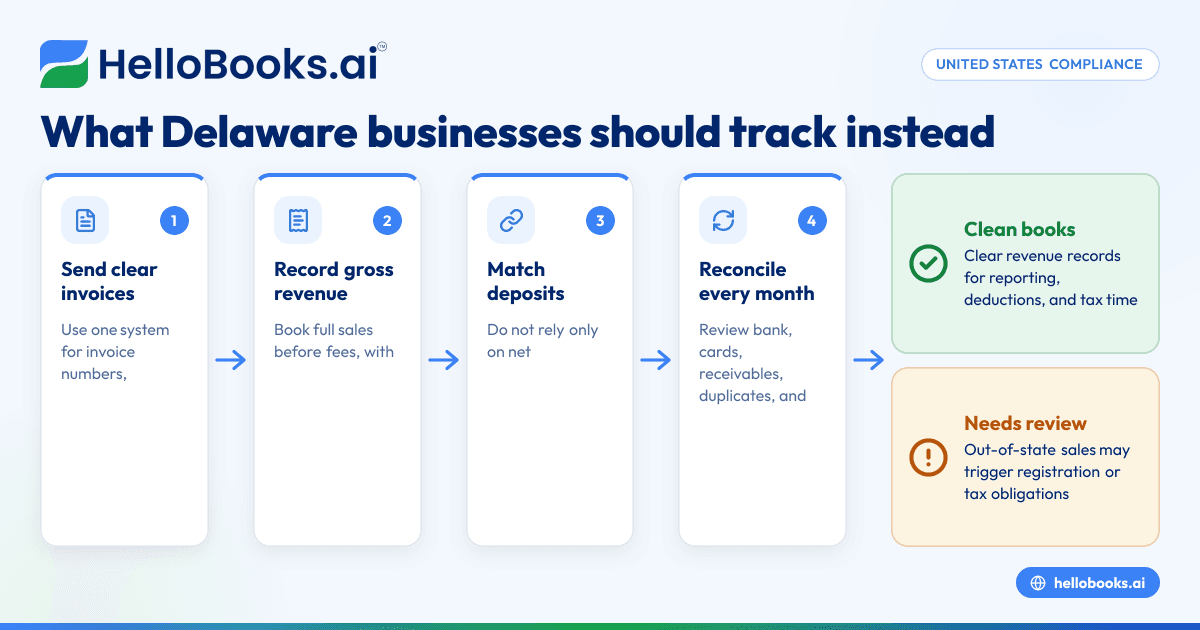
Use a monthly process: send clear invoices, record gross revenue before fees, match every deposit, reconcile bank and card accounts, and review customer balances by state. Delaware's no-sales-tax setup reduces one step, but clean books still depend on disciplined recordkeeping.
That short answer is the operating rule. Here is how to apply it.
Step 1: Use one source of truth for invoicing
Create invoices in one system. Avoid sending some from email, some from Word, and some from a payment app. That always creates gaps.
A solid invoice software setup helps you keep invoice numbers, dates, customer names, and status in one place.
Step 2: Record gross revenue, not just net deposits
When a payment processor takes fees out before sending cash, book the full sale and the fee separately. This gives you accurate revenue and accurate expense reporting.
Step 3: Reconcile every month
Bank and card reconciliation is where bookkeeping errors surface. Do not wait until year-end.
A monthly process should include:
- bank account reconciliation
- credit card reconciliation
- undeposited funds review
- accounts receivable review
- duplicate transaction scan
- uncategorized expense cleanup
If this takes too long, bank reconciliation software can reduce manual matching.
Step 4: Keep expense records current
Delaware’s lack of sales tax does not reduce the need for good expense documentation. Save receipts, categorize spending correctly, and separate personal and business purchases.
This matters for tax deductions, cash flow planning, and financial reports.
Step 5: Track sales by state if you sell beyond Delaware
Many Delaware businesses sell online or serve customers elsewhere in the United States. Once that happens, your state-by-state tracking matters.
Even if your home state has no sales tax, another state may have its own rules based on sales activity. Your books should be able to show revenue by state without a manual scramble.
Step 6: Review monthly reports
At a minimum, review these each month:
- profit and loss statement
- balance sheet
- accounts receivable aging
- expense detail
- cash flow by account
- sales by customer or state
This helps you catch problems while they are still small.
Delaware gross receipts tax and bookkeeping basics
Delaware’s no-sales-tax reputation often hides the issue that business activity may still be subject to Delaware gross receipts tax. This tax is different from sales tax. It is generally tied to gross receipts from business activity, and the exact treatment can depend on your industry and revenue.
For a small-business owner, the bookkeeping lesson is simple: your revenue records must be complete and organized.
What that means in practice in Delaware
You should be able to answer:
- What did the business earn this month?
- What type of revenue was it?
- Which legal entity earned it?
- Which state was the customer in?
- Were there returns or allowances?
- Are the records supported by invoices and deposits?
If your books are messy, gross receipts review becomes harder than it needs to be.
Keep your chart of accounts simple but specific
Do not create dozens of unnecessary accounts. But do create enough structure to separate meaningful categories.
Examples might include:
- product sales
- service revenue
- shipping income
- refunds and allowances
- merchant processing fees
- contractor expense
- office expense
- software subscriptions
A simple chart of accounts is easier to maintain and easier for your accountant to review.
What if I sell online from Delaware into other states?
If you sell from Delaware into other states, you may need to monitor whether those states require sales tax registration and collection based on your activity there. Delaware’s no-sales-tax rule does not override another state’s rules, so customer location and sales volume matter.
This is one of the biggest blind spots for Delaware owners.
Common situations that create confusion
You might run:
- an e-commerce store shipping goods nationwide
- a software or service business with clients in multiple states
- a wholesale business based in Dover selling to out-of-state buyers
- a contractor or installer working physically in another state
In these cases, Delaware may still be simple, but your overall tax picture may not be.
What records help most
Track these every month:
- sales dollars by state
- transaction count by state
- shipping destination
- returns by state
- exemption documentation if relevant
- registration status by state
This is where cleaner books save real time. Instead of rebuilding reports in a panic, you already have the data.
Why automation helps
If you are still copying transactions between spreadsheets and your accounting file, errors are almost guaranteed as volume grows.
Tools built for AI bookkeeping and AI accounting software can help with invoice capture, categorization, and reconciliation. For many owners, that means fewer month-end surprises and faster visibility into what the business actually earned.
Can AI help a Delaware small business track revenue better?
Yes. AI can help classify transactions, match deposits, flag missing entries, and speed up reconciliation. For owners searching ai delaware sales workflows, the real value is cleaner books and faster month-end close, not a fake sales tax shortcut.
That short answer is the practical one. AI is useful when it removes repetitive bookkeeping work and makes your records more reliable.
Where AI helps most in a Delaware business
A small business in Delaware often has a lean back office. The owner or office manager handles invoicing, payments, expenses, and follow-up. That is exactly where automation can help.
Useful areas include:
- invoice creation and tracking
- receipt capture
- transaction categorization
- duplicate detection
- bank matching
- month-end review
If your business has outgrown spreadsheets, it may be time to look at accounting software in the USA or modern accounting software for small business.
What to watch for
Do not treat automation as autopilot. Review categorizations, reconcile regularly, and keep approval controls in place. Good software improves bookkeeping discipline. It does not replace it.
A practical monthly checklist for Delaware small-business owners
Use this checklist at the end of each month:
- Send all invoices for the month.
- Confirm all payments are recorded.
- Book gross revenue before processor fees.
- Record refunds and credits separately.
- Reconcile bank accounts.
- Reconcile credit cards.
- Review unpaid customer invoices.
- Review expenses and attach receipts.
- Check sales by state if you sell outside Delaware.
- review monthly financial reports.
This process does not need to be complicated. It needs to be consistent.
When to ask for help
You should consider outside help if:
- reconciliation is more than one month behind
- you do not trust your profit number
- customer balances are unclear
- you sell in several states
- your accountant keeps sending adjusting entries
- tax season feels reactive every year
At that point, better software or professional support can pay for itself in saved time and cleaner reporting. If needed, you can also find an accountant.
Delaware small-business owners often start with simple systems and outgrow them quietly. The sooner you fix the process, the easier growth becomes.
If you want a simpler way to handle invoicing, reconciliation, and day-to-day bookkeeping, you can book a demo or compare options on the pricing page.
Frequently asked questions
Do I need to charge sales tax to customers in Delaware?
For most retail sales in Delaware, there is no state or local sales tax to charge. But you still need accurate invoices and revenue records, and you may need to review other tax obligations based on your business activity.
Read next
This article covers one part of a bigger topic. For the complete picture, read our guide to sales tax.