
Key takeaways
What this article covers, in order:
- Why cards go wrong more than checking does
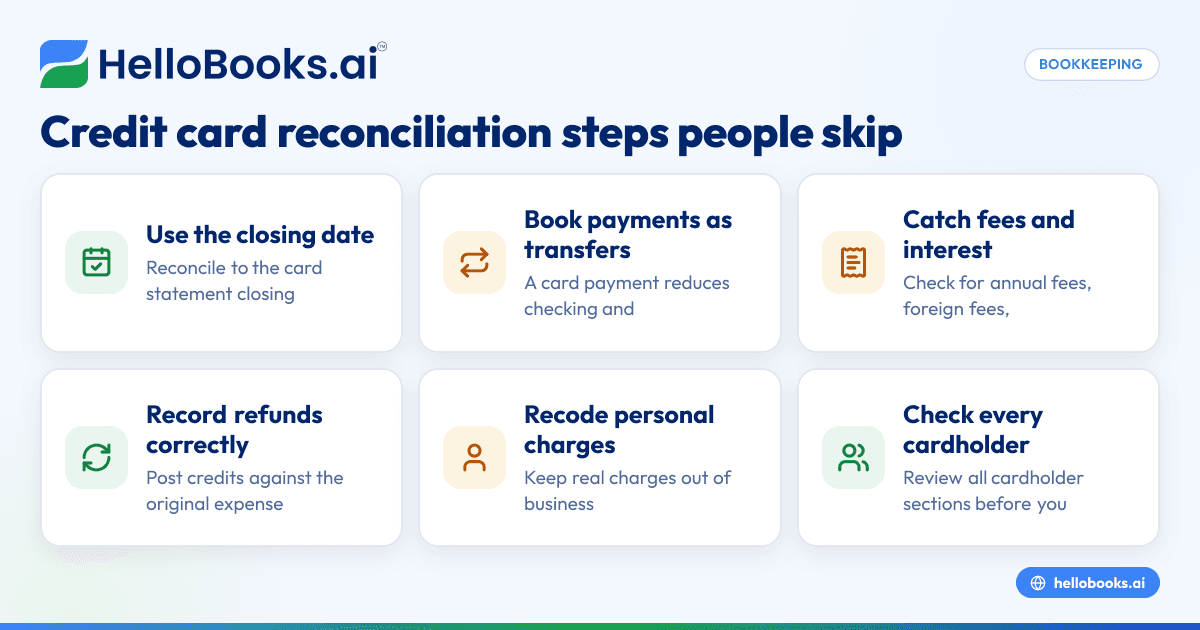
- Skipped step 1: Using the statement's closing date
- Skipped step 2: Recording the card payment as a transfer
- Skipped step 3: Fees, interest and annual charges
- Skipped step 4: Refunds and credits
- Skipped step 5: Personal charges
Credit card reconciliation means matching every charge, credit, fee and payment in your books to the card statement, then confirming that your books show the same balance owed as of the statement's closing date. It works like a bank reconciliation, except the balance is money you owe, the statement rarely closes at month-end, and a few easy-to-miss items cause most of the trouble.
Why cards go wrong more than checking does
Checking accounts get attention because that's where the cash is. Cards get a glance at the minimum payment and that's about it. Then year-end arrives and the card liability on the Balance Sheet is off by a few hundred dollars that nobody can explain.
In our experience, card reconciliations fail for the same handful of reasons, again and again. Here they are, as the steps people skip.
Skipped step 1: Using the statement's closing date
Your bank statement probably ends on the last day of the month. Your card statement might close on the 18th, the 22nd or the 25th. If you reconcile a card statement that closed Sep 25, 2026 against your books through Sep 30, 2026, you'll pick up five days of charges the statement doesn't include, and it will never balance.
Fix: reconcile each card to its own closing date and closing balance. Filter your books to that date.
Skipped step 2: Recording the card payment as a transfer
This is the big one. When you pay your card from checking, it is not an expense. The expenses were the individual charges. The payment just moves money from one account (checking) to pay down another (the card liability).
If you record a $2,000 card payment as "office expenses," you've counted those expenses twice: once when each charge came in and once when you paid the bill. Your profit is understated by $2,000 and your card balance in the books won't come down.
Fix: record card payments as a transfer: decrease checking, decrease the card liability. In most accounting software, you match the payment in the checking feed to the same payment in the card feed.
Skipped step 3: Fees, interest and annual charges
Cards love small charges that nobody enters: annual fees, foreign transaction fees, late fees, interest on a carried balance. They often show on the statement in a separate section, below the purchases, where they're easy to overlook.
Skipped step 4: Refunds and credits
A vendor refunds you $48.00. It appears as a credit on the card. If nobody records it, your expenses stay $48.00 too high and your card liability looks $48.00 higher in the books than it really is.
Skipped step 5: Personal charges
On a sole proprietor's or single-member LLC's card, it's common for a personal dinner or a family purchase to sneak in. Don't delete it and don't book it as a business expense. Record it as an owner draw (or, for a corporation, follow your CPA's guidance on how to treat it). The charge is real; it just isn't a business cost.
Skipped step 6: Checking every cardholder
If three employees have cards on one account, the statement might group charges by cardholder. It's easy to reconcile the primary card and forget the other two sections. Count the sections before you start.
A worked example
Rosa runs an interior design studio in Denver. (She's a made-up example.) Her business card statement closed on Sep 25, 2026.
- Statement closing balance, Sep 25, 2026: $4,318.62 owed
- Card liability in her books as of Sep 25, 2026: $4,056.12 owed
- Difference: $262.50 (the statement shows more owed)
She works through the statement line by line. Purchases and her Sep 20, 2026 payment of $2,000.00 all match. Five items don't:
| Item on statement | Amount | Effect on balance owed |
|---|---|---|
| Design software annual renewal | $189.00 | Increases |
| Card annual fee | $95.00 | Increases |
| Foreign transaction fee (overseas fabric order) | $4.50 | Increases |
| Interest charge | $22.00 | Increases |
| Refund from a lighting vendor | $48.00 | Decreases |
Charges she missed: $189.00 + $95.00 + $4.50 + $22.00 = $310.50.
Net of the refund: $310.50 − $48.00 = $262.50.
That's exactly the difference. Once she records all five, her books show $4,056.12 + $262.50 = $4,318.62 owed, matching the statement.
Here's how each one is recorded:
| Item | Debit | Credit |
|---|---|---|
| Software renewal | Software subscriptions expense $189.00 | Credit card liability $189.00 |
| Annual fee | Bank and card fees expense $95.00 | Credit card liability $95.00 |
| Foreign transaction fee | Bank and card fees expense $4.50 | Credit card liability $4.50 |
| Interest | Interest expense $22.00 | Credit card liability $22.00 |
| Vendor refund | Credit card liability $48.00 | Lighting and fixtures expense $48.00 |
Note that the refund goes back against the same expense account the original purchase hit. That keeps your expense totals honest.
One more thing Rosa noticed: a $64.00 charge in her books dated Sep 27, 2026. It's after the closing date, so it belongs on the October 2026 statement. Because she filtered her books to Sep 25, 2026, it didn't throw anything off. That's skipped step 1 doing its job.
A card reconciliation checklist
Use this each time a card statement closes:
- [ ] Note the statement's closing date and closing balance.
- [ ] Confirm the opening balance equals last statement's closing balance.
- [ ] Filter your books to the same closing date.
- [ ] Count cardholder sections on the statement.
- [ ] Match every purchase by amount, date and merchant.
- [ ] Find fees, interest and annual charges in their own section.
- [ ] Record refunds and credits against the original expense account.
- [ ] Confirm payments are recorded as transfers, not expenses.
- [ ] Recode any personal charges as owner draws.
- [ ] Check that your book balance equals the statement balance.
- [ ] Save the statement with the reconciliation.
What about pending charges?
Pending charges aren't on the statement and aren't final. Some get adjusted (restaurant tips, hotel holds) or dropped entirely. Leave them alone until they post. If your bank feed brings in pending items, just make sure you're not recording a pending amount and then the posted amount as two separate transactions.
How HelloBooks helps
HelloBooks lets you connect most US banks and credit cards, so card charges, credits and fees come into your books from the card issuer's data rather than from a PDF you retype. If a card won't connect, import its CSV statement. Credit-card accounts reconcile the same way as checking: the reconcile screen lines the card statement up against your ledger, suggests a match for each line with a confidence score and the reason for it, and leaves you the exceptions, which is usually where the missed fees and refunds from Rosa's example turn up. You get the same reconciliation report (opening balance, cleared items, outstanding items, closing balance) in PDF or CSV. Because both the checking account and the card can be connected, the card payment shows up on both sides, which makes it easier to treat as a transfer. Bank connections run from 1 live feed on Free, to 3 on Starter ($14.99/month), to unlimited on Pro ($39.99/month). Starter also adds AI auto-categorization, which suggests accounts for new card charges. If you run an LLC and want a fuller picture of the setup, see our page on accounting for LLCs, or the bank reconciliation software overview.
FAQs
Is a credit card payment an expense?
No. Paying your card balance is a transfer from checking to the card liability. The expenses were recorded when each charge was made.
What date should I reconcile my credit card to?
The statement's closing date, not the end of the month. Card statements often close mid-month.
How do I record a credit card refund?
Debit the credit card liability and credit the same expense account the original purchase went to.
How should I handle personal charges on a business card?
Record them as an owner draw for a sole proprietor or single-member LLC. For corporations, ask your CPA how they prefer it handled. Either way, don't record them as business expenses.
Do I need to reconcile a card I pay off in full every month?
Yes. Paying in full doesn't guarantee every charge, fee and refund was recorded correctly. Those still affect your expenses even if the balance hits zero.
Treat your card like a bank account with its own calendar, and most of the mystery differences stop showing up.
Start free, no credit card. Try HelloBooks Free