


Key takeaways
What this article covers, in order:
- Why this comes up / what goes wrong
- Step-by-step
- Example (fictional figures)
- Common mistakes
- Doing this in HelloBooks
- Frequently asked questions
Consulting businesses in India benefit from tax provisions like input tax credit (ITC) on business expenses, GST invoicing rules tailored for services, and compliance simplifications under GST. This article explains the main tax benefits relevant to consulting firms, outlines step-by-step actions to optimise tax benefits, highlights common mistakes to avoid, and provides a worked example using typical figures for an IT services firm.
Why this comes up / what goes wrong
Consulting business owners and accountants often struggle to fully utilise tax benefits due to the complexity of GST rules for services and the nuances of ITC claims. Many consulting firms operate across states, making place-of-supply rules important for correct GST classification. Errors here can lead to incorrect tax payments or denial of ITC. Additionally, consulting businesses frequently maintain books in Excel or Tally, which can lead to manual errors and missed opportunities for tax optimisation. Understanding these tax benefits and compliance requirements is essential to reduce tax liability and improve cash flow.
Step-by-step
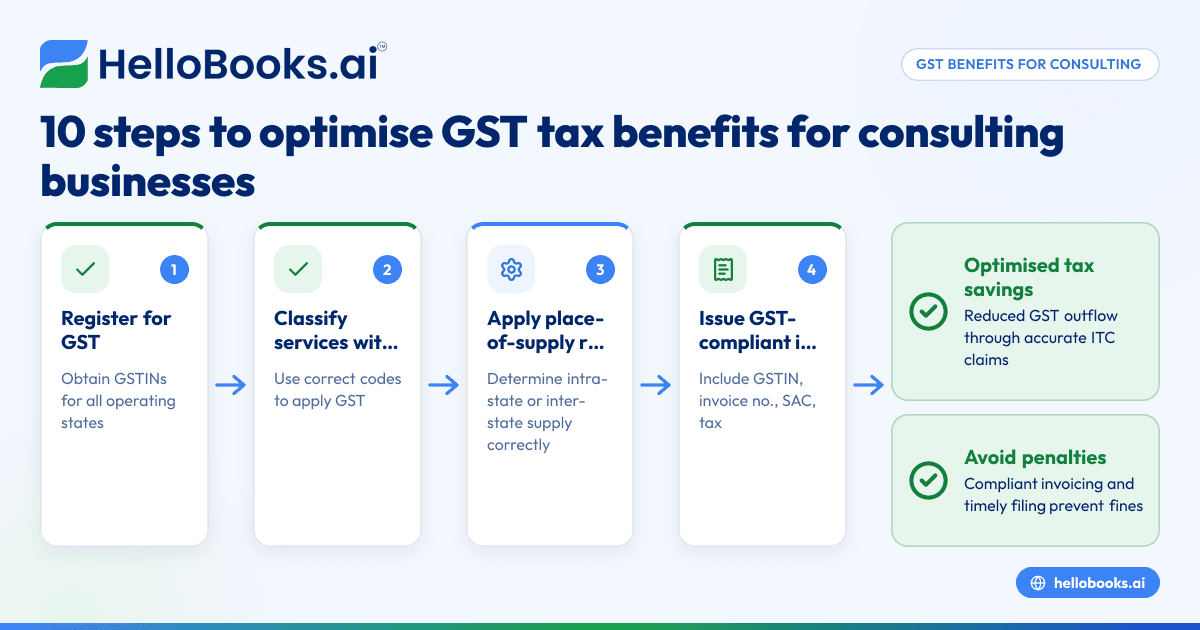
- Register for GST and obtain GSTIN(s): Ensure your consulting business is registered under GST and has a valid GSTIN for each state where you operate.
- Classify your services correctly using SAC codes: Use the correct Services Accounting Codes (SAC) for your consulting services to apply the right GST rates.
- Apply place-of-supply rules properly: Determine whether your supply is intra-state or inter-state based on the client's location and GSTIN. This affects whether CGST+SGST or IGST applies.
- Issue GST-compliant invoices: Include all mandatory details such as GSTIN, invoice number, HSN/SAC codes, place of supply, and tax breakup.
- Maintain accurate purchase and sales registers: Track all supplier invoices to claim eligible ITC.
- Reconcile GSTR-2A/2B with your purchase register: Verify that your suppliers have uploaded invoices correctly to avoid ITC denial.
- File GSTR-1 and GSTR-3B on time: Report outward supplies and claim ITC accurately to stay compliant.
- Track ITC reversals and blocked credits: Identify any expenses where ITC is not allowed and adjust your claims accordingly.
- Maintain records for audit and assessment: Keep all invoices, contracts, and GST returns organised for at least six years.
- Review tax benefits periodically with a professional: Consult your chartered accountant to stay updated on GST rules and optimise tax benefits.
For detailed invoicing guidance, see GST invoicing. For software tailored to agencies and professional services, visit IT and professional services.
Example (fictional figures)
A consulting practice in Noida provides IT advisory services. They issued invoices worth ₹12,00,000 in March 2024 with an assumed GST rate of 18%. They also purchased office equipment and software services worth ₹3,00,000 including GST at 18%.
- Outward GST collected: ₹12,00,000 × 18% = ₹2,16,000
- Input GST paid: ₹3,00,000 × 18% = ₹54,000
- Net GST payable: ₹2,16,000 - ₹54,000 = ₹1,62,000
The firm claims ITC of ₹54,000 on purchases against GST liability on sales, reducing their tax outflow.
They file GSTR-1 showing ₹12,00,000 sales and GSTR-3B with ₹1,62,000 net GST payable.
This example shows how consulting businesses can reduce GST paid by claiming ITC on eligible purchases.
Common mistakes
- Incorrect place-of-supply leading to wrong tax head (CGST+SGST vs IGST): Prevent by verifying client's GSTIN and applying place-of-supply rules correctly. HelloBooks can automate this with its place-of-supply and tax head split feature.
- Missing supplier invoices in GSTR-2B causing ITC denial: Regularly reconcile your purchase register with GSTR-2A/2B to identify missing or mismatched invoices.
- Not maintaining proper invoice details: Ensure all GST invoice elements are present to avoid compliance issues.
- Claiming ITC on blocked or non-eligible expenses: Understand ITC restrictions and track reversals carefully.
- Delays in filing returns leading to penalties: File GSTR-1 and GSTR-3B on time to avoid late fees.
- Manual data entry errors in spreadsheets or Tally: Use automation tools to reduce errors and save time.
Learn more about avoiding errors in GST invoicing at GST invoicing.
Doing this in HelloBooks
HelloBooks helps consulting businesses reconcile their purchase register against GSTR-2A and 2B nightly, flagging missing, mismatched, or excess-credit invoices before GSTR-3B filing. It also automates place-of-supply and tax head splitting, preventing common invoice errors such as charging CGST+SGST on inter-state sales or IGST on local ones. These features help consulting firms claim ITC accurately and comply with GST invoicing rules efficiently. For more details, visit HelloBooks for India and explore its GST return filing software features at /gst-return-filing-software.
Frequently asked questions
What tax benefits can consulting businesses claim under GST?
Consulting businesses can claim input tax credit (ITC) on GST paid on business expenses, reducing their overall tax liability. They must comply with GST invoicing rules and file returns accurately to avail these benefits.
How does place-of-supply affect GST for consulting services?
Place-of-supply determines whether CGST+SGST or IGST applies. For intra-state supplies, CGST and SGST are charged; for inter-state, IGST applies. Correctly applying this rule ensures proper tax calculation.
Can consulting firms claim ITC on all purchases?
No. ITC is allowed only on purchases used for business and not blocked under GST rules. Expenses like personal use or certain motor vehicles may be excluded. Tracking ITC reversals is important.
What are the consequences of not reconciling GSTR-2B with purchase records?
Failure to reconcile can lead to claiming ITC on invoices not uploaded by suppliers, resulting in ITC denial and penalties during audits.
How can software like HelloBooks assist consulting businesses with GST compliance?
HelloBooks provides GSTR-2A/2B reconciliation and ITC tracking, flags invoice errors, and automates place-of-supply tax head splits. This reduces manual errors and helps consulting firms comply with GST invoicing rules efficiently.
Key takeaways
- Consulting businesses can reduce GST outflow by claiming ITC on eligible purchases.
- Correct place-of-supply determination is essential for applying the right GST tax heads.
- Regular reconciliation of purchase records with GSTR-2B prevents ITC denial.
- Accurate GST invoicing with required details avoids compliance issues.
- HelloBooks helps streamline GSTR-2B reconciliation and place-of-supply tax head splitting.
- Timely filing of GSTR-1 and GSTR-3B is critical to avoid penalties.
Optimise your consulting business tax benefits and compliance by leveraging these steps and tools. To see how HelloBooks can help, Book a 30-minute demo.
This article is general information, not tax or legal advice. Rules change; confirm the current position on gst.gov.in or with your chartered accountant before acting.


