
Key takeaways
What this article covers, in order:
- Why this comes up / what goes wrong
- Step-by-step
- Example (fictional figures)
- Common mistakes
- Frequently asked questions
- Key takeaways
Consulting expenses refer to all costs that a consulting business incurs in the process of delivering its services. For Indian IT and professional services firms, these typically include payments to subcontractors, travel expenses for client meetings, software subscriptions, and office overheads such as supplies and utilities. Proper management of consulting expenses is crucial to maintain profitability, ensure accurate financial reporting, and comply with GST regulations.
Why this comes up / what goes wrong
Consulting business owners and accountants in cities like Pune, Chennai, and Noida often handle multiple projects simultaneously. Each project may have varied expense types and payment terms. Without a systematic approach, expenses can be misclassified, overlooked, or mixed with personal costs. This results in inaccurate profit calculations, errors in GST returns, and difficulty in budgeting. For example, a digital agency in Pune may struggle to track subcontractor payments across several clients, while an IT services firm in Chennai might miss reconciling travel expenses properly. These issues cause confusion, affect cash flow decisions, and complicate GST compliance.
Step-by-step
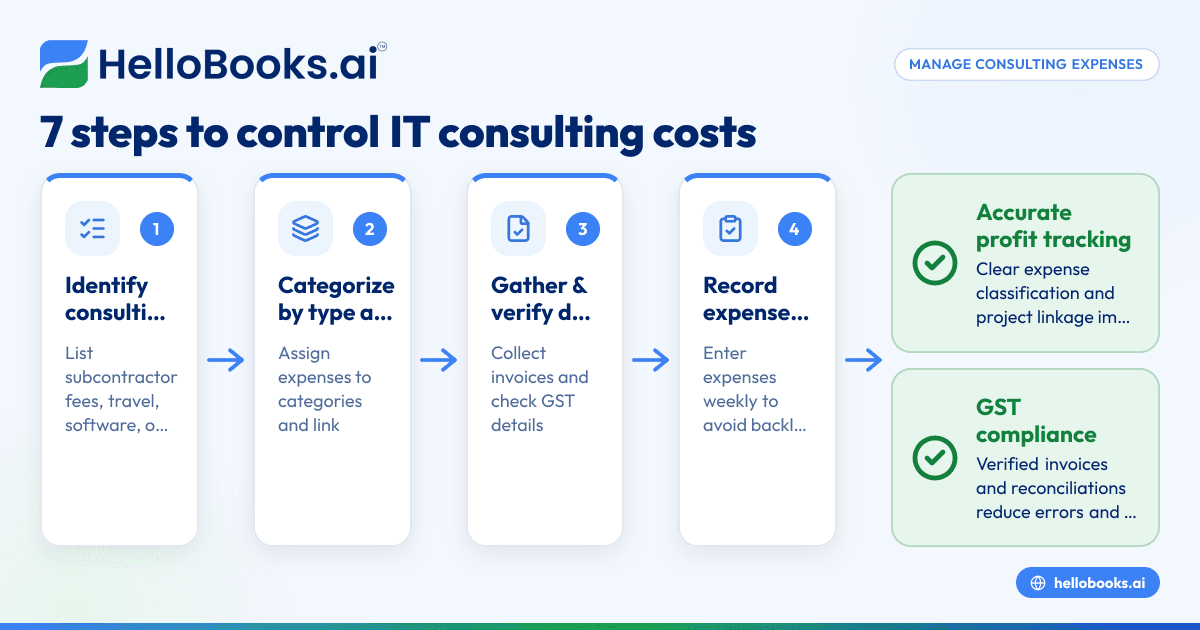
- Identify all consulting-related expenses: Make a comprehensive list of all costs directly related to delivering consulting services. This includes subcontractor fees, client-related travel, software licenses, office supplies, and communication expenses.
- Categorize expenses by type and project: Assign each expense to a clear category such as travel, software subscriptions, or subcontractor fees. Link expenses to the relevant client project or internal cost centre to track profitability per engagement.
- Gather and verify supporting documents: Collect invoices, bills, payment receipts, and contracts. Check for accuracy, GST details, and vendor registration status, especially if you intend to claim input tax credit (ITC).
- Record expenses promptly: Enter expenses into your accounting system, spreadsheet, or books regularly—ideally weekly—to avoid backlog and reduce errors.
- Reconcile expenses with bank statements monthly: Match recorded expenses against bank transactions to identify missing, duplicate, or incorrect entries.
- Review expenses before GST filing: Confirm that all consulting expenses are correctly classified and that ITC is claimed only on eligible expenses supported by valid GST invoices.
- Monitor expense trends and budgets: Track expenses over time to detect overspending or savings opportunities. Adjust budgets and forecasts accordingly.
Using accounting and expense management software tailored for IT and professional services can simplify these steps and improve accuracy.
Example (fictional figures)
Consider a consulting practice in Noida that incurred the following consulting expenses in April 2024:
- Subcontractor fees: ₹1,50,000
- Travel expenses: ₹30,000
- Software subscription: ₹20,000
- Office supplies: ₹10,000
Calculate total consulting expenses:
₹1,50,000 + ₹30,000 = ₹1,80,000
₹1,80,000 + ₹20,000 = ₹2,00,000
₹2,00,000 + ₹10,000 = ₹2,10,000
The firm verifies GST invoices for subcontractor fees and software subscriptions to claim input tax credit. Travel and office supplies are recorded but GST input credit is not claimed on these as per company policy.
Common mistakes
- Mixing personal and business expenses: This causes confusion and inaccurate records. Prevent by maintaining separate bank accounts and cards for business transactions.
- Not categorizing expenses properly: Misclassification leads to incorrect financial reports and GST errors. Use consistent categories and link expenses to projects.
- Delaying expense recording: Leads to backlog and missed entries. Enter expenses weekly to keep records current.
- Ignoring GST compliance on expenses: Claiming ITC without valid GST invoices can result in penalties. Always verify vendor GST registration and invoice details.
- Failing to reconcile expenses with bank statements: Unnoticed errors accumulate. Conduct monthly reconciliations.
- Overlooking expense trends: Missing overspending can hurt profitability. Review monthly expense reports and budgets.
For better control, consider accounting solutions that support expense management and GST compliance.
Frequently asked questions
What qualifies as a consulting expense?
Consulting expenses are costs necessary to deliver consulting services, including subcontractor fees, client-related travel, software tools, and office overheads. These must be directly related to your consulting business.
How should consulting expenses be recorded for GST?
Record consulting expenses with proper GST invoices whenever applicable. Input tax credit can only be claimed on expenses with valid GST invoices from registered vendors. Keep these documents ready for GST filing.
Can travel expenses be claimed as consulting expenses?
Yes, travel expenses for client meetings or project work are consulting expenses. Ensure they are supported by bills and are business-related. GST input credit on travel expenses may have restrictions.
How can I avoid errors in expense management?
Maintain clear expense categories, record expenses promptly, reconcile with bank statements, and verify GST details on invoices. Regular reviews help catch errors early.
Is it necessary to link expenses to projects?
Linking expenses to projects helps track profitability and control costs per client. It also improves reporting accuracy.
What tools can help with managing consulting expenses?
Accounting software tailored for IT and professional services and expense management can simplify tracking, categorization, and GST compliance.
Key takeaways
- Consulting expenses include subcontractor fees, travel, software, and office costs related to client projects.
- Proper classification and timely recording of expenses prevent accounting errors.
- Verify GST invoices to claim input tax credit correctly.
- Regular reconciliation with bank statements ensures accuracy.
- Linking expenses to projects improves financial insights.
- Use specialized accounting and expense management tools for better control.
Managing consulting expenses carefully helps Indian IT and professional services firms maintain profitability and compliance. To explore accounting solutions that fit your consulting business, Book a 30-minute demo.