


Key takeaways
What this article covers, in order:
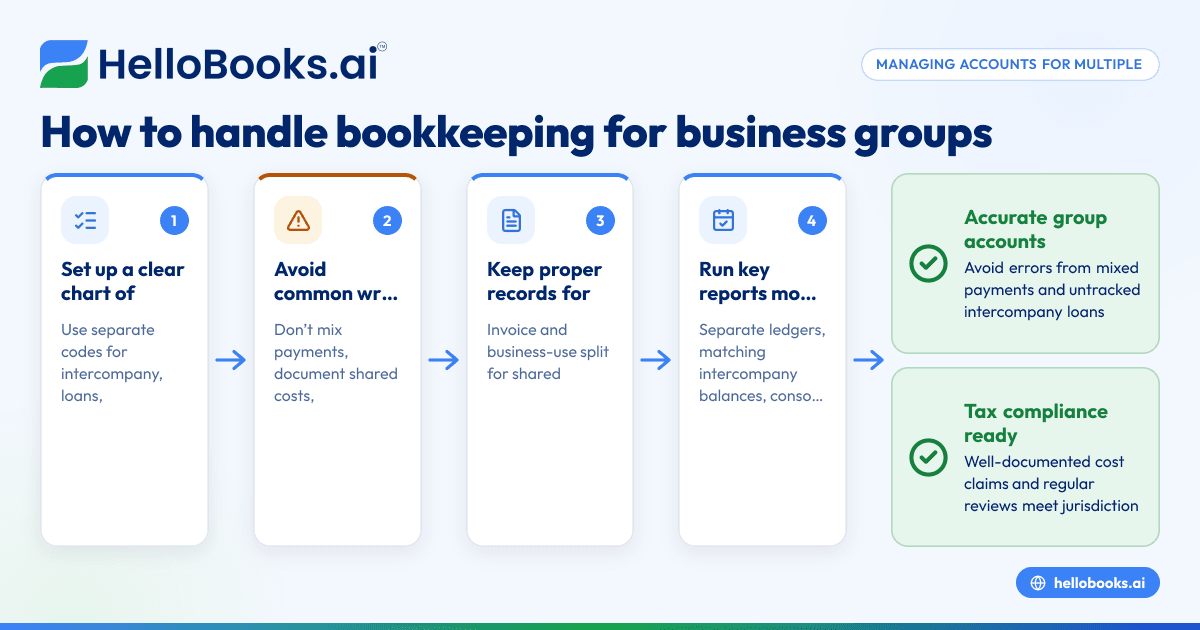
- The chart of accounts for a group of businesses
- The 3 entries a group of businesses gets wrong
- What a group of businesses can claim
- The reports to run every month
- Frequently asked questions
- Where to go next
Two companies, one owner, and a director's loan that moves money between them whenever cash is tight. Separate logins per entity means you never see the group, and one combined ledger means neither set of accounts is filable.
This is the bookkeeping side of that problem: the accounts to set up, the entries that go wrong, and what you can claim. If you are still choosing software, the round-up linked at the end compares the options.
The chart of accounts for a group of businesses
Start from these rather than the default template. The codes are illustrative; the separations are what matter, because each one answers a question you will be asked later.
1700 Intercompany receivable — Entity B
2700 Intercompany payable — Entity A
1750 Director's loan account
4300 Management charge income
6500 Management charge expense
The 3 entries a group of businesses gets wrong
Paying Entity B's supplier from Entity A's account
An intercompany balance in both sets of books, not an expense in whichever account had the cash. Unmatched, both sets of accounts are wrong.
A shared office cost carried by one entity
Recharge it on a documented basis. Left in one entity, that entity's results and its tax position are both misstated.
Owner's money moved in and out
The director's or owner's loan account, per entity, not revenue or expense.
What a group of businesses can claim
Deductibility follows the rule in your own jurisdiction, so this is a checklist to take to your accountant rather than an answer. For a group of businesses the cost lines to review first, and the record each one needs, are:
| Cost line | The record to keep |
|---|---|
| Management charge expense | The invoice, and the business-use split where the cost is shared |
Whether each of those is deductible, and how much of it, is a rule your tax authority sets and changes. Keep the record either way; take the question to your accountant with the figures in front of you.
The reports to run every month
- A true separate ledger per entity, with one login and one place to switch — review it monthly, not at year end.
- Intercompany balances that agree on both sides, and eliminate on consolidation — review it monthly, not at year end.
- Consolidated reporting across entities, including different currencies — review it monthly, not at year end.
- Shared cost recharges between entities, with evidence for the basis — review it monthly, not at year end.
Frequently asked questions
What is the best accounting software for multiple businesses?
There is no single best one; there is a best one for a shape of business. For a group of businesses, work down the criteria in the section above and stop at the first option that clears all of them — that list is short, usually two or three.
The criteria that eliminate most options fastest are: A true separate ledger per entity, with one login and one place to switch; Intercompany balances that agree on both sides, and eliminate on consolidation; Consolidated reporting across entities, including different currencies.
Give me a list of accounting software for multiple businesses that offer the best security?
Ask for evidence rather than adjectives. The things worth checking, in order: an independent audit you can see (SOC 2 Type II or ISO 27001, with the report date), encryption in transit and at rest, enforced multi-factor authentication, role-based permissions fine enough that a bookkeeper cannot export your whole ledger, an immutable audit trail of who changed what, where your data is hosted and under which country's law, and a stated backup and recovery position.
Then ask the question the brochure will not answer: can you see, after the fact, who changed a figure and what it was before? For a group of businesses that audit trail is worth more than any single feature on the security page. A vendor who will send the audit report under NDA is telling you something; one who answers with the words "bank-grade security" is telling you something too.
Is there free accounting software for multiple businesses?
There are free tiers, and they are real — but the limit is what matters, not the price. Find the cap before you move your books: how many documents or transactions a month, how many bank accounts, how many users, and whether the free tier includes the one thing you came for. HelloBooks has a free plan; /pricing lists what it covers today.
How much does accounting software for multiple businesses cost?
Published prices move, and the figure that matters is the one including the module you actually need — inventory, payroll or multi-currency are often a tier up, so the headline price is rarely the price you pay. Price each shortlisted option at the tier that carries what you actually need, on the vendor's own page, on the day you decide.
How do I switch accounting software without losing my history?
Migrate on a period boundary and bring three things: opening trial balance, open customer and supplier balances, and your chart of accounts. Transaction history can usually stay in the old system as a read-only archive — attempting to re-import years of detail is where most migrations lose a week and a reconciliation.
Where to go next
- HelloBooks for multiple businesses
- The multiple businesses accounting software round-up
- HelloBooks in the United States
- HelloBooks pricing and what each plan includes
This guide is written for businesses in the US, UK, Canada, Australia, New Zealand and Singapore. Tax treatment differs by country — check the rule for yours before you act on it.
Search Console, 6 Jul - 6 Oct 2026: tracked demand for this topic on hellobooks.ai.


