
Key takeaways
What this article covers, in order:
- Key takeaways
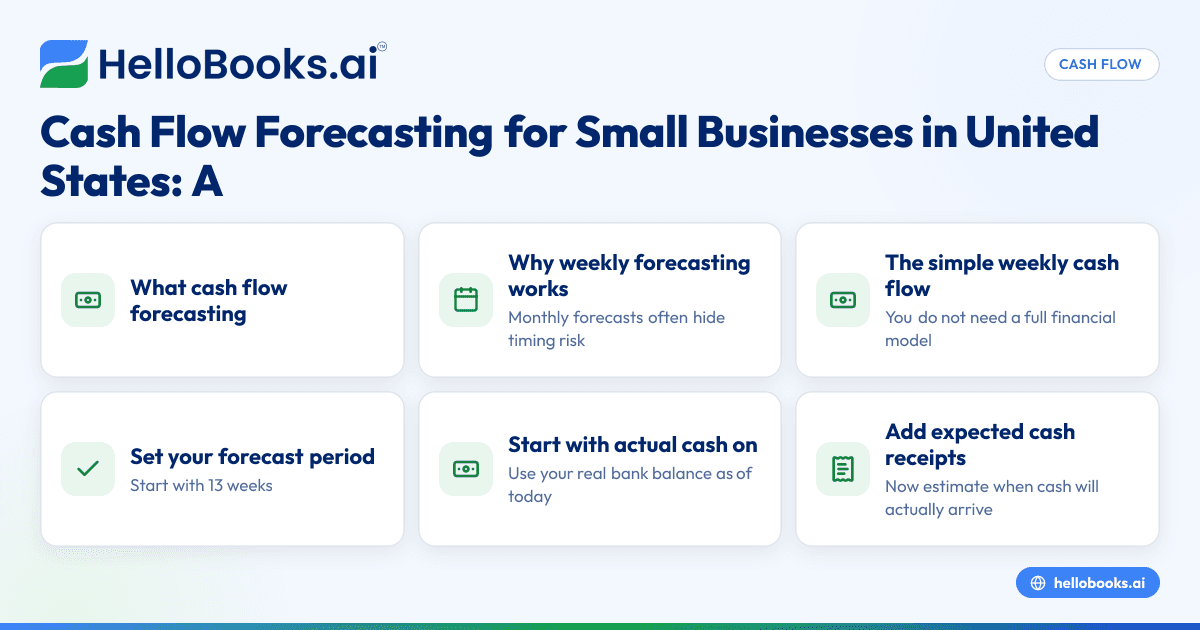
- What cash flow forecasting means for a small business in the United States
- Why weekly forecasting works better than monthly for many small businesses
- The simple weekly cash flow forecasting method
- What to include in cash outflows
- A simple weekly cash flow forecast example
Cash flow forecasting for a small business in the United States means estimating how much cash will come in and go out over the next few weeks or months. A simple weekly forecast helps you spot shortfalls early, delay nonessential spending, speed up collections, and avoid surprise overdrafts or missed payroll.
Key takeaways
- A weekly cash flow forecast is a practical tool for small businesses because cash usually moves faster than monthly reports show.
- Start with your current bank balance, then add expected cash receipts and subtract expected cash payments by week.
- Use realistic dates, not invoice dates or bill dates, because timing is what makes or breaks cash flow.
- Review and update the forecast every week using actual bank activity, unpaid invoices, payroll dates, rent, loan payments, and tax obligations.
- Separate “guaranteed,” “likely,” and “uncertain” cash inflows so you do not overestimate available cash.
- If your forecast lives in spreadsheets today, tools like AI bookkeeping and bank reconciliation software can reduce manual updates.
What cash flow forecasting means for a small business in the United States
Cash flow forecasting shows whether your business will have enough cash to operate. It focuses on money moving through your bank account, not just profit on paper.
That difference matters. A Chicago wholesaler may look profitable in QuickBooks, but still run short on cash if customers pay in 45 days and suppliers need payment in 15 days. A Houston services business may have signed contracts, but still miss payroll if collections slip by one week.
For most small businesses, the best starting point is a weekly cash flow forecast. Weekly forecasting is detailed enough to catch issues early. It is also simple enough to maintain without turning it into a finance project no one updates.
This post covers a practical weekly method for US small businesses. It works well for service firms, ecommerce sellers, agencies, contractors, and growing product businesses. It is general information, not tax or legal advice.
Why weekly forecasting works better than monthly for many small businesses
Monthly forecasts often hide timing risk. A month can look fine overall, while one bad week creates a real cash problem.
For example, imagine this pattern:
- Payroll hits on Friday.
- Rent clears on the first of the month.
- A large customer payment is due “net 30” but usually arrives 10 days late.
- Credit card payouts from Stripe come in every few days.
- Sales tax payments or quarterly estimated taxes are due soon.
On a monthly report, total inflows may still exceed total outflows. But your bank account can still dip below zero in the middle of the month.
A weekly forecast solves this by showing timing clearly. You can see:
- when cash will be tight
- which week needs action
- whether to delay a purchase
- whether to follow up harder on receivables
- whether to draw on a credit line early
This is why cash flow forecasting small business owners can actually use tends to be weekly, not quarterly and not overly complex.
The simple weekly cash flow forecasting method
You do not need a full financial model. You need a clean 13-week view and a habit of updating it every week.
Step 1: Set your forecast period
Start with 13 weeks. That is long enough to catch issues and short enough to stay accurate.
A 13-week cash flow forecast is common because it covers roughly one quarter. It also matches the way many businesses think about payroll cycles, tax dates, and receivables collections.
Create one column for each week. Use week-ending dates such as:
- 05/09/2026
- 05/16/2026
- 05/23/2026
Then build these rows:
- Opening cash balance
- Cash in
- Cash out
- Net cash movement
- Closing cash balance
Your closing balance for one week becomes the opening balance for the next.
Step 2: Start with actual cash on hand
Use your real bank balance as of today. If you operate multiple accounts, combine only the accounts available for operations. Exclude restricted cash if you cannot use it freely.
Do not start with accounts receivable. Do not start with “expected” deposits. Start with actual cash in the bank.
This keeps your forecast grounded in reality.
Step 3: Add expected cash receipts by week
Now estimate when cash will actually arrive. This is the most important part of the forecast.
Include common inflows such as:
- customer payments on unpaid invoices
- cash sales
- card payouts from Stripe or other processors
- loan proceeds already approved
- owner contributions, if planned
- tax refunds only if timing is reasonably certain
Use the expected cash receipt date, not the invoice date.
If a Detroit manufacturer has a $25,000 invoice dated 04/30/2026, but the customer usually pays in six weeks, place it in the week cash is likely to land. If that customer has a history of paying late, reflect that. Conservative forecasts are more useful than optimistic ones.
Use three confidence levels for receipts
A simple way to avoid overestimating is to tag receipts as:
- Committed: highly likely and scheduled
- Likely: expected based on pattern
- Uncertain: possible but not reliable
For planning, include committed and likely cash. Keep uncertain receipts visible, but separate them from your main closing cash balance. This gives you a base case instead of a wish list.
What to include in cash outflows
Cash outflows are usually easier to predict than receipts. That is why many businesses get into trouble by estimating expenses carefully but overstating collections.
Step 4: List fixed and variable cash payments
Include all expected cash payments by week, such as:
- payroll and payroll taxes
- rent
- utilities
- software subscriptions
- contractor payments
- inventory purchases
- loan payments
- insurance
- owner draws
- credit card payments
- sales tax remittances, where applicable
- federal and state tax payments, if scheduled
If you collect sales tax in the United States, remember that filing frequency and due dates vary by state. Put those payments in the correct week based on your state schedule.
If you issue payments to contractors, that affects year-end 1099 reporting, but your forecast should focus on when the cash leaves the account, not the form filing date.
Step 5: Separate essential from discretionary spending
Not every cash payment has the same urgency.
Mark payments as:
- Essential: payroll, taxes, rent, debt service, critical vendors
- Important: marketing, software, routine supplies
- Discretionary: equipment upgrades, bonuses, nonurgent projects
If your forecast shows a tight week, this ranking helps you act fast. You can protect essentials first and postpone discretionary spending without guessing.
A simple weekly cash flow forecast example
Here is a basic example for a US marketing agency.
Opening cash on 06/01/2026: $42,000
Week 1
Cash in
- Client A payment: $12,000
- Stripe payouts: $4,500
Cash out
- Payroll: $18,000
- Rent: $4,000
- Software: $1,200
- Freelancer payments: $3,500
Net cash movement
- $16,500 in minus $26,700 out = -$10,200
Closing cash
- $42,000 - $10,200 = $31,800
Week 2
Cash in
- Client B payment: $9,000
- Client C payment: $6,500
Cash out
- Payroll taxes: $5,000
- Ad spend: $4,500
- Credit card payment: $7,000
Net cash movement
- $15,500 in minus $16,500 out = -$1,000
Closing cash
- $31,800 - $1,000 = $30,800
Week 3
Cash in
- Client D payment: $22,000
Cash out
- Payroll: $18,000
- Freelancer payments: $4,000
- Insurance: $2,000
Net cash movement
- $22,000 in minus $24,000 out = -$2,000
Closing cash
- $30,800 - $2,000 = $28,800
This business is still positive, but the trend is downward. If Week 3’s $22,000 payment slips, the owner may need to collect faster, cut ad spend, or use a line of credit.
That is the point of forecasting. You do not wait for a bank alert. You see the issue weeks ahead.
How to build your weekly forecast in practice
A forecast only works if it is easy to maintain.
Use this 7-step weekly routine
- Pull your current bank balances. Use the actual balances at the start of the review.
- Reconcile last week’s activity. Match expected versus actual cash movements. This is where expense management software and automated categorization can save time.
- Update unpaid invoices. Review who owes you money, how much, and when payment is realistically expected.
- Update upcoming bills and payroll. Include exact dates for payroll runs, rent, taxes, card settlements, and debt payments.
- Adjust timing based on new information. If a client says payment will land Friday instead of Tuesday, move it.
- Review your lowest projected cash week. This is your decision point. Ask what actions will protect cash.
- Share the forecast with decision makers. The owner, finance lead, or operations head should all see the same version.
Keep assumptions visible
Do not hide assumptions in formulas no one understands.
Add notes such as:
- “Client A usually pays 10 days late”
- “Payroll includes quarterly bonus on 06/26/2026”
- “Texas sales tax payment due this week”
- “Inventory order can be delayed by one week if needed”
This makes the forecast easier to trust and easier to update.
Common mistakes in cash flow forecasting small business owners should avoid
A forecast can fail even when the math is correct. The usual issue is poor assumptions.
Mistake 1: Using invoice dates instead of expected payment dates
Revenue is not cash. An invoice marked due does not mean the money arrives on that date.
Base collections on actual payment behavior.
Mistake 2: Ignoring taxes and irregular payments
Quarterly taxes, annual insurance, software renewals, and bonuses often get missed. These items can create sudden dips.
Build them into the right week.
Mistake 3: Treating all receivables as equally collectible
Some customers pay on time. Some need reminders. Some create risk.
Separate likely receipts from uncertain ones.
Mistake 4: Not updating the forecast every week
A forecast is not a one-time spreadsheet. It is a weekly management tool.
If you skip updates, it stops being useful quickly.
Mistake 5: Forgetting the effect of payment processors and transfer delays
Card sales are not always same-day cash. Stripe, ACH, and bank transfer timing can shift cash into the next week.
Forecast cash settlement timing, not just sales activity.
What to do when your forecast shows a cash shortfall
A good forecast does not prevent every shortfall. It gives you time to respond well.
Actions that can improve short-term cash flow
- Speed up collections. Call overdue customers. Send reminders. Ask for partial payments on large invoices.
- Invoice faster. Do not wait until month-end if work is complete. Use simple invoice software to send invoices promptly and track status.
- Delay nonessential spending. Push out discretionary purchases, ad spend, or equipment orders where possible.
- Negotiate vendor timing. Ask suppliers for extended payment terms before cash gets too tight.
- Review inventory buying. Product businesses often tie up too much cash in stock. Reduce slow-moving purchases if possible.
- Use financing carefully. If you have a line of credit, forecast when and why you need it. Do not rely on borrowing to cover recurring structural issues.
Look for root causes, not just quick fixes
If your forecast shows repeated weekly pressure, the problem may be deeper:
- gross margin is too low
- receivables collections are too slow
- payroll grew faster than revenue
- debt payments are too heavy
- inventory is absorbing too much cash
In that case, the forecast becomes a diagnostic tool, not just a scheduling tool.
When to move beyond spreadsheets
Spreadsheets are fine at the beginning. Many small businesses start there, and that is reasonable.
But they become harder to trust when:
- you have multiple bank accounts
- invoice volume is rising
- reconciliations are delayed
- receipts and expenses are scattered across tools
- no one agrees on the latest version
At that stage, better bookkeeping systems can help you keep forecasts tied to current data. If your team is outgrowing manual processes, it may be worth reviewing accounting software in the USA or a QuickBooks alternative that reduces data entry and improves visibility.
The goal is not fancy dashboards. The goal is cleaner books, faster updates, and fewer surprises.
A simple 13-week template you can use
Your forecast can be very simple. Use these row labels:
- Opening cash
- Customer collections
- Card processor payouts
- Other cash receipts
- Total cash in
- Payroll
- Payroll taxes
- Rent
- Vendor payments
- Loan payments
- Software and subscriptions
- Tax payments
- Owner draws
- Other cash payments
- Total cash out
- Net cash flow
- Closing cash
Then add one column for each week.
If you want, add a second section below the main forecast:
- overdue invoices
- top 10 expected receipts
- large upcoming bills
- risks and assumptions
- actions for this week
That second section is often what turns the forecast into a useful management habit.
How often should a small business review cash flow?
Review the forecast every week at minimum. Some businesses should review it more often.
You may need twice-weekly reviews if you have:
- tight payroll coverage
- large inventory purchases
- uneven customer payments
- seasonal swings
- rapid growth
- recent losses
A 20-minute review every Monday can prevent a costly scramble on Friday.
Final thoughts
Cash flow forecasting small business owners can actually use does not need to be complicated. Start with actual bank cash, forecast receipts and payments by week, and update it every week using real information. If you do this consistently, you will make better decisions on hiring, spending, collections, and growth.
If you want a simpler way to keep your books current and your cash picture clearer, you can book a demo or compare plans on our pricing page.
Frequently asked questions
What is the difference between cash flow forecasting and budgeting?
A budget is a plan for revenue and expenses over a period, usually monthly or annually. A cash flow forecast focuses on when cash actually enters and leaves your bank account. A business can be on budget and still run short on cash.
How far ahead should a small business forecast cash flow?
Most small businesses should start with a 13-week forecast. It is detailed enough to manage near-term risk and simple enough to keep updated. You can add a monthly forecast beyond that for longer-term planning.
Should I include unpaid invoices in my cash flow forecast?
Yes, but only in the week you realistically expect to receive payment. Do not assume every invoice will be paid exactly on its due date. Use customer payment history and current follow-up status.
How often should I update my cash flow forecast?
Update it at least once a week. If your cash position is tight or your business has volatile inflows, update it twice a week. The more timing matters, the more often you should review it.