


Key takeaways
What this article covers, in order:
- The transactions a personal trainer gets wrong
- 6 options for personal training accounting
- What to look for in personal training accounting software
- The chart of accounts a personal trainer needs
- How to choose, in order
- Frequently asked questions
Clients buy blocks of sessions, you rent space from a gym or pay a percentage of what you take, and some months are twice the others. The money for ten sessions arrives today; nine of them are work you still owe.
That is the question this page answers: which accounting software holds a personal trainer's transactions properly, and what to check before you commit. Written for UAE businesses.
The transactions a personal trainer gets wrong
Before the software list, the accounting. These are the entries this vertical books incorrectly most often, and the correct treatment — if a package cannot do these cleanly, nothing else about it matters.
A 10-session pack paid up front. A liability released per session. On receipt, the sale month is inflated and the nine delivery months look empty.
A percentage paid to the gym. A cost of sale per location, not general rent, so you can see which venue actually pays.
Sessions that expired unused. Recognise them at expiry under a written policy. Carried forever, the liability is wrong and so is your profit.
6 options for personal training accounting
| Option | What it is known for | Typically suits |
|---|---|---|
| HelloBooks | Cloud ledger with AI-assisted bookkeeping and bank feeds | Businesses wanting AI-assisted bookkeeping, with a free plan to start on |
| Zoho Books | Ledger inside the wider Zoho business suite | Teams already running other Zoho products |
| Xero | Cloud ledger with bank feeds and a wide add-on ecosystem | Businesses whose accountant already works in Xero |
| QuickBooks Online | General-purpose small-business ledger with a large app marketplace | Businesses that want the widest choice of third-party add-ons |
| Sage Business Cloud | Long-established accounting line with cloud editions | Businesses wanting a long-established vendor with local support |
| Odoo | Open-source ERP with an accounting module | Businesses wanting ERP modules well beyond accounting |
Positioning, not pricing. Published prices and plan contents change too often for a table to stay true, and the tier carrying the one feature you need is usually not the entry tier — so take the current figure from each vendor's own pricing page before you shortlist. Fit for personal training is settled by the criteria below, against your own numbers.
What to look for in personal training accounting software
Generic accounting checklists are the reason this decision goes wrong. These are the 7 criteria that actually separate the options for a personal trainer:
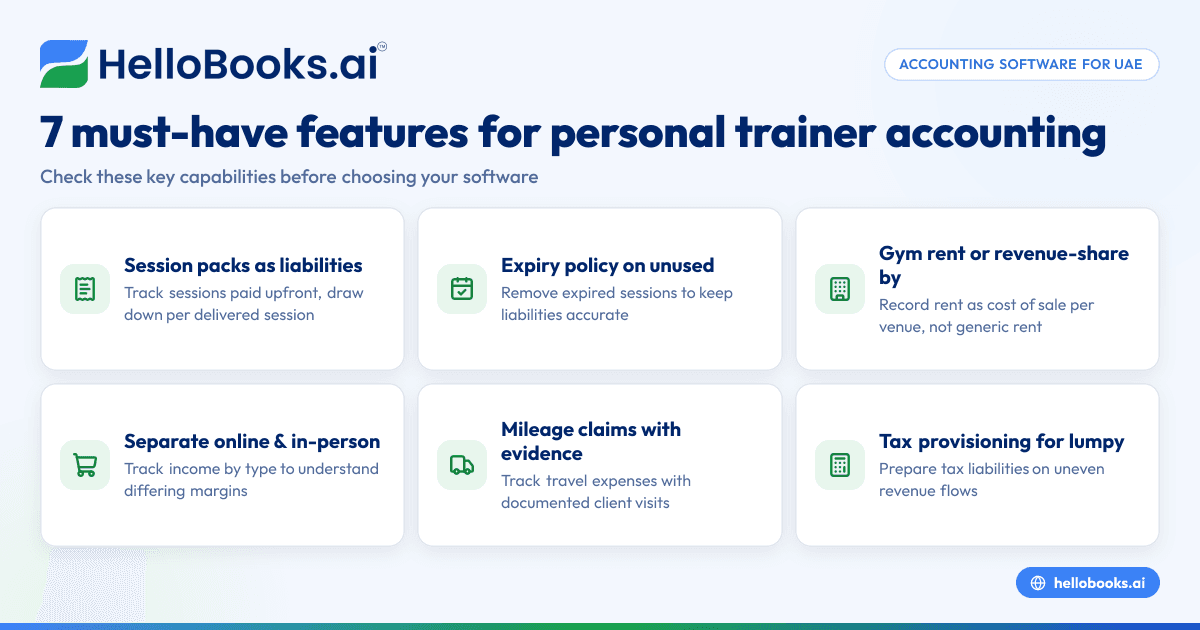
- Session packs held as a liability and drawn down per session delivered
- Expiry policy applied to unused sessions, so the liability does not grow forever
- Gym rent or revenue-share handled as a cost per location
- Online and in-person income separated, because the margins differ
- Mileage between clients and home-office claims, with evidence
- Tax provisioning on an income that is genuinely lumpy
- Invoicing and recurring payments that do not need chasing by hand
The chart of accounts a personal trainer needs
Whatever you choose, set it up with these accounts rather than the default template. The codes are illustrative; the separations are the point.
2310 Unused session packs held
4000 One-to-one session income
4100 Group and class income
4200 Online coaching income
5100 Gym rent and revenue share
6300 Mileage and travel
2400 Tax provision
How to choose, in order
- Write down the three entries above as they happen in your business, with real figures from last month.
- Put each shortlisted package through all of them in a trial. Not a demo — a trial, with your own numbers.
- Check the reports you will actually be asked for: personal training profitability, and whatever the FTA expects.
- Only then compare price, and compare the tier that includes what you needed in step 2.
Frequently asked questions
What is the best accounting software for personal trainers?
There is no single best one; there is a best one for a shape of business. For a personal trainer, work down the criteria in the section above and stop at the first option that clears all of them — that list is short, usually two or three.
The criteria that eliminate most options fastest are: Session packs held as a liability and drawn down per session delivered; Expiry policy applied to unused sessions, so the liability does not grow forever; Gym rent or revenue-share handled as a cost per location.
Give me a list of accounting software for personal trainers that offer the best security?
Ask for evidence rather than adjectives. The things worth checking, in order: an independent audit you can see (SOC 2 Type II or ISO 27001, with the report date), encryption in transit and at rest, enforced multi-factor authentication, role-based permissions fine enough that a bookkeeper cannot export your whole ledger, an immutable audit trail of who changed what, where your data is hosted and under which country's law, and a stated backup and recovery position.
Then ask the question the brochure will not answer: can you see, after the fact, who changed a figure and what it was before? For a personal trainer that audit trail is worth more than any single feature on the security page. A vendor who will send the audit report under NDA is telling you something; one who answers with the words "bank-grade security" is telling you something too.
Is there free accounting software for personal trainers?
There are free tiers, and they are real — but the limit is what matters, not the price. Find the cap before you move your books: how many documents or transactions a month, how many bank accounts, how many users, and whether the free tier includes the one thing you came for. HelloBooks has a free plan; /pricing lists what it covers today.
How much does accounting software for personal trainers cost?
Published prices move, and the figure that matters is the one including the module you actually need — inventory, payroll or multi-currency are often a tier up, so the headline price is rarely the price you pay. Price each shortlisted option at the tier that carries what you actually need, on the vendor's own page, on the day you decide.
How do I switch accounting software without losing my history?
Migrate on a period boundary and bring three things: opening trial balance, open customer and supplier balances, and your chart of accounts. Transaction history can usually stay in the old system as a read-only archive — attempting to re-import years of detail is where most migrations lose a week and a reconciliation.
Where to go next
This guide describes UAE practice under Federal Tax Authority rules, including VAT returns and corporate tax, and uses dirhams.
Search Console, 6 Jul - 6 Oct 2026: tracked demand for this topic on hellobooks.ai. This draft exists to answer it properly.


