
Key takeaways
What this article covers, in order:
- Meet the business
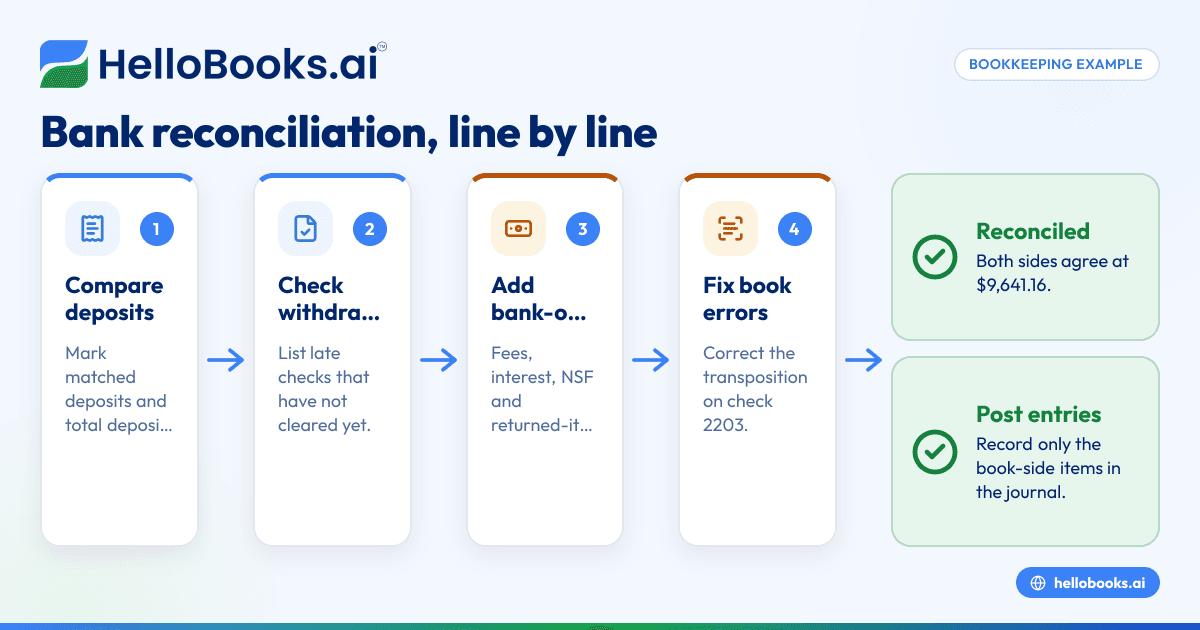
- Step 1: Compare deposits
- Step 2: Compare checks and withdrawals
- Step 3: Find what the bank knows that Dev doesn't
- Step 4: Find Dev's own mistake
- Step 5: Build the reconciliation
Below is a complete bank reconciliation example for one month, using real dollar figures for deposits in transit, outstanding checks, bank fees, interest, a bounced customer check and a transposition error. Every number adds up, and you'll see the journal entries that follow, so you can copy the layout for your own account.
Meet the business
Dev owns a three-person landscaping company in Columbus, Ohio. He's a made-up example, but his September 2026 is the kind of month we see all the time: busy, a little messy, and a balance that doesn't match.
On Oct 4, 2026, he sits down with two numbers:
- Bank statement ending balance, Sep 30, 2026: $9,876.40
- Book balance for checking, Sep 30, 2026: $9,945.79
The books show $69.39 more than the bank. That difference by itself tells him almost nothing. Several items are pulling in opposite directions, and we need to separate them.
Step 1: Compare deposits
Dev goes through the deposits on the statement and ticks off each one in his books. Everything matches except two deposits at the bottom of his book register:
| Date | Description | Amount | On statement? |
|---|---|---|---|
| Sep 30, 2026 | Customer payment, Hillcrest HOA | $1,240.00 | No |
| Sep 30, 2026 | Customer payment, residential job | $385.50 | No |
He made both deposits at the branch after the bank's daily cutoff on Sep 30, 2026. They'll appear on the October 2026 statement. These are deposits in transit, totaling $1,625.50.
Step 2: Compare checks and withdrawals
Next, he ticks off checks and debits. Three checks he wrote in late September 2026 haven't been cashed:
| Check # | Payee | Amount |
|---|---|---|
| 2201 | Mulch and stone supplier | $650.00 |
| 2204 | Equipment rental | $1,120.75 |
| 2206 | Fuel card top-up | $89.99 |
| Total outstanding | $1,860.74 |
Quick check of that total: $650.00 + $1,120.75 = $1,770.75, plus $89.99 = $1,860.74.
Step 3: Find what the bank knows that Dev doesn't
On the statement, these items have no match in his books:
| Item | Amount | Effect on books |
|---|---|---|
| Monthly service fee | $15.00 | Reduce cash |
| Outgoing wire fee | $25.00 | Reduce cash |
| Interest earned | $2.37 | Increase cash |
| Customer check returned, NSF | $300.00 | Reduce cash |
| Returned-item fee | $12.00 | Reduce cash |
The NSF item needs a word. A customer paid a $300.00 invoice by check, Dev deposited it and recorded it, and it bounced. The bank pulled the $300.00 back out and charged a $12.00 fee for the trouble.
Step 4: Find Dev's own mistake
One more thing turns up. Check #2203 to a nursery cleared the bank for $427.00. In Dev's books, he'd typed it as $472.00. Classic transposition: the 2 and the 7 swapped. His books show $45.00 less cash than they should, so correcting it adds $45.00 back.
Tip: transposition errors always produce a difference that divides evenly by 9. Here, $45.00 ÷ 9 = $5.00. When you see a stubborn gap that's a multiple of 9, look for swapped digits first.
Step 5: Build the reconciliation
Now he puts it all together.
Bank side
| Amount | |
|---|---|
| Statement ending balance | $9,876.40 |
| Add: deposits in transit | +$1,625.50 |
| Less: outstanding checks | −$1,860.74 |
| Adjusted bank balance | $9,641.16 |
Working: $9,876.40 + $1,625.50 = $11,501.90. Then $11,501.90 − $1,860.74 = $9,641.16.
Book side
| Amount | |
|---|---|
| Book balance | $9,945.79 |
| Add: interest earned | +$2.37 |
| Add: correction, check #2203 ($472.00 recorded, $427.00 actual) | +$45.00 |
| Less: monthly service fee | −$15.00 |
| Less: wire fee | −$25.00 |
| Less: NSF customer check | −$300.00 |
| Less: returned-item fee | −$12.00 |
| Adjusted book balance | $9,641.16 |
Working: additions are $2.37 + $45.00 = $47.37. Deductions are $15.00 + $25.00 + $300.00 + $12.00 = $352.00. Net adjustment is $47.37 − $352.00 = −$304.63. And $9,945.79 − $304.63 = $9,641.16.
Both sides agree at $9,641.16. Dev is reconciled.
Why the original $69.39 gap was misleading
Notice that the starting difference was only $69.39, yet the actual adjustments ran into the thousands on the bank side and over $350 on the book side. The bank-side timing items net to −$235.24 ($1,625.50 − $1,860.74), and the book-side corrections net to −$304.63. The gap between them is $69.39.
This is why you never try to "find the difference" as a single number when you're reconciling a month for the first time. You build both sides properly, and the difference explains itself.
Step 6: Post the journal entries
Only the book-side items get entries. The deposits in transit and outstanding checks are already recorded correctly and will clear next month.
| # | Account debited | Debit | Account credited | Credit |
|---|---|---|---|---|
| 1 | Bank fees expense | $40.00 | Checking | $40.00 |
| 2 | Checking | $2.37 | Interest income | $2.37 |
| 3 | Accounts receivable (customer) | $300.00 | Checking | $300.00 |
| 4 | Bank fees expense | $12.00 | Checking | $12.00 |
| 5 | Checking | $45.00 | Landscaping supplies expense | $45.00 |
A few notes on these:
- Entry 1 combines the $15.00 service fee and $25.00 wire fee. You can post them separately if you like the detail.
- Entry 3 puts the $300.00 back into accounts receivable, because the customer still owes it. The invoice is unpaid again. Don't book it as an expense.
- Entry 4: some businesses pass the $12.00 returned-item fee on to the customer if their terms allow. If Dev does, he'd invoice it separately.
- Entry 5 reduces the supplies expense by $45.00, because he'd overstated it when he typed $472.00.
After posting, Dev's checking account in the books shows $9,641.16.
Step 7: Set up next month
Dev keeps a short carry-forward note for the October 2026 reconciliation:
- Confirm both deposits ($1,240.00 and $385.50) appear in early October 2026.
- Confirm checks #2201, #2204 and #2206 clear.
- Follow up with the customer whose $300.00 check bounced.
If any of those three checks are still outstanding in a couple of months, they deserve a phone call. Old uncashed checks become their own small headache.
The layout to copy
If you want to rebuild this in a spreadsheet or on paper, here's the skeleton:
- Statement ending balance
- \+ Deposits in transit (list each one)
- − Outstanding checks (list each one)
- = Adjusted bank balance
- Book balance
- \+ Interest, unrecorded deposits, errors that understated cash
- − Fees, NSF items, unrecorded payments, errors that overstated cash
- = Adjusted book balance
- Lines 4 and 8 must match exactly.
A spreadsheet works for one account with a few dozen transactions. Once you're juggling a couple of accounts and a few hundred transactions a month, it starts costing real time. Our Excel alternative page covers when it's worth switching.
How HelloBooks helps
HelloBooks lets you connect most US banks and credit cards so the statement-side transactions come straight from the bank. If a bank won't connect, you can import a CSV statement. On the reconcile screen, each statement line comes with an AI match suggestion, a confidence score and the reason for the match, so you'd spend your time on the leftovers, like Dev's NSF check and the $45.00 transposition. His deposits in transit and uncashed checks would show as outstanding items on the reconciliation report, next to the opening balance, cleared items and closing balance, and you can export that report as PDF or CSV for your files. Items like fees and interest show up as bank transactions you then categorize, and on Starter ($14.99/month) and above, AI auto-categorization suggests the account for you. The Free plan covers 1 live bank feed and up to 200 transactions per year, and you can invite your bookkeeper or CPA to review the books with you. More on the bank reconciliation software page.
FAQs
Where do deposits in transit go in a bank reconciliation?
Add them to the bank statement balance. Your books already include them; the bank hasn't posted them yet.
Where do outstanding checks go?
Subtract them from the bank statement balance. Your books already show the payment; the payee hasn't cashed the check.
How do I record a bounced (NSF) customer check?
Debit accounts receivable for the check amount and credit cash. The customer owes you again. Record the bank's returned-item fee separately as a bank fee expense.
Do bank fees need a journal entry?
Yes. They're on the bank side already, so you record them in your books: debit bank fees expense, credit cash.
What's the 9 trick in bank reconciliation?
If you swap two digits in an amount, the error always divides evenly by 9. A $45.00 or $270.00 difference is a strong hint to look for a transposed number.
Copy the layout, plug in your own month, and you'll have a reconciliation you can hand to anyone.
Start free, no credit card. Try HelloBooks Free