
Key takeaways
What this article covers, in order:
- Key takeaways
- What is accounts receivable follow up?
- Why does accounts receivable follow up matter so much?
- What should an accounts receivable follow up process include?
- Build a simple accounts receivable follow up workflow
- When should you follow up on unpaid invoices?
Late payments usually do not mean a customer will never pay. Most small businesses in the United States collect faster when they follow a clear, repeatable accounts receivable follow up process with set timing, consistent messages, and accurate records. The goal is simple: get paid faster without damaging good customer relationships.
Key takeaways
- A strong accounts receivable follow up workflow starts before the invoice is overdue.
- Use fixed checkpoints like 3, 7, 14, and 21 days past due so your team acts consistently.
- Keep every follow-up tied to the right invoice, contact, promise date, and dispute note.
- Segment customers by amount due, age of invoice, and payment risk to focus effort where it matters.
- Phone calls work best after reminder emails fail, especially for larger invoices.
- Automation and AI bookkeeping tools can reduce manual chasing and improve visibility.
What is accounts receivable follow up?
Accounts receivable follow up is the process of reminding customers to pay outstanding invoices and resolving anything that blocks payment. It includes pre-due reminders, overdue emails, calls, dispute handling, and escalation.
For a small business in Chicago, Houston, or Detroit, this process matters because unpaid invoices hurt cash flow long before they become bad debt. Payroll, rent, software subscriptions, and vendor bills still need to be paid on time. A simple collections workflow helps you stay polite, professional, and consistent.
Many businesses handle follow-up in spreadsheets or by searching through inboxes. That usually leads to missed reminders, duplicate outreach, and weak records. A better process gives each invoice a clear owner, a contact history, and a next action date.
Why does accounts receivable follow up matter so much?
A disciplined follow-up process shortens your days sales outstanding and makes cash flow easier to predict. It also helps you spot real problems earlier, such as purchase order issues, billing disputes, or customers in financial trouble.
When follow-up is irregular, your team often finds out too late that:
- The invoice went to the wrong email address
- The customer needed a purchase order number
- The amount does not match the buyer's records
- The approver is on leave
- The payment batch was missed
- The customer wants revised billing terms
Those are fixable issues if you catch them early. They become collection problems when nobody checks in.
Good follow-up also protects customer relationships. That sounds counterintuitive, but clear communication reduces friction. Most customers do not mind reminders when they are accurate, brief, and sent at the right time.
What should an accounts receivable follow up process include?
A good process includes clear due dates, reminder timing, contact ownership, escalation rules, dispute tracking, and reporting. It should tell your team what to do before due date, after due date, and when payment risk increases.
Under that simple summary, the workflow should answer practical questions. Who sends the first reminder? When do you switch from email to phone? When does sales get involved? When do you stop service, if your contract allows it? Those decisions should not depend on mood or memory.
Core parts of the workflow
At minimum, your accounts receivable follow up process should include:
- Invoice accuracy checks Confirm customer name, billing contact, PO number, payment terms, tax treatment, and line items before sending.
- Pre-due reminders Send a short reminder a few days before the due date.
- Past-due sequence Set standard reminder points such as 3, 7, 14, and 21 days overdue.
- Call rules Define when a collector, founder, account manager, or finance lead should call.
- Dispute handling Record the issue, owner, resolution date, and revised due date if needed.
- Escalation Move high-value or long-overdue invoices to a stronger outreach path.
- Reporting Review aging, collector activity, dispute reasons, and broken promises weekly.
Without these basics, collections depend too much on individual effort.
Build a simple accounts receivable follow up workflow
Small businesses do not need a complex collections department. They need a light process that works every week. The best starting point is a six-step workflow.
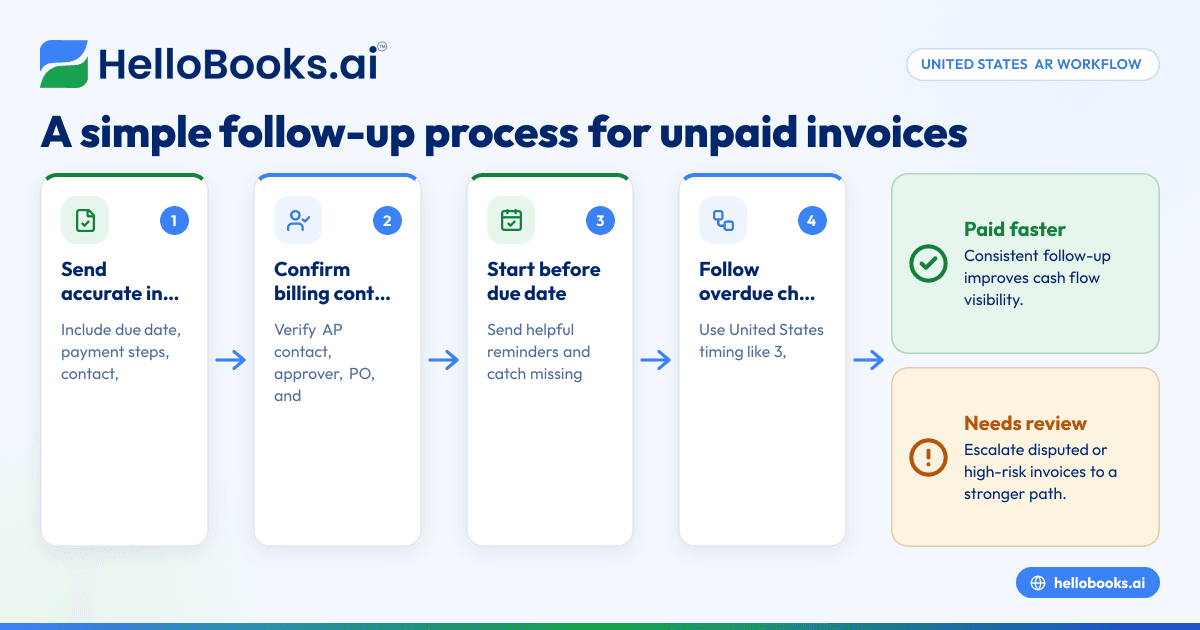
1. Send accurate invoices fast
You cannot collect on invoices that are late, incomplete, or confusing. Send invoices as soon as the work is completed or the product ships. Include the due date, payment instructions, contact for billing questions, and any required supporting documents.
If you bill customers on recurring schedules, standardize the format. Consistent invoices are easier for customers to approve and easier for your team to track. Using reliable invoice software helps reduce missed fields and manual errors.
2. Confirm the right billing contact
This step is often skipped. It causes many avoidable delays.
For each customer, keep at least:
- Billing contact name
- Billing email
- AP phone number
- Approver or department owner
- Required PO number or vendor code
- Preferred invoice submission method
If the invoice went to a buyer instead of accounts payable, follow-up may fail even if the customer wants to pay. Confirm the right path early.
3. Start before the due date
Pre-due reminders improve collection rates because they catch process issues before an invoice ages.
A simple schedule:
- 5 days before due date: Friendly reminder with invoice copy
- 1 day before due date: Brief note confirming the invoice is coming due
At this stage, the tone should stay helpful. Ask if anything is needed to process payment. This is often where you discover missing paperwork.
4. Use a standard overdue sequence
Once an invoice is overdue, consistency matters more than creativity.
A practical small business sequence looks like this:
- 3 days past due Send a polite reminder. Attach the invoice and ask for expected payment date.
- 7 days past due Send a firmer reminder. Mention the number of days overdue and ask for confirmation.
- 14 days past due Call the billing contact. If no response, email both AP and your customer contact.
- 21 days past due Escalate internally. Involve sales or the account owner if the relationship matters.
- 30+ days past due Move the invoice to a formal collections review. Consider service holds only if your contract allows it.
The sequence should be written down and followed every week.
5. Record every promise and dispute
Collections break down when promises live in email threads. If a customer says, "We will pay next Friday," that promise date should sit next to the invoice record. If they dispute a line item, log the exact reason and owner.
Useful dispute categories include:
- Missing PO
- Price mismatch
- Quantity or delivery issue
- Tax question
- Duplicate invoice concern
- Waiting for manager approval
- Payment run timing
These details help you separate "won't pay" from "can't pay yet."
6. Review aging and next actions weekly
At least once a week, review your accounts receivable aging report. Group invoices by current, 1-30 days overdue, 31-60, 61-90, and over 90 days. Then assign next actions.
A weekly review should answer:
- Which invoices need a call today?
- Which customers have broken payment promises?
- Which disputes are blocking cash?
- Which large balances need manager involvement?
- Which accounts are repeatedly paying late?
This gives your team a practical collections agenda instead of a vague reminder list.
When should you follow up on unpaid invoices?
Start before the due date, then continue at fixed intervals after the invoice becomes overdue. For most small businesses, reminders at 5 days before due date and 3, 7, 14, and 21 days after due date are a solid starting point.
That timing works because it balances persistence with professionalism. It gives customers enough space to process routine payments, but it does not let invoices age silently.
Suggested timing by invoice size and risk
You can adjust the timeline based on value and customer behavior.
Low-risk, small invoices
Use standard reminders and mostly email. A short call at 14 or 21 days is usually enough.
Medium invoices
Add a call earlier, around 7 to 14 days overdue. Confirm the payment batch date and approver.
Large or high-risk invoices
Use tighter monitoring. Follow up before the due date, on the due date, and by phone within a week if unpaid. High-value balances deserve more active management.
Watch payment patterns, not just due dates
A customer who always pays 10 days late may not need the same tone as a customer who suddenly stops responding. Keep notes on:
- Usual payment cycle
- Average days late
- Common dispute reasons
- Preferred contact method
- Whether sales involvement helps
This is where ai accounts receivable tools can help. They can surface patterns across invoice histories, identify customers likely to pay late, and suggest where your team should focus first.
How do you write a good accounts receivable follow up email?
Keep it short, specific, and easy to act on. Include invoice number, amount due, due date, payment method, and a clear request for either payment or an expected payment date.
That short format works because busy AP teams scan quickly. They should not have to search for the invoice number or figure out what you want from them.
Simple email structure
Use this structure for almost every reminder:
- Clear subject line
- Invoice number and amount in the first sentence
- Due date or days overdue
- Invoice attached
- Direct request for payment date
- Contact point for disputes
Example: pre-due reminder
Subject: Reminder: Invoice 1048 due on 05/15/2026
Hi Maria,
Just a reminder that invoice 1048 for $2,450 is due on 05/15/2026. I have attached the invoice here for convenience. Please let me know if you need any documents to process payment.
Thank you,
Evan
Example: 7 days overdue
Subject: Past due: Invoice 1048 for $2,450
Hi Maria,
Invoice 1048 for $2,450 was due on 05/15/2026 and is now 7 days past due. I have attached the invoice again. Please confirm the expected payment date, or let me know if there is any issue holding payment.
Thank you,
Evan
Example: after no response
Subject: Follow-up needed: Invoice 1048 past due
Hi Maria,
I am following up on invoice 1048 for $2,450, now 14 days past due. Please confirm the payment date today. If this should be directed to another billing contact, kindly share the right person and I will resend it immediately.
Thank you,
Evan
Should you call customers about overdue invoices?
Yes, especially when the invoice is large, the customer is unresponsive, or the payment promise was missed. Phone calls help resolve simple blockers faster than long email threads.
Calls work well because they reveal what is actually happening. You can quickly learn whether the invoice is in approval, stuck with AP, under dispute, or simply overlooked.
When to use phone instead of email
A call is usually better when:
- The invoice is more than 14 days overdue
- The amount is material to your cash flow
- The customer opened emails but did not reply
- The customer promised payment and missed the date
- The issue sounds operational, not financial
What to say on the call
Keep the script simple:
- Confirm the invoice number and amount
- Ask whether the invoice is approved for payment
- Ask for the exact payment date
- Ask what is blocking payment, if unpaid
- Repeat back the next step
Example:
"Hi Maria, I am calling about invoice 1048 for $2,450. It was due on 05/15/2026. Can you confirm whether it is approved for payment, and if so, what date we should expect payment?"
Write down the answer immediately.
How should you handle disputes during follow-up?
A dispute should pause generic collections messages and move into a resolution path with an owner and due date. Keep following up, but focus on fixing the issue, not repeating the same payment request.
This is where many teams lose time. They keep sending reminders on an invoice that cannot be paid until someone corrects a PO number, updates pricing, or reissues the invoice.
A simple dispute workflow
- Log the dispute reason
- Assign an internal owner
- Set a target resolution date
- Update the customer with progress
- Reissue the invoice if needed
- Restart follow-up from the revised due date
This post is general information, not tax or legal advice. If a dispute involves tax treatment, contract terms, or state sales tax questions in the United States, confirm the correct handling with your accountant or attorney.
Track root causes
Over time, dispute data helps improve billing quality. If many disputes come from missing PO numbers or pricing mismatches, fix that upstream. Collections gets easier when invoices are right the first time.
What metrics should you track for accounts receivable follow up?
Track aging, collection activity, dispute volume, promise-to-pay performance, and cash collected. These metrics show whether your process is working and where invoices are getting stuck.
Do not overcomplicate the scorecard. A few practical numbers reviewed weekly can improve results quickly.
Five useful AR metrics
1. Aging by bucket
See how much is current, 1-30 days overdue, 31-60, 61-90, and over 90.
2. Promise-to-pay kept rate
Track how often customers pay on the date they promised.
3. Average days overdue
This shows how far invoices slip beyond terms.
4. Dispute rate
Measure how many invoices are delayed by billing issues.
5. Collector activity
Track reminders sent, calls made, and accounts touched each week.
A modern accounting software in the USA setup can make these reports easier to review than spreadsheets alone.
Where can automation help without making collections feel robotic?
Automation helps with reminders, task queues, aging visibility, and payment promise tracking. It should handle routine steps so your team can spend time on exceptions, large balances, and sensitive customer conversations.
That balance matters. Customers do not want endless generic reminders. Your team does not want to manually send the same email 40 times a week.
Best use cases for automation
Automation works well for:
- Sending pre-due reminders
- Triggering overdue emails by aging bucket
- Flagging broken payment promises
- Prioritizing high-value invoices
- Creating call lists for collectors
- Storing notes and contact history
Where people should stay involved
Keep human review for:
- Large strategic accounts
- Complex disputes
- Payment plans
- Service hold decisions
- Relationship-sensitive escalations
For small businesses that have outgrown spreadsheets, AI accounting software can help create a more reliable workflow. If you are comparing systems, look at whether they support invoicing, reporting, and clean follow-up tracking in one place. Some teams also move when they need a QuickBooks alternative with simpler automation and less manual work.
Common mistakes in accounts receivable follow up
Even a basic process works well if you avoid a few common errors.
Sending invoices late
Late invoicing shifts every collection step backward. Bill quickly.
Chasing without checking for issues
If the invoice has a mistake, reminders alone will not help.