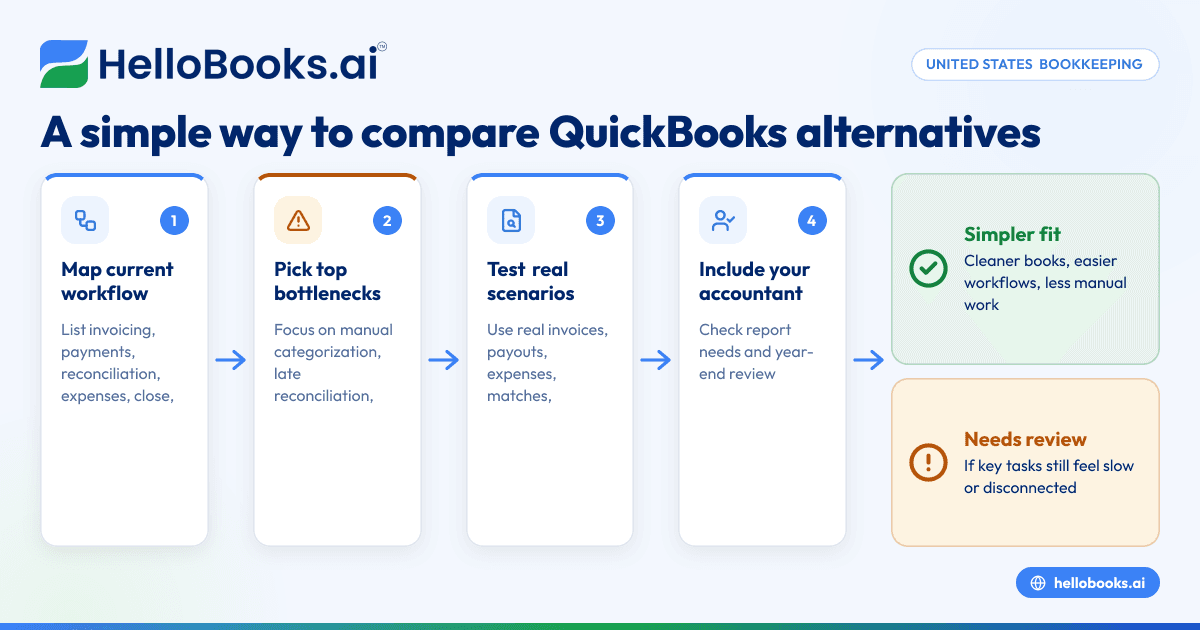

Key takeaways
What this article covers, in order:
- Key takeaways
- What is an accounts receivable aging report?
- Why the accounts receivable aging report matters in the United States
- How an accounts receivable aging report is structured
- How to read an accounts receivable aging report properly
- Common reasons invoices age badly
An accounts receivable aging report shows which customer invoices are current, which are overdue, and how long they have been unpaid. In the United States, it is one of the simplest ways to spot cash flow risk, tighten collections, and reduce bad debt before it hits your books.
Key takeaways
- An accounts receivable aging report groups unpaid invoices by age, such as current, 1–30 days, 31–60 days, 61–90 days, and over 90 days.
- It helps US businesses see collection risk early and focus follow-up on the invoices most likely to turn into write-offs.
- The report is useful for credit control, cash flow planning, allowance for doubtful accounts, and customer payment reviews.
- You should review both the total balance and the customer-level detail, not just the summary buckets.
- Faster collections usually come from better invoicing, clear payment terms, steady follow-up, and regular reconciliation.
- Software can reduce manual work by syncing invoices, payments, and bank activity into a single workflow.
What is an accounts receivable aging report?
An accounts receivable aging report lists all unpaid customer invoices and sorts them by how long they have been outstanding. Most reports use time buckets like current, 1–30 days past due, 31–60 days past due, 61–90 days past due, and over 90 days past due.
The report gives you a quick answer to a practical question: how much money customers owe you, and how late those payments are. If you run a small business in Chicago, Houston, or Detroit, this report can tell you whether your receivables are healthy or whether your cash is getting stuck with a few slow-paying accounts.
This matters because revenue is not the same as cash. You may have sent invoices and booked sales, but if customers have not paid, you still need cash for payroll, rent, inventory, and taxes. The aging report turns that problem into something visible and manageable.
Why the accounts receivable aging report matters in the United States
US businesses often deal with mixed payment terms, different customer types, and several payment channels. You may invoice on net 15, net 30, or net 45 terms. You may collect by ACH, card, check, or wire. You may also have customers that require purchase orders, approvals, or vendor portal submissions before they pay.
That is why the aging report is more than a bookkeeping report. It is a collections tool and a cash forecasting tool.
Here is what it helps you do:
1. Protect cash flow
If too much of your receivables sits in the 61–90 or 90+ day bucket, your business may start feeling cash pressure. You may still look profitable on paper, but your bank balance may tell a different story.
2. Prioritize collections work
Aging helps your team focus on the highest-risk invoices first. A $20,000 invoice that is 75 days overdue needs different attention than a $500 invoice that became due yesterday.
3. Review customer payment behavior
Some customers always pay in 10 days. Others always pay in 45, even if your terms are net 30. The aging report shows patterns that can help you reset terms, ask for deposits, or pause future work.
4. Support month-end close
Your finance team may use the report when reviewing receivables, reconciling payments, and estimating doubtful accounts. This is general information, not tax or legal advice.
5. Help owners make better decisions
If one or two customers make up a large share of overdue balances, that is a customer concentration risk. The report gives owners a reason to act before the issue becomes a write-off.
How an accounts receivable aging report is structured
Most aging reports have a similar format. They show the customer name, invoice number, invoice date, due date, original amount, open balance, and aging bucket.
A typical layout looks like this:
- Current: Not yet due
- 1–30 days past due
- 31–60 days past due
- 61–90 days past due
- Over 90 days past due
Some businesses add more buckets, such as over 120 days. Others track by invoice date instead of due date, but due-date aging is usually more useful for collections.
Example
A marketing agency in Houston has these unpaid invoices on 03/31/2026:
- Customer A: $4,000 due 03/25/2026
- Customer B: $9,500 due 02/20/2026
- Customer C: $1,200 due 04/10/2026
- Customer D: $6,800 due 12/30/2025
The aging report would likely classify them like this:
- Current: Customer C, $1,200
- 1–30 days past due: Customer A, $4,000
- 31–60 days past due: Customer B, $9,500
- 90+ days past due: Customer D, $6,800
That simple view tells you where to focus. Customer D is now a high-risk balance. Customer B needs active follow-up. Customer A may just need a reminder.
How to read an accounts receivable aging report properly
Many business owners look at the grand total first. That is useful, but it is not enough. A healthy aging report depends on the mix inside the total.
Look at the percentage in each aging bucket
If most of your open balance sits in current and 1–30 days, your receivables are usually in decent shape. If a large share sits beyond 60 days, your collection process may need work.
For example, a business with $100,000 in receivables is in a different position if:
- $80,000 is current and $20,000 is overdue, versus
- $30,000 is current and $70,000 is overdue
The total is the same, but the risk is not.
Look at customer concentration
Check whether one customer makes up a large portion of the overdue balance. If one account holds $40,000 of your $60,000 past-due receivables, that customer deserves immediate attention.
Look at dispute patterns
Aging can reveal more than late payment. It can show billing mistakes, missing PO numbers, short payments, duplicate invoices, or customer disputes. If the same customer appears in old buckets every month, the issue may be process-related, not just credit-related.
Look at invoice size and age together
A small old invoice may be annoying. A large old invoice can affect payroll, inventory orders, or debt payments. Review high-value invoices first.
Compare aging month over month
One aging report is a snapshot. Two or three months of reports show trend. If your 90+ day bucket keeps growing, you have a system problem, not a one-time delay.
Common reasons invoices age badly
Most overdue receivables do not happen by accident. There is usually a process issue behind them.
Invoices go out late
If you wait until the end of the month to invoice work completed earlier, you delay your own cash collection. The payment clock starts only after the invoice is issued.
Payment terms are unclear
Customers may not know whether payment is due on receipt, net 15, or net 30. The invoice should state the due date clearly, not just the issue date.
Billing details are incomplete
Missing purchase order numbers, the wrong billing contact, or incomplete service details can slow approval. This is common with larger customers and procurement-heavy businesses.
Follow-up is inconsistent
Many businesses send an invoice once and hope for the best. Collections improve when reminders are scheduled before and after the due date.
Payments are not matched quickly
If a customer pays but the payment is not applied to the correct invoice, the aging report may show false overdue balances. That creates confusion and wastes time for both sides.
Customers have weak payment habits
Some customers simply pay slowly. If that happens often, you may need deposits, shorter terms, milestone billing, or stricter credit controls.
How to use the report to collect faster
The best aging report is the one that leads to action. Use it every week, not just at month-end.
1. Segment your overdue invoices
Break receivables into clear groups:
- Invoices not yet due
- 1–15 days overdue
- 16–30 days overdue
- 31–60 days overdue
- Over 60 days overdue
- Disputed invoices
- High-value invoices
Each group needs a different response. Early-stage reminders should be polite. Old balances need urgency and escalation.
2. Build a simple follow-up schedule
A practical collection cadence can look like this:
- Send the invoice immediately after delivery or milestone completion.
- Send a reminder 3–5 days before the due date.
- Follow up on the due date with invoice details and payment options.
- Follow up again at 7 days overdue.
- Escalate at 15–30 days overdue to a manager or account owner.
- Review credit hold or revised terms for repeat late payers.
Keep messages short and clear. Include invoice number, amount due, due date, and payment method.
3. Assign one owner for each overdue account
Collections slip when nobody owns them. For each overdue balance, assign a person responsible for outreach, notes, and next steps.
4. Contact the right person
Do not rely only on your sales contact. Confirm the billing contact, accounts payable contact, and any approval contact. In larger US companies, invoices often get delayed because they are sitting with the wrong person.
5. Resolve disputes fast
If a customer says the amount is wrong, the service was incomplete, or a document is missing, treat that separately from standard collections. Disputed invoices need resolution, not just reminders.
6. Review terms for repeat offenders
If a customer always pays late, change the process. Options include deposits, progress invoicing, auto-pay, or shorter billing cycles.
Best practices for keeping your aging report clean
Aging reports become useful only when your data is accurate. Here are the habits that matter most.
Invoice promptly and consistently
Send invoices as soon as work is complete or goods are delivered. Delayed invoicing leads to delayed cash.
Use clear due dates
Write the exact due date on the invoice. That is easier to act on than general terms alone.
Reconcile payments regularly
Match incoming payments to open invoices every day or every week. This keeps aging accurate and avoids chasing customers who have already paid. If your team is still doing this manually, bank reconciliation software can reduce the cleanup work.
Standardize customer records
Make sure customer names, contacts, tax details, addresses, and payment terms are consistent. Duplicate or messy records can distort reporting.
Separate current from disputed balances
A disputed invoice should not be treated the same way as a customer who is simply late. Tagging those balances helps your team work the right issue.
Review aging weekly
Weekly review is often enough for most small businesses. If cash is tight or invoice volume is high, review it more often.
Metrics to track alongside the aging report
The aging report is strong on its own, but it gets better when paired with a few simple metrics.
Days sales outstanding
DSO estimates how long it takes to collect receivables. It is a useful trend metric, though it is less detailed than aging.
Collection effectiveness
You can compare how much was collectible during a period versus how much you actually collected. This helps you judge the quality of your collection process.
Bad debt and write-offs
If old buckets keep turning into write-offs, your credit policy may be too loose, or your billing process may be weak.
Average days late by customer
This helps you identify which customers should get different terms or closer monitoring.
Spreadsheets vs software for accounts receivable aging
Many small businesses start with spreadsheets. That works for a while. Then invoice volume grows, customer records get messy, and follow-up becomes inconsistent.
Spreadsheets have a few common problems:
- Manual aging formulas break
- Due dates get overwritten
- Payments are not matched in real time
- Multiple versions create confusion
- Collections notes are scattered across email and calls
Accounting systems can generate aging reports automatically and update them as invoices and payments change. If you are evaluating tools, accounting software in the USA should make invoicing, collections, and reporting easier from one place. If invoicing itself is slow, dedicated invoice software can also help standardize due dates, reminders, and customer records.
For businesses that want less manual posting and cleanup, AI bookkeeping can reduce data entry and improve the accuracy of receivables reporting.
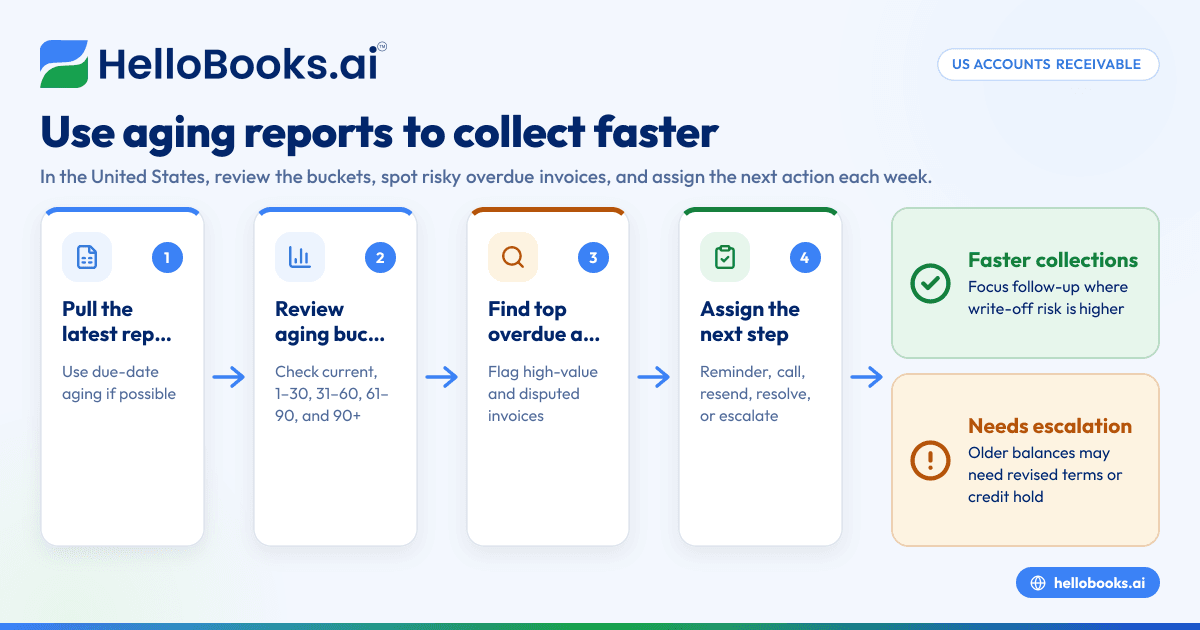
A simple weekly AR aging review process
If you want a practical routine, use this 20-minute review every week.
Step 1: Pull the latest report
Run the aging report as of the current date. Use due-date aging if possible.
Step 2: Review totals by bucket
Note how much is current, 1–30, 31–60, 61–90, and 90+ days overdue.
Step 3: Identify top overdue accounts
List the top 10 overdue balances by amount. Then mark any disputed invoices separately.
Step 4: Assign actions
For each overdue invoice, set one next step:
- Reminder email
- Phone call
- Resend invoice
- Resolve dispute
- Escalate internally
- Adjust terms for future work
Step 5: Check unapplied payments and credits
Make sure recent customer payments, credit notes, and adjustments are reflected correctly.
Step 6: Update your cash forecast
Use likely collection dates to adjust near-term cash expectations. This makes your forecast more realistic.
When to escalate an overdue receivable
Not every late invoice needs heavy action. But some do.
Consider escalation when:
- The invoice is over 60 or 90 days overdue
- The customer has stopped responding
- A large balance is affecting cash flow
- The customer has a history of repeated late payment
- There is an unresolved dispute with no progress
- New work is continuing while old balances remain unpaid
Escalation may mean involving a senior manager, pausing future work, requiring upfront payment, or revising credit terms. The right approach depends on the customer relationship and the value at risk.
Final thoughts
An accounts receivable aging report is one of the clearest ways to understand your cash position. It shows which customers owe you money, how late those invoices are, and where your collection effort should go first. If you review it weekly and act on it consistently, you can often collect faster without changing your prices or adding new sales.
If you want to spend less time chasing spreadsheets and more time on clean invoicing, receivables, and reporting, you can book a demo or compare plans on pricing.
Frequently asked questions
What is included in an accounts receivable aging report?
It usually includes customer names, invoice numbers, invoice dates, due dates, unpaid balances, and aging buckets. Some reports also show sales reps, payment terms, and collection notes.
How often should I review my accounts receivable aging report?
Most small businesses should review it weekly. If your cash flow is tight or invoice volume is high, review it more often.
What is a good accounts receivable aging mix?
There is no single perfect mix for every business. In general, lower balances in the 61–90 and 90+ day buckets are better, and most receivables should stay current or only slightly overdue.