


Key takeaways
What this article covers, in order:
- Why this comes up / what goes wrong
- Step-by-step
- Example (fictional figures)
- Common mistakes
- Doing this in HelloBooks
- Frequently asked questions
An account payable framework is a structured process that manages a company’s obligations to pay suppliers for goods and services received. It ensures timely payment, accurate record-keeping, and proper reconciliation of invoices, helping maintain good supplier relationships and financial control. This article explains why an account payable framework is important for small businesses, provides step-by-step instructions, a worked example, common mistakes to avoid, and how HelloBooks supports this process.
Why this comes up / what goes wrong
Small business owners in India often struggle with managing their accounts payable due to manual bookkeeping methods like spreadsheets, Tally, or bill books. This can lead to delays in payments, missed discounts, duplicate payments, or incorrect entries that affect GST compliance and financial reporting. Without a clear framework, reconciling supplier invoices with purchase orders and payments becomes time-consuming and error-prone, impacting cash flow and supplier trust.
Many small businesses also find it hard to track invoice due dates and GST details correctly, which can result in penalties or ITC mismatches. This confusion often arises because invoices are not verified thoroughly or payments are processed without proper reconciliation. Establishing a clear account payable framework helps avoid these issues by standardising the process and ensuring all steps are followed consistently.
Step-by-step
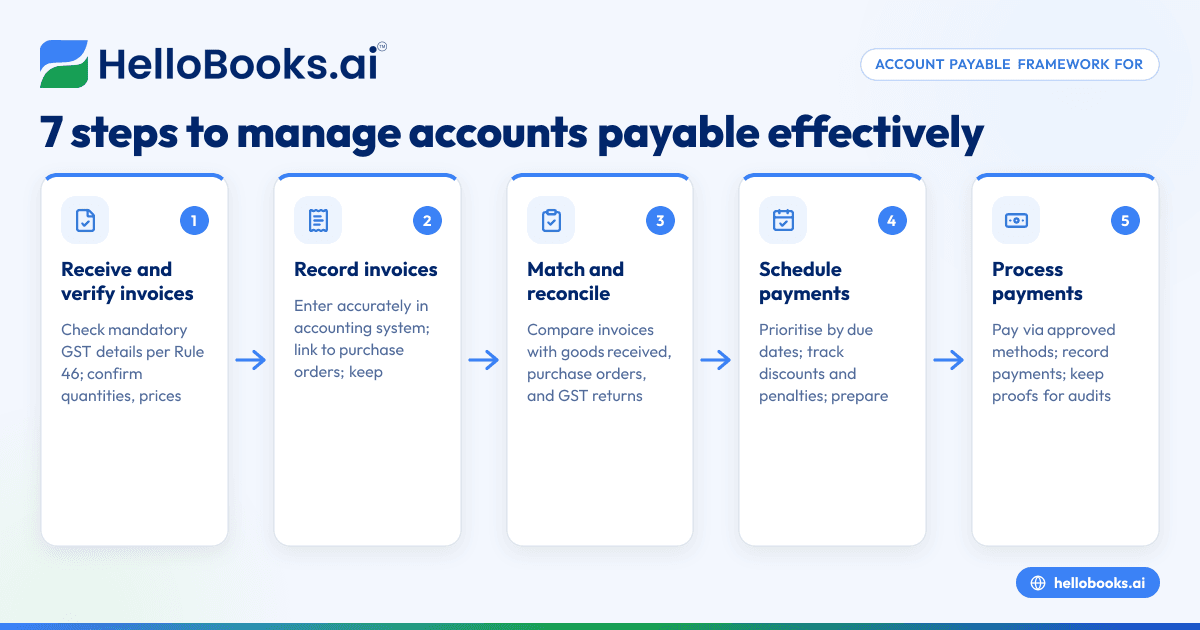
- Receive and Verify Supplier Invoices
- Collect all tax invoices from suppliers.
- Check that each invoice contains mandatory details as per Rule 46, including supplier's name, GSTIN, invoice number, date, recipient details, HSN/SAC codes, taxable value, tax rates, and signature [source: cgst-rule-46/rule46-particulars].
- Verify quantities, prices, and discounts against purchase orders or contracts.
- Confirm that the invoice date and number are unique and sequential to avoid duplicates.
- Record Invoices in the Accounting System
- Enter invoice details accurately into your accounting records or software.
- Assign unique invoice numbers and link to purchase orders if available.
- Maintain a digital or physical file of all invoices for easy retrieval.
- Match and Reconcile
- Match invoices against goods received notes and purchase orders to confirm accuracy.
- Reconcile invoices with GST returns (GSTR-2B) and payment records regularly to ensure input tax credit eligibility.
- Check for any discrepancies in tax rates or amounts.
- Schedule Payments
- Prioritise payments based on due dates and available cash flow.
- Take note of early payment discounts or penalties for late payments.
- Prepare a payment calendar or ageing report to monitor outstanding liabilities.
- Process Payments
- Make payments via bank transfer, cheque, or other approved methods.
- Record payment details against the respective invoices.
- Obtain payment confirmations and keep proofs for audit purposes.
- Maintain Records and Reports
- Keep copies of paid invoices and payment proofs.
- Generate accounts payable ageing reports to monitor outstanding liabilities.
- Review monthly profit and loss statements to assess expenses.
- Review and Audit
- Periodically review accounts payable for discrepancies or fraud.
- Ensure GST compliance by cross-verifying invoices with returns.
- Conduct internal audits to improve the process and prevent errors.
For detailed invoicing and GST compliance, see GST invoicing and e-invoicing (IRN and QR).
Example (fictional figures)
Consider a small business that received an invoice on 10/04/2024 for office supplies:
- Invoice amount (before tax): ₹48,000
- CGST rate: 9%
- SGST rate: 9%
Calculate GST amounts:
₹48,000 × 9% = ₹4,320 (CGST)
₹48,000 × 9% = ₹4,320 (SGST)
Total GST = ₹4,320 + ₹4,320 = ₹8,640
Total invoice value = ₹48,000 + ₹8,640 = ₹56,640
Steps:
- Verify invoice details including GSTIN, HSN code, and signatures.
- Record invoice of ₹56,640 in the accounts payable ledger.
- Schedule payment before due date to avoid late fees.
- After payment, mark invoice as cleared and keep payment proof.
Common mistakes
- Ignoring invoice verification
- Prevent by checking all mandatory details as per Rule 46 before recording.
- Delayed payments leading to supplier dissatisfaction
- Prevent by maintaining a payment schedule and accounts payable ageing report.
- Duplicate payments
- Prevent by reconciling invoices with purchase orders and previous payments.
- Incorrect GST treatment on invoices
- Prevent by cross-verifying GST rates and tax amounts with official invoices.
- Poor record keeping
- Prevent by digitising invoices and payment proofs and regularly updating records.
- Not reconciling with GST returns
- Prevent by regularly matching invoices with GSTR-2B and GSTR-3B filings to avoid ITC mismatches.
See more on invoicing and GST compliance at GST invoicing and e-invoicing (IRN and QR).
Doing this in HelloBooks
HelloBooks provides financial reports including accounts payable ageing and monthly profit & loss statements that come from the same entries used for GST, ensuring your books and GST returns agree. This reduces errors and saves time in reconciliation. Explore more on HelloBooks for India and advanced reporting at hellobooks.ai/advance-reporting.
Frequently asked questions
What is account payable?
Account payable refers to the money a business owes to its suppliers for goods or services received but not yet paid. It is recorded as a liability in the books and managed through an account payable framework.
What is the account payable process?
The account payable process involves receiving invoices, verifying details, recording them in the accounting system, scheduling and making payments, and reconciling with purchase orders and GST returns to ensure accuracy.
How do I ensure GST compliance in accounts payable?
Ensure every supplier invoice contains mandatory GST invoice particulars as per Rule 46, record GST amounts correctly, and reconcile invoices with GSTR-2B and GSTR-3B filings regularly.
Can I manage accounts payable without software?
Yes, but it requires careful manual record-keeping with spreadsheets or books, timely verification, and regular reconciliation to avoid errors and delays.
How does accounts payable affect cash flow?
Managing accounts payable effectively helps you plan payments to maintain healthy cash flow, avoid late fees, and take advantage of early payment discounts.
What reports help manage accounts payable?
Accounts payable ageing reports show outstanding liabilities by due date, helping prioritise payments. Monthly profit and loss statements provide insights into expenses. HelloBooks links these reports with GST entries for accuracy.
Key takeaways
- An account payable framework ensures timely and accurate payment of supplier invoices.
- Verify invoice details strictly as per GST Rule 46 before recording.
- Use an organised process for invoice recording, reconciliation, and payment scheduling.
- Avoid common mistakes like delayed payments, duplicate entries, and poor record keeping.
- Regularly reconcile invoices with GST returns to maintain compliance.
- HelloBooks helps by linking GST entries to financial reports for better accuracy.
To see how this works in practice, Book a 30-minute demo with HelloBooks.


