


Key takeaways
What this article covers, in order:
- Key takeaways
- Why is careful client acceptance important for manufacturers in Maharashtra?
- What does "ai accepting clients" mean for manufacturing businesses?
- How to assess new clients before accepting orders as a manufacturer in Maharashtra?
- How can Maharashtra manufacturers comply with GST and e-invoicing while accepting clients?
- What role do contracts play when accepting clients as a small manufacturing business?
Accepting clients as a manufacturer in Maharashtra involves more than just saying yes to any order. It requires evaluating the potential client’s financial stability, their fit with your production capacity, and compliance with GST and other regulations. Adopting best practices helps protect cash flow, reduce risks, and build strong business relationships.
Key takeaways
- Assess client financial health and background before accepting orders.
- Understand GST compliance requirements for buyers and connect with e-invoicing.
- Use clear, comprehensive contracts to outline payment terms, delivery schedules, and quality expectations.
- Automate bookkeeping and invoicing with AI accounting software to streamline client management.
- Establish a standard client onboarding process for consistency and risk reduction.
- Monitor client payments regularly and reconcile accounts for better cash flow visibility.
Why is careful client acceptance important for manufacturers in Maharashtra?
Manufacturers in Maharashtra, especially in industrial hubs like Pune, Mumbai, and Nashik, handle orders that often involve large quantities of raw materials and extended production timelines. Accepting clients without thorough evaluation may lead to payment delays, disputes over quality or delivery, and compliance failures, particularly concerning GST laws.
For example, if a manufacturer in Pune accepts a large order without verifying the client’s GST registration, the input tax credit mechanism might break down, leading to refund delays or tax demand notices. Similarly, accepting orders that exceed your plant’s capacity without planning raw material purchases can cause missed deadlines and penalties.
A structured approach to client acceptance protects your cash flow, reduces bad debts, and keeps regulatory filings accurate. In a competitive Maharashtra manufacturing market, relationships with reliable clients are essential for sustainable growth.
What does "ai accepting clients" mean for manufacturing businesses?
"AI accepting clients" refers to using artificial intelligence tools to streamline and enhance the process of evaluating and onboarding new clients. For manufacturers, this means AI can automate checks like GST verification, financial risk assessment, contract generation, and payment tracking.
Implementing AI in client acceptance saves time and reduces errors, helping Maharashtra manufacturers focus on production while ensuring new orders are reliable and compliant.
How to assess new clients before accepting orders as a manufacturer in Maharashtra?
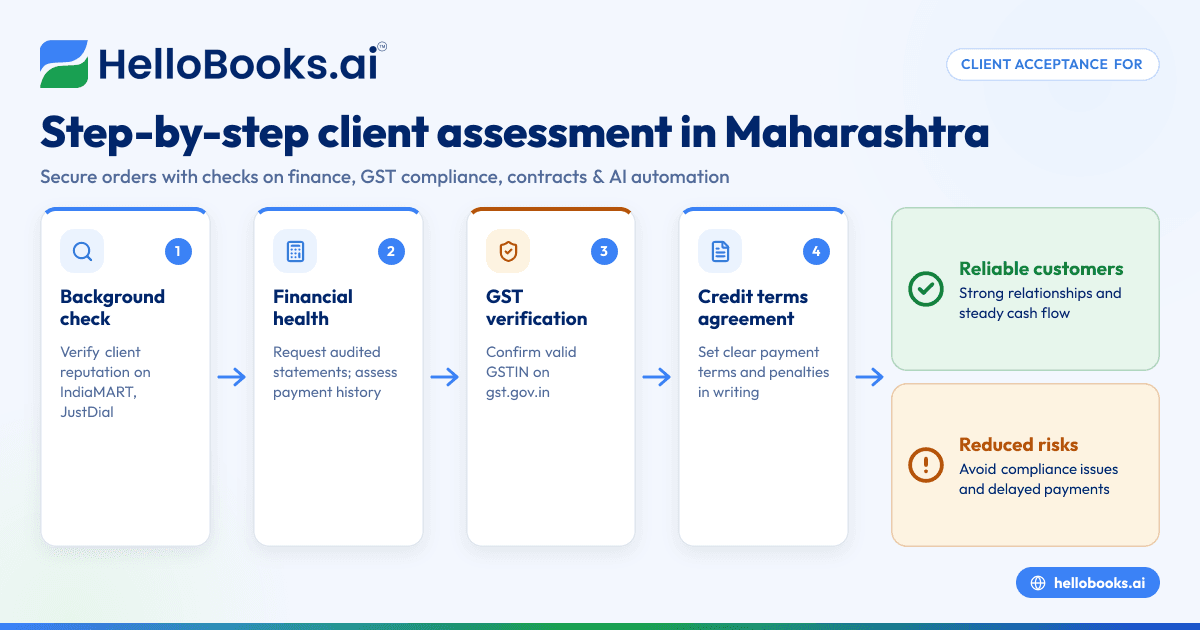
Here is a detailed step-by-step process to assess clients thoroughly:
1. Background Check
Start with a search on IndiaMART, JustDial, or industry directories to confirm the client’s market presence and reputation. Look for customer reviews, trade history, and years in business.
Example: Suppose you receive an inquiry from a firm in Nashik for automotive parts. Checking their IndiaMART profile can reveal if they have credible testimonials or any reported issues. If the firm is new or has poor reviews, proceed cautiously.
2. Financial Health
Request audited financial statements or bank references for clients with large orders. Look for steady revenue growth, profitability, and clean payment history with other suppliers.
Worked example: A factory in Pune is considering a large order from a new dealer. You ask for their last two years’ balance sheets. If the client shows consistent profits and positive cash flow, it reduces risk. If their records show declining revenue or overdue liabilities, consider asking for an advance or a smaller initial order.
3. GST Verification
Use the official GST portal’s GSTIN search to verify client details. Confirm that the GSTIN is valid, matches their business name, and their registration status is “Active”.
Pitfall to avoid: A client’s GSTIN might be fake or canceled. In that case, issuing invoices under GST leads to compliance issues and input tax claim denials.
4. Credit Terms Agreement
Discuss payment terms including advance amounts, credit duration (e.g., 30 days), and penalties for late payment.
Tip: Always put these terms in writing, whether via email or contract. For example, “50% advance within 5 days of order confirmation, remaining 50% within 30 days of delivery, with 2% monthly penalty for delays.”
5. Order Feasibility
Assess whether your production capacity and material supply chain can handle the order volume and delivery dates.
Example: If your factory in Mumbai has a lead time of 20 days for a specific raw material, but the client demands delivery within 10 days, you must negotiate timelines or reject the order.
6. Legal and Compliance Verification
Certain manufacturing categories require product licenses or statutory approvals (e.g., BIS certification). Confirm these documents for both your products and client usage restrictions if applicable.
How can Maharashtra manufacturers comply with GST and e-invoicing while accepting clients?
From October 1, 2023, e-invoicing under GST became mandatory for businesses with a turnover exceeding ₹10 crore. This impacts client acceptance because:
- You need to generate GST-compliant invoices via the Invoice Registration Portal (IRP).
- Your software should integrate with IRP to auto-generate Invoice Reference Numbers (IRNs).
- e-Invoices must accurately reflect HSN codes, GST rates, place of supply, and client GST details.
Practical steps for GST compliance:
- Verify Client GSTIN: Confirm active status on gst.gov.in before issuing an invoice.
- Use E-invoicing Software: Choose AI-enabled e-invoicing software that captures client GSTIN and generates e-invoices automatically.
- Verify Tax Rates and Place of Supply: Ensure correct GST rates (e.g., 18% for auto parts) and state codes to avoid mismatch.
- Maintain Records: Store e-invoices securely as evidence for GST audit and filing.
Common pitfall: Mistakes in GSTIN or place of supply can lead to ITC denial for your client and affect your tax filings.
What role do contracts play when accepting clients as a small manufacturing business?
Contracts protect your factory and clarify business terms. They should include:
- Detailed product descriptions and quality standards.
- Delivery timetables and penalties for delays.
- Payment terms with due dates and late payment fees.
- Warranty clauses covering defects or replacements.
- Dispute resolution clauses specifying jurisdiction (e.g., courts in Mumbai).
Using contract templates for Maharashtra manufacturers saves time and ensures compliance with the Indian Contract Act. Customize them per client and order size.
Example: For a client from Pune ordering fabricated metal parts, your contract might specify ISO standards followed, 7-day delivery after advance payment, 10% penalty for delays beyond 5 days, and a 90-day warranty on parts.
How does AI help you in accepting clients and managing client data?
AI-powered accounting software in India like HelloBooks can transform client acceptance by automating many tedious checks:
- Instant GSTIN validation with live government data.
- Auto-generation of contracts and invoices with client details.
- Credit risk checks based on financial databases and payment history.
- Automated payment reminders and follow-ups.
- Bank reconciliation software linking incoming receipts to outstanding invoices.
This automation reduces human error and prevents missed deadlines or invoice mismatches, critical for manufacturers juggling multiple clients in Maharashtra’s busy markets.
What is the step-by-step process to streamline client acceptance for manufacturers in Maharashtra?
Follow this practical process to create a consistent client onboarding system:
1. Initial Inquiry Handling
Record all inquiries in a CRM or spreadsheet with client name, contact info, and order details.
2. Client Background and GST Verification
Check GST status on gst.gov.in and search client reputation on IndiaMART or JustDial.
3. Financial Evaluation and Credit Terms Proposal
Request financial references and discuss payment terms, including advance percentage and credit period.
4. Prepare and Send Quotation/Contract
Send a professional document detailing product specs, price breakdown, GST rates, delivery timelines, and payment conditions.
5. Client Confirmation and Advance Payment
Obtain written confirmation (email or signed contract) and receive an advance payment before starting production.
6. Order Planning and Production Scheduling
Confirm raw material procurement timelines and schedule production accordingly.
7. Issue GST-Compliant Invoice via AI Software
Generate and submit e-invoice through integrated software like HelloBooks to IRP.
8. Delivery and Payment Monitoring
Track dispatch and use bank reconciliation software to match payments promptly with invoices.
9. Post-Sale Support and Feedback
Establish open communication channels for warranty claims or future repeat orders.
How does AI improve payment tracking after accepting clients?
Cash flow depends on timely payments. AI tools improve payment tracking by:
- Regularly scanning bank statements and linking payments to invoices.
- Identifying delayed payments automatically and sending reminders.
- Providing reports on outstanding receivables and ageing analysis to plan working capital.
For example, a manufacturer in Nashik can automate reminders to clients who miss the ₹5 lakh monthly invoice deadline, reducing overdue payments and financing costs.
If you're ready to simplify client acceptance and boost your manufacturing business efficiency in Maharashtra, consider booking a personalized demo of HelloBooks at /book-a-demo or compare plans suitable for your needs at /pricing.
Frequently asked questions
What documents should I collect before accepting a manufacturing client in Maharashtra?
Collect valid GSTIN certificates, business registration proof, financial statements or credit references, and signed contracts confirming terms. This protects you against non-payment and helps during GST audits.
How does e-invoicing affect client acceptance and invoicing?
E-invoicing requires you to submit invoice details digitally to GST’s IRP before issuance. This validates invoices instantly, allows clients to claim input tax credits faster, and reduces errors, which helps maintain good client relations.
Can AI accounting software help with GST return filing after accepting clients?
Yes, AI software uses your invoicing data to auto-populate GSTR-1 and other GST returns, schedules reminders for deadlines, and flags inconsistencies to avoid penalties. It eases compliance for busy manufacturers.
How do I handle disputes over payments with my clients?
Start by consulting the contract’s payment terms and maintain polite communication. If disputes persist, use documented email trails and legal provisions under Indian law to escalate payments or consider arbitration.
Is it necessary to check client credit ratings before accepting orders?
Absolutely. Checking credit health protects your cash flow by minimizing chances of delayed or defaulted payments. It also helps negotiate better terms or require advance payments.
How can HelloBooks help manufacturers accept clients efficiently?
HelloBooks automates many acceptance tasks: verifying GSTINs, generating compliant e-invoices, managing contracts, monitoring payments, and reconciling bank statements. This streamlines operations, reduces errors, and frees your team to focus on production and growth.
Read next
This article covers one part of a bigger topic. For the complete picture, read our guide to accepting clients view.


