
Key takeaways
What this article covers, in order:
- Key takeaways
- What is a 13-week cash flow forecast for small businesses in United States?
- Why does a 13-week cash flow forecast matter?
- What should be included in a 13-week cash flow forecast?
- How do you build a 13-week cash flow forecast step by step?
- A simple 13-week cash flow forecast template
A 13-week cash flow forecast is a short-term planning tool that shows the cash you expect to collect and spend each week over the next 13 weeks. For a small business in the United States, it helps you spot cash gaps early, delay noncritical spending, speed up collections, and make better decisions before a crunch hits.
Key takeaways
- A 13-week cash flow forecast tracks actual cash in and cash out by week, not profit.
- It is most useful for small businesses with uneven collections, payroll pressure, inventory buys, or debt payments.
- Start with your opening cash balance, then add expected receipts and subtract expected disbursements each week.
- Use real inputs from invoices, bills, payroll dates, loan schedules, and bank activity instead of rough guesses.
- Review and update the forecast every week using actual results to improve accuracy.
- Common mistakes include mixing accrual numbers with cash numbers, forgetting taxes, and being too optimistic on collections.
What is a 13-week cash flow forecast for small businesses in United States?
A 13-week cash flow forecast is a weekly cash planning model for the next quarter. It focuses on when money actually enters and leaves your bank account. That makes it different from a profit and loss statement, which records income and expenses based on accounting rules.
For many small businesses in the United States, 13 weeks is the sweet spot. It is short enough to be realistic and actionable. It is long enough to cover payroll cycles, rent, loan payments, inventory orders, software subscriptions, and seasonal slowdowns.
If you run a wholesale business in Chicago, a machine shop in Detroit, or a marketing agency in Houston, your biggest risk may not be lack of sales. It may be timing. A customer may pay in 45 days while payroll hits every two weeks. A sales tax payment may land in the same week as rent and insurance. A 13-week view helps you manage that timing.
This forecast is also useful when you need to talk to lenders, investors, or your internal team. It gives everyone a simple weekly picture of liquidity. You can see if you need to cut spending, follow up on overdue invoices, or use a line of credit.
Why does a 13-week cash flow forecast matter?
It gives you a weekly view of survival cash. You can see trouble early, protect payroll, and make decisions while you still have options.
A monthly forecast can hide problems. Week-to-week detail shows when cash is tight, not just whether the month looks positive overall. That matters when payroll runs on Friday, rent clears on the first, and a large customer pays late.
A 13-week model helps small businesses do five practical things:
- Protect payroll and core bills You can see whether payroll, rent, utilities, debt payments, and insurance are covered.
- Prioritize collections If week 5 looks tight, your team can push overdue invoices now instead of waiting.
- Control spending You can delay equipment purchases, marketing tests, or inventory replenishment that is not urgent.
- Plan financing needs If a shortfall is coming, you have time to discuss a credit line or payment plan.
- Reduce surprises Tax payments, annual renewals, and large vendor bills stop being “unexpected” when they are in the model.
What should be included in a 13-week cash flow forecast?
Include beginning cash, weekly cash receipts, weekly cash disbursements, and ending cash. Keep it simple, but detailed enough to show timing by week.
Underneath that simple structure, most small businesses should include these line items.
Cash receipts
These are inflows that will actually hit your bank account during the week:
- Customer payments on open invoices
- Cash sales
- Card settlements from processors
- Subscription receipts
- Refunds
- Loan proceeds
- Owner contributions
- Tax refunds, if already expected and documented
Be conservative. If a customer usually pays in 40 days, do not place the receipt in next week just because the invoice is due.
Cash disbursements
These are outflows that will leave the bank:
- Payroll and payroll taxes
- Rent
- Utilities
- Inventory or cost of goods purchases
- Vendor payments
- Software subscriptions
- Loan payments
- Insurance
- Merchant fees
- Owner draws
- Equipment purchases
- State sales tax payments
- Federal or state estimated tax payments, if applicable
This post is general information, not tax or legal advice. Filing dates and tax treatment depend on your business and state.
Beginning and ending cash
Every week needs:
- Beginning cash balance
- Plus total cash receipts
- Minus total cash disbursements
- Equals ending cash balance
That ending balance becomes the next week’s beginning balance.
How do you build a 13-week cash flow forecast step by step?
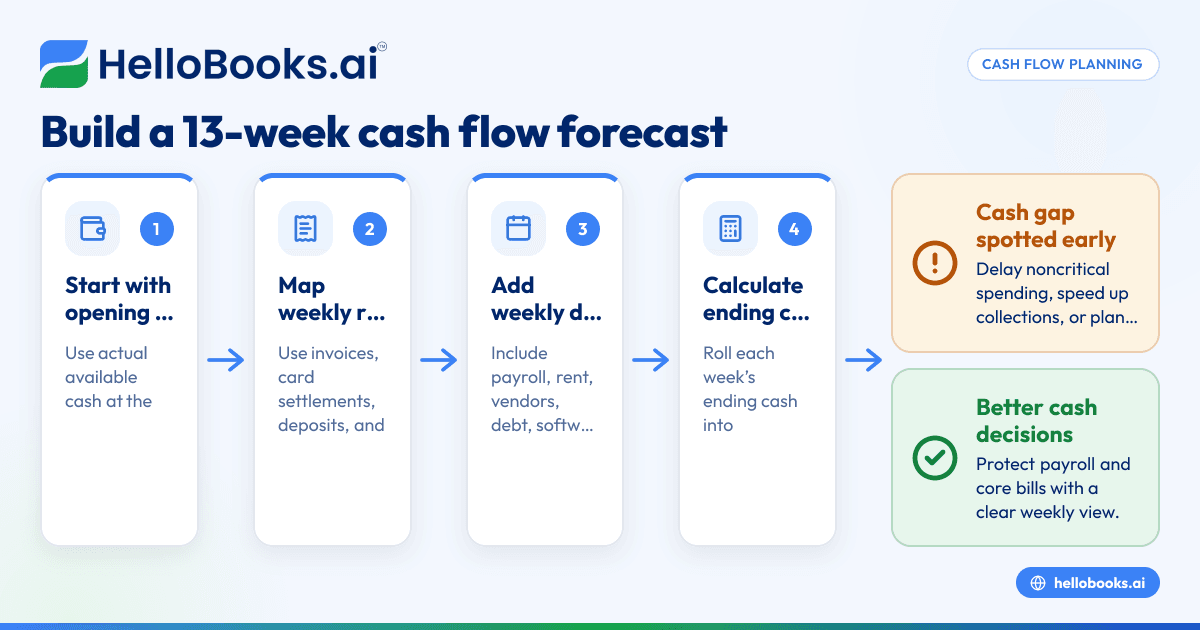
Start with the cash you have today, then map expected receipts and payments into the correct weeks. Update it every week with actual bank activity.
Step 1: Choose a weekly template
A spreadsheet works fine. Use 13 columns for 13 weeks. Put line items down the left side. Group them into:
- Beginning cash
- Receipts
- Disbursements
- Net cash flow
- Ending cash
If your current books are spread across email, spreadsheets, and bank downloads, moving to accounting software in the USA can make this process faster and cleaner.
Step 2: Enter your opening cash balance
Use the actual available cash at the start of week 1. That usually means the cash in your operating account and any other accounts you can use for operations. Do not include unused financing unless it is already approved and available.
Step 3: List all expected cash receipts by week
Use open invoices, recurring revenue, card settlements, and known deposits. Assign each receipt to the week you realistically expect cash, not the invoice date.
A simple rule helps. Base timing on customer behavior, not policy. If your terms are net 30 but most customers pay in 45 days, forecast 45 days.
Step 4: List all cash disbursements by week
Pull from payroll calendars, vendor due dates, rent schedules, debt schedules, software renewals, and planned purchases. Make sure one-time or quarterly payments are included.
For product businesses, inventory buys can create the biggest swings. For service businesses, payroll is often the largest line. For both, missing a tax payment can distort the forecast.
Step 5: Calculate weekly ending cash
For each week:
Beginning cash + receipts - disbursements = ending cash
Then roll that ending cash into the next week.
Step 6: Add notes for uncertain items
Mark any inflow or outflow that is not locked in. For example:
- Large customer payment not yet confirmed
- Vendor payment that could be delayed
- Seasonal inventory order under review
- Insurance renewal amount not final
This prevents false confidence.
Step 7: Review every week
At the end of each week, replace the forecast with actual numbers. Then re-forecast the remaining 12 weeks. That rolling process is where the forecast becomes useful.
A simple 13-week cash flow forecast template
Here is a practical structure you can copy into a spreadsheet.
Receipts section
- Customer collections
- Cash sales
- Card settlements
- Other receipts
- Total receipts
Disbursements section
- Payroll
- Payroll taxes
- Rent
- Utilities
- Inventory purchases
- Vendor payments
- Loan payments
- Insurance
- Software and subscriptions
- Marketing
- Owner draws
- Sales tax payments
- Other disbursements
- Total disbursements
Summary section
- Beginning cash
- Total receipts
- Total disbursements
- Net cash flow
- Ending cash
If you send many invoices each month, using invoice software can help you track open receivables and expected collection dates more reliably.
Example: a small business 13-week cash flow forecast
Say a packaging distributor in Houston starts week 1 with $85,000 in cash.
In week 1, it expects:
- $42,000 in customer collections
- $28,000 in payroll and payroll taxes
- $9,500 in rent and utilities
- $18,000 in vendor payments
- $3,000 in software, insurance, and other bills
Week 1 ending cash would be:
$85,000 + $42,000 - $58,500 = $68,500
Now imagine week 3 includes a $35,000 inventory purchase and a slower collection week. The forecast may show cash dropping below the level management is comfortable with. That gives the owner time to act. They might reduce the order, split the vendor payment, or accelerate collections from top customers.
This is where a weekly model earns its value. It turns “we should be fine this month” into a clearer answer.
What are the most common mistakes?
The biggest mistakes are using profit instead of cash, overestimating collections, and forgetting irregular payments.
Below are the errors that show up most often in small business forecasts.
1. Mixing accrual accounting with cash timing
Revenue on your P&L is not the same as cash received. Expenses recorded in your books are not always cash paid that week. A cash flow forecast must be based on bank timing.
2. Being too optimistic about collections
Many forecasts assume every invoice is paid on the due date. That rarely happens. Build collection timing based on actual payment history.
3. Leaving out payroll taxes and tax payments
Payroll is not just wages. It includes employer taxes and benefit payments. Sales tax payments can also create sharp weekly outflows if you did not plan for them.
4. Ignoring annual, quarterly, or irregular bills
Insurance renewals, license fees, maintenance contracts, bonuses, and debt fees often get missed because they are not monthly.
5. Not separating must-pay and can-delay expenses
If cash gets tight, you need to know what is essential. Group disbursements into critical and flexible categories.
6. Failing to update the forecast weekly
A forecast is not a one-time exercise. If actual collections fall short this week, the rest of the schedule needs to change.
How can AI help with a 13-week cash flow forecast?
AI can speed up data entry, categorize transactions, suggest collection timing, and surface unusual cash movements. It does not replace judgment, but it can reduce manual work and make weekly updates easier.
For many finance teams, the hard part is not building the first template. The hard part is keeping it current. Cash data sits in invoices, bank feeds, bills, payroll files, and spreadsheets. AI tools can help pull that information together faster.
An ai 13 week forecasting workflow can be useful when your team wants to refresh the model every week without spending half a day on exports and manual recoding. The point is not to automate decisions blindly. The point is to cut the busywork so you can focus on collections, spending priorities, and risk.
If you want fewer manual spreadsheet steps, AI bookkeeping and AI accounting software can help organize the underlying transaction data that feeds your forecast.
How often should you update a 13-week cash flow forecast?
Update it every week. A weekly refresh keeps the forecast useful and lets you respond before a small gap becomes a real cash problem.
Set a standing review cadence. Many small businesses do this on Monday morning or Friday afternoon. The process can be simple:
- Pull actual bank and payment activity for the prior week.
- Compare forecast versus actual receipts and disbursements.
- Adjust timing for late collections or changed bills.
- Add any new commitments, such as a vendor order or tax payment.
- Recalculate the remaining 12 weeks.
This review should involve the person who knows cash best. That may be the owner, controller, office manager, or outside accountant.
If bank activity is still matched by hand, bank reconciliation software can reduce the cleanup work before each weekly review.
Who should own the forecast inside a small business?
One person should own the forecast, but inputs should come from sales, operations, and finance. Clear ownership keeps the process consistent.
In a business with fewer than 20 employees, the owner or office manager may maintain it. In a larger company, it may sit with a controller or finance lead. The owner still needs visibility, because cash choices often involve tradeoffs across teams.
For example:
- Sales knows whether a large customer payment is truly coming.
- Operations knows if inventory can wait a week.
- Finance knows which obligations must be paid on time.
- The owner decides what tradeoffs are acceptable.
The forecast works best when everyone uses the same cash view.
When is a 13-week forecast especially important?
It matters most when cash timing is tight, revenue is uneven, or the business is changing quickly.
You should strongly consider a weekly cash forecast if:
- You are growing fast and hiring ahead of collections
- Your customers pay on terms
- You carry inventory
- You have seasonal demand
- You are behind on bookkeeping
- You are using a line of credit
- You have debt covenants or lender reporting
- You are trying to cut costs without hurting operations
It is also valuable during system changes. If you are moving away from spreadsheets or comparing a QuickBooks alternative, a 13-week forecast gives you a practical control report during the transition.
Turning the forecast into action
A cash flow forecast is only useful if it changes behavior. Once you identify a weak week, decide what you will do about it.
Common actions include:
- Accelerate collections Follow up on overdue invoices. Offer simpler payment options. Confirm payment dates with large customers.
- Slow discretionary spending Delay equipment, travel, hiring, or testing budgets that are not critical.
- Adjust vendor timing Ask to split a payment or move it by a week if the relationship allows.
- Reduce inventory pressure Buy smaller quantities or reorder later if stock levels permit.
- Prepare financing early If you may need outside funding, start the conversation before the cash dip.
- Protect visibility Keep the forecast current so the team can see whether actions are working.
If expense controls are weak, expense management software can make it easier to see where cash is going and tighten approval discipline.
A 13-week cash flow forecast does not need to be complex. It needs to be current, realistic, and tied to decisions. If you want to spend less time updating books and more time managing cash, book a demo at book a demo or compare options on the pricing page.
Frequently asked questions
Is a 13-week cash flow forecast the same as a budget?
No. A budget is usually monthly and focuses on planned revenue and expenses. A 13-week cash flow forecast is weekly and focuses on actual cash timing.
Should I include unpaid invoices as cash receipts?
Only if you assign them to the week you realistically expect payment. Do not include the full accounts receivable balance in week 1 unless you truly expect it to arrive then.
How detailed should my forecast be?
Detailed enough to reflect the major drivers of cash. Most small businesses need separate lines for collections, payroll, rent, inventory, debt, taxes, and key vendors. Too much detail can make weekly updates harder.