Key takeaways
What this article covers, in order:
- Key takeaways
- What is AI accounting software, and how does it help small businesses?
- How does AI accounting software streamline tax compliance in the United States?
- Why is automation important for small business bookkeeping?
- What features should small businesses look for when choosing accounting software?
- How does HelloBooks.ai compare to QuickBooks and traditional bookkeeping?
Top AI Accounting Software for Small Businesses in the United States: Streamline Your Bookkeeping and Tax Compliance
AI accounting software automates bookkeeping, invoicing, and tax compliance for U.S. small businesses. It reduces manual data entry and errors while keeping your records up to date with federal and state regulations.
Key takeaways
- AI accounting software automates bookkeeping, invoicing, bank reconciliation, and tax compliance for U.S. small businesses.
- Using such software can reduce manual data entry and human errors while streamlining sales tax handling and 1099 reporting.
- Features to look for include automated expense management, integration with popular payment platforms, and up-to-date compliance tools.
- Choosing AI tools compatible with your existing systems like QuickBooks or ERP platforms eases adoption and data syncing.
- Software with strong security, audit trails, and compliance with U.S. law supports informed decision-making and meets buyer expectations.
- HelloBooks.ai offers an AI-driven solution tailored to U.S. small business needs, from bookkeeping to invoicing and tax compliance.
What is AI accounting software, and how does it help small businesses?
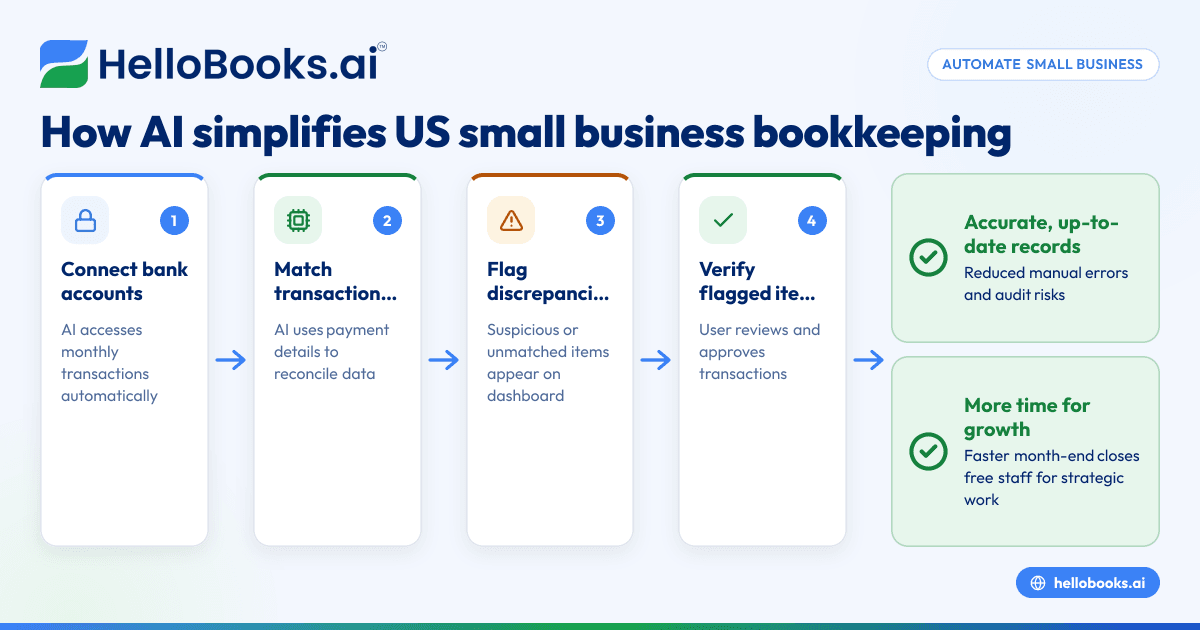
AI accounting software uses artificial intelligence to automate and optimize accounting tasks. It rapidly processes data from invoices, bank statements, and receipts to generate accurate bookkeeping entries, reconcile accounts, and prepare financial reports.
For U.S. small businesses, this reduces the heavy manual workload involved in tracking sales tax, 1099 contractors, and payroll taxes. The software constantly updates compliance requirements based on IRS regulations and state tax laws, helping businesses avoid penalties.
By automating routine processes, AI accounting software frees up time for business owners and finance leads to focus on strategic decisions, growth, and customer service.
How does AI accounting software streamline tax compliance in the United States?
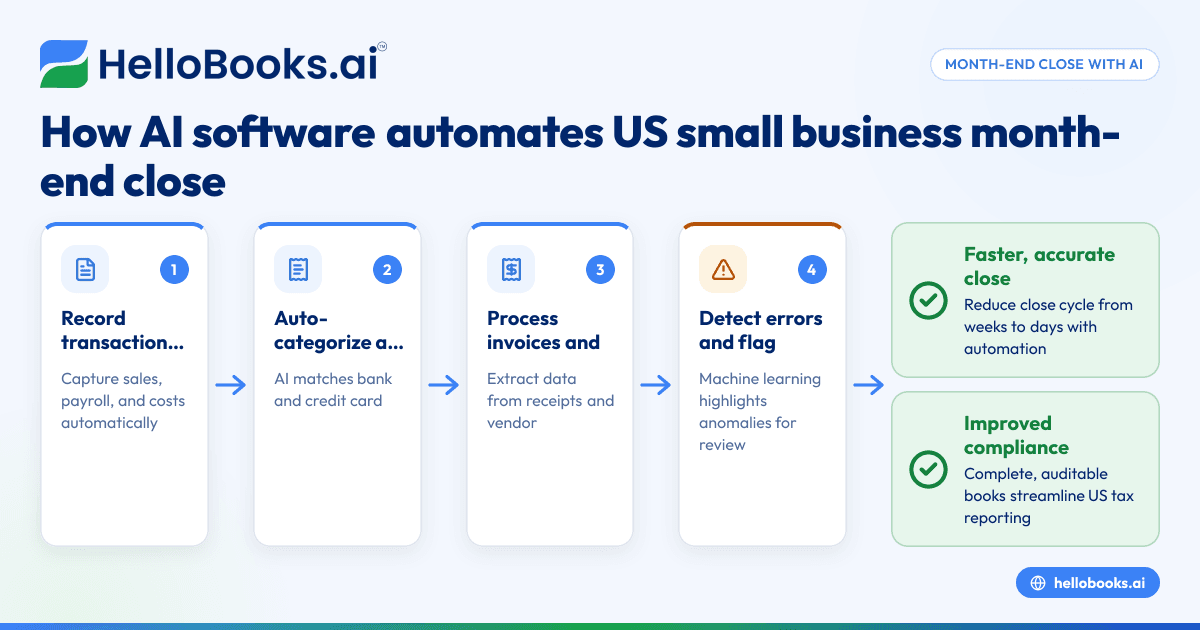
AI accounting software automatically calculates and applies the correct sales tax rates based on your business’s jurisdiction and customer location. It keeps track of tax filing deadlines and generates 1099-MISC forms required for reporting payments to contractors.
These systems also align with IRS tax code changes and state-specific regulations, ensuring your records stay compliant. Some platforms support integration with online tax filing services, simplifying submissions and reducing filing errors.
Automated audit trails maintain detailed records required in case of IRS audit or state tax authority inquiries, making tax time less stressful and error-prone.
Why is automation important for small business bookkeeping?
Automation reduces time spent on repetitive tasks like data entry and improves accuracy. This efficiency is crucial for small businesses in cities like Chicago and Houston, especially when managing growing transaction volumes without extra staff.
AI-powered bank reconciliation software automatically matches transactions with invoices and expenses, detecting errors early. Expense management software streamlines approval workflows and receipt submissions, saving hours monthly.
Overall, automation leads to faster financial closes, greater cash flow clarity, and more reliable reports for lenders or investors.
What features should small businesses look for when choosing accounting software?
When selecting AI accounting software, consider the following features essential for U.S. small businesses:
- Automated bookkeeping: Supports importing transactions from banks and payment gateways like Stripe.
- Invoicing and payment tracking: Includes customizable invoice templates and payment reminders.
- Sales tax calculation and filing: Automatically applies multi-state sales tax rates and produces detailed reports.
- 1099 form generation: Tracks contractor payments and prepares IRS-compliant forms.
- Bank reconciliation: Matches bank statements to recorded transactions efficiently.
- Expense management: Enables employees to submit receipts and track expenses via mobile apps.
- Financial reports: Creates profit and loss, balance sheets, and cash flow statements on demand.
- Integration: Compatible with popular tools like QuickBooks or ERP systems used in manufacturing or retail.
- Security and data privacy: Meets SOC 2 expectations and data protection best practices.
HelloBooks.ai offers all these features with advanced AI-driven workflows optimized for small businesses.
How does HelloBooks.ai compare to QuickBooks and traditional bookkeeping?
HelloBooks.ai leverages AI to automate tasks where QuickBooks often requires manual input. Unlike traditional spreadsheet bookkeeping or legacy systems, HelloBooks.ai reduces data entry time through automated bank reconciliation and expense management.
It supports U.S.-specific compliance needs such as multi-state sales tax, 1099 form preparation, and tax deadlines. Built with integration capabilities, it can complement an existing QuickBooks setup or replace it for cost-conscious businesses seeking automation.
The AI-driven platform scales with your business, handling increasing transaction volumes without the need for additional staff or bookkeeping hours.
How secure is AI accounting software like HelloBooks.ai?
AI accounting software providers prioritize data security by implementing encryption, role-based access controls, and regular backups. HelloBooks.ai adheres to industry best practices for data privacy in the United States.
The system maintains detailed audit logs, ensuring traceability of all actions taken within the software. This assists in compliance audits, fraud prevention, and regulatory reporting.
Users should review vendor security policies and compliance certifications before selecting software to protect sensitive financial and customer information.
How to get started with AI accounting software for your small business in the USA
Getting started with AI accounting software involves assessing your needs, evaluating options, and planning a smooth transition. HelloBooks.ai offers tailored demos and support to ease adoption for U.S. small businesses.
- Assess your needs: Identify pain points like manual bookkeeping, late tax filings, or lost receipts.
- Evaluate software: Compare AI accounting software focusing on U.S. compliance, automation, integrations, and usability.
- Request demos: Schedule product demos—you can book a demo with HelloBooks.ai to explore how AI streamlines your finances.
- Plan migration: Prepare and import your accounting data from spreadsheets or legacy systems.
- Train your team: Ensure finance staff understand the tools to maximize benefits.
- Implement and monitor: Launch the software and adjust workflows based on performance.
Conclusion
AI accounting software is revolutionizing bookkeeping and tax compliance for small businesses in the United States. Tools like HelloBooks.ai save time, reduce errors, and keep you current on tax laws while delivering clear financial insights.
If you want to explore AI-powered bookkeeping for your business, you can book a demo at HelloBooks.ai or compare plans to find the best fit for your needs.
Frequently asked questions
What is the difference between AI accounting software and traditional accounting software?
AI accounting software uses machine learning and data recognition to automate routine bookkeeping and forecasting. Traditional software often requires manual entry and rule setup. AI solutions reduce effort, speed up processes, and improve accuracy.
Can AI accounting software handle multi-state sales tax in the US?
Yes, many AI accounting solutions automatically calculate applicable state and local sales taxes based on your customer's location and update rates as laws change, ensuring compliance across states.
Is my financial data safe when using AI accounting software?
Reputable AI accounting software providers use strong encryption, access controls, and regular audits to protect your data. Always review the provider’s security policies and compliance certifications before choosing software.
How does AI accounting software help with 1099 reporting?
AI software tracks payments to contractors, flags vendors requiring 1099 filing, and prepares IRS-compliant forms, reducing errors during tax season.
Can AI accounting software integrate with QuickBooks or Stripe?
Yes, many AI accounting platforms support integration with QuickBooks for accounting and Stripe for payment processing. This allows seamless data flow and eliminates duplicate data entry.
How easy is it to switch from spreadsheet bookkeeping to AI accounting software?
Switching usually involves exporting your current bookkeeping data and importing it into the software. Most platforms offer onboarding support and tutorials to help small businesses transition smoothly.
Ready to streamline your bookkeeping and tax compliance? Book a demo with HelloBooks.ai today or compare plans to find the perfect fit for your business.
Read next
This article covers one part of a bigger topic. For the complete picture, read our guide to accounting software.