
Key takeaways
What this article covers, in order:
- Key takeaways
- What is sales tax, and why does it matter?
- How do I know if I need to collect sales tax?
- What is a sales tax nexus?
- How do I register for a sales tax permit in the US?
- How to calculate sales tax for my business?
Navigating sales tax collection and filing is a crucial responsibility for small businesses in the United States. Sales tax is a consumption tax imposed by state and local governments on the sale of goods and certain services. Understanding how to collect, report, and pay sales tax correctly ensures compliance and avoids costly penalties.
Key takeaways
- Sales tax rules vary by state and locality, requiring careful tracking of where sales occur.
- Small businesses must register for sales tax permits in states where they have nexus.
- Accurate sales tax collection impacts pricing, invoicing, and customer relations.
- Filing and remitting sales tax must meet each state's deadlines to avoid fines.
- AI sales tax solutions can simplify data entry, categorization, and filing processes.
- Integration with [accounting software for small business] can automate compliance tasks effectively.
What is sales tax, and why does it matter?
Sales tax is a tax states and localities charge on the sale of goods and some services. Businesses must collect this tax from customers and remit it to tax authorities. Getting this right is critical to avoiding audits, penalties, and interest.
Sales tax is a government-imposed tax on the sale of tangible personal property and certain services. In the United States, it is primarily governed at the state level, making rules complex and varied. Businesses must collect sales tax from customers and remit these taxes to the appropriate state and local tax authorities. For small businesses, mastering sales tax compliance is essential to avoid audits, penalties, and interest charges.
How do I know if I need to collect sales tax?
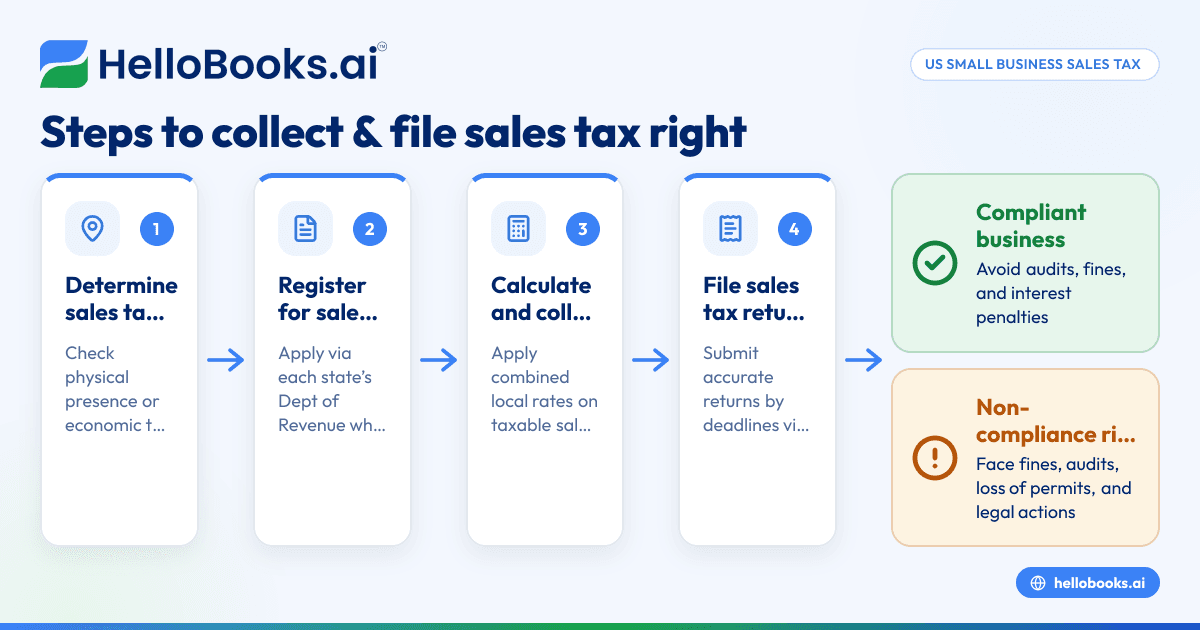
You need to collect sales tax if your business has nexus—a sufficient connection to a state. Nexus includes physical presence or economic thresholds like sales volume or transaction count. Registering for a sales tax permit and collecting tax on taxable sales is required once nexus is established.
You must collect sales tax if your business has a nexus in a state. Nexus means a significant presence or connection, which can be physical (like a storefront or warehouse) or economic (like meeting a sales threshold). Most states enforce an economic nexus if sales exceed a certain dollar amount or transaction count. Once nexus is established, you have to register for a sales tax permit and collect tax on taxable sales.
Economic nexus laws now affect even online and remote sellers, so many small businesses in cities like Chicago or Houston may have to collect sales tax in multiple states.
What is a sales tax nexus?
Sales tax nexus is the legal connection between a business and a state that obligates the business to collect and remit sales tax there. Physical nexus can include having employees, inventory, or offices in a state. Economic nexus is based on reaching minimum sales revenue or transaction counts within that state, even without a physical presence.
Determining nexus correctly is vital. Thresholds vary but frequently include $100,000 in sales or 200 transactions annually. Businesses must monitor sales continuously to know when nexus is triggered.
How do I register for a sales tax permit in the US?
You must apply through each state’s Department of Revenue or taxation website where you have nexus. Registration typically requires your business details, federal EIN, and expected sales volume. Permit approvals can take days or weeks. Only after receiving the permit may you legally collect sales tax.
Registration requirements, fees, and processing times vary by state. Some states allow online registration, speeding up the process.
How to calculate sales tax for my business?
Sales tax rates vary by state, county, and city. To calculate the tax, apply the total combined rate for the customer's location to the taxable sale amount. Some items may be exempt or have special rates (e.g., groceries, clothing). Always check local provisions and use updated rate tables.
For example, a $100 sale in Detroit might include a 6% state tax plus 2.4% city tax, totaling an 8.4% sales tax, or $8.40.
How do I collect sales tax from customers?
Most small businesses collect sales tax at the point of sale, adding it to the invoice or receipt. Online sellers should display the tax clearly during checkout, adjusting rates based on customer location. Accurate collection requires updating tax tables regularly and accounting for exemptions.
Using invoice software integrated with your bookkeeping can help automate correct sales tax calculation and collection.
What is the role of AI sales tax tools in managing compliance?
AI sales tax tools help automate sales tax calculations, collection, and filing. They analyze transactions in real-time to detect where tax applies, update rates automatically, and generate reports for filing. For busy small business owners, these tools reduce errors and the time spent on tax compliance tasks.
This evolution is especially valuable when dealing with multiple tax jurisdictions or complex rate structures.
How do I file my sales tax return?
Sales tax returns are filed through each state’s online portal or by mail, summarizing taxable sales, tax collected, and adjustments. Filing is required even for zero tax collected. Submit returns by the due date to avoid penalties. Many AI accounting software tools generate returns automatically and can file electronically for you.
Use the state's online portal or mail in your sales tax return, which summarizes taxable sales, tax collected, and any adjustments. Filing is necessary even if no tax was collected, indicated by a zero return. Double-check your numbers and submit by the due date to avoid late fees. Many AI accounting software tools generate these returns automatically and can file electronically for you.
What are the penalties for late or incorrect sales tax filing?
Penalties vary by state and can include fines, interest on unpaid taxes, and possible loss of permits. Repeated failures may trigger audits or legal action. Filing accurate returns on time is crucial. Maintaining good records and using automation tools mitigate these risks.
What records should I keep to stay compliant?
Maintain detailed records of sales, collected taxes, exemptions claimed, and filed returns. Good records support accuracy and defend you in case of audits. Save invoices, receipts, and reports for at least three to five years, as most states' statutes of limitations fall within that range.
Using [bank reconciliation software] and [expense management software] in tandem with your sales tax tracking leads to better organized records.
Can I use accounting software to manage my sales tax?
Yes. Many [accounting software in the USA] options include sales tax modules that track nexus, apply correct tax rates, collect tax amounts, and prepare filing reports. Tools like QuickBooks are popular, but there are effective [QuickBooks alternatives] available too.
Using such software reduces manual work and minimizes errors, essential for small businesses scaling up.
How do I handle sales tax for online sales versus in-store sales?
The same rules about nexus and taxability apply to both online and physical sales. However, online sales often require using the customer's shipping address to determine tax rates. Online sellers must also consider marketplace facilitator laws where platforms like Amazon collect and remit sales tax on their behalf.
Stay informed as online sales tax laws continue evolving.
When selling services, do I have to collect sales tax?
It depends on the state and type of service. Some states tax specific services like landscaping or telecommunications, while many professional services are exempt. Confirm taxable services per your state’s rules and collect tax accordingly.
Summary
Sales tax compliance for small businesses in the United States involves understanding nexus, registering for permits, collecting tax correctly, and filing returns timely. Keeping up with local tax rates and filing deadlines can be complex, but AI sales tax solutions and integrated bookkeeping software can simplify these processes. This helps save time, reduce errors, and stay compliant.
To explore how HelloBooks can help automate your sales tax and bookkeeping, book a demo or compare plans today.
Frequently asked questions
What is the difference between sales tax and use tax?
Sales tax is collected by the seller at the point of sale. Use tax is paid by the buyer on taxable purchases made out of state when sales tax was not collected. Both taxes ultimately serve to apply tax to consumer purchases.
Can I charge sales tax on shipping fees?
Some states require sales tax on shipping if shipping is part of the sale of taxable goods. Others exempt shipping charges separately. Check your state's rules to calculate shipping fees correctly for tax.
How does economic nexus affect small online businesses?
Economic nexus requires out-of-state sellers to collect sales tax if their sales exceed thresholds in that state, even without physical presence. Small online sellers should track sales by state to ensure compliance.
Are sales tax exemptions applicable?
Yes. Certain customers or products may be exempt from sales tax — like nonprofits, resale purchases, or groceries depending on the state. Collect valid exemption certificates and document them carefully.
Can HelloBooks automate sales tax filing?
Yes. HelloBooks provides AI bookkeeping features that handle sales tax calculations, transaction categorization, and generate reports to ease filing. Explore automation advantages by booking a demo.
What should I do if I make a mistake on my sales tax return?
If you discover an error, file an amended return promptly with correct information. Contact the state’s tax department if needed for guidance, and pay any underreported tax with interest to minimize penalties.
Read next
This article covers one part of a bigger topic. For the complete picture, read our guide to sales tax.