
Key takeaways
What this article covers, in order:
- Key takeaways
- Understanding Sales Tax and Remote Sales in the USA
- What are the common economic nexus thresholds for remote sellers?
- How can AI sales tax tools help small businesses manage remote sales tax?
- How do I register for sales tax permits in states I have nexus?
- What kinds of remote sales require collecting sales tax?
Managing sales tax for remote sales in the USA is complex due to varying state laws and economic nexus rules. Small businesses must track where they have sales tax obligations, collect and remit taxes correctly, and keep accurate records. AI bookkeeping simplifies these tasks, helping businesses avoid penalties and save time.
Key takeaways
- Sales tax remote sales USA require understanding state economic nexus thresholds and registration rules.
- Remote sellers must collect sales tax in states where they exceed sales or transaction limits.
- AI bookkeeping automates sales tax tracking, calculation, and filing for multiple states.
- Using AI-driven sales tax features reduces errors and saves hours on compliance.
- Stay updated on state tax law changes, especially for remote sales rules.
- Accurate sales tax management supports smooth audits and compliance for small US businesses.
Understanding Sales Tax and Remote Sales in the USA
Sales tax in the US is state-administered, meaning each state sets its own tax rates, rules, and compliance requirements. For small businesses making remote sales—selling goods or services to customers in states where the business has no physical presence—sales tax can be tricky.
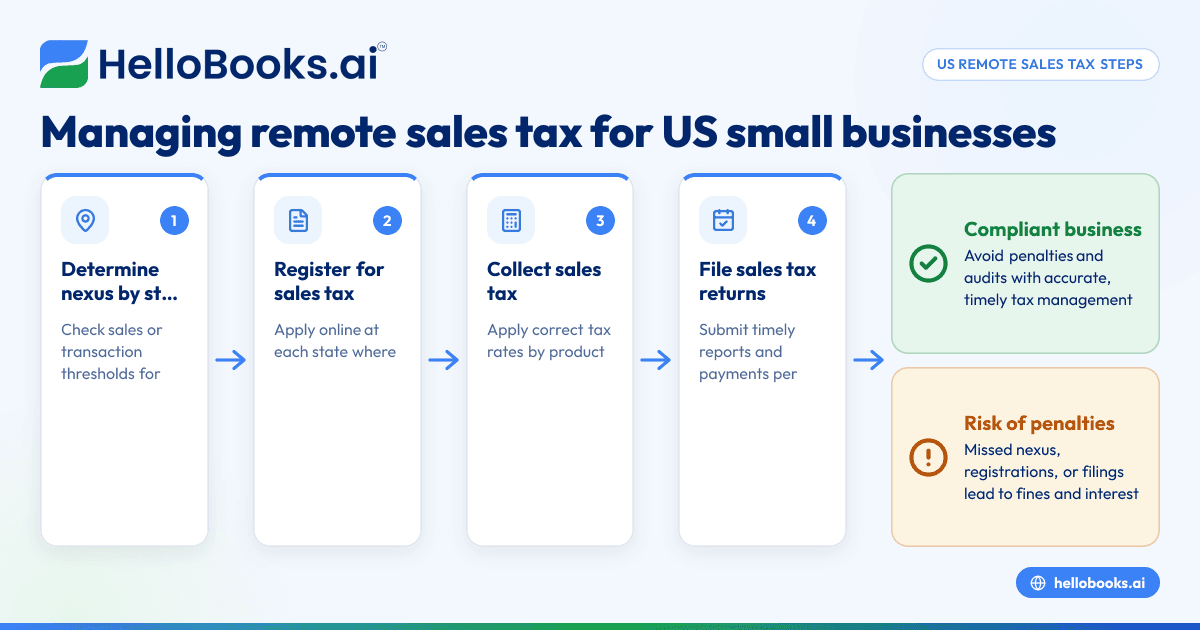
Historically, businesses needed a physical presence (nexus) in a state to owe sales tax there. However, since the 2018 Supreme Court decision in South Dakota v. Wayfair, states can require remote sellers to collect sales tax based on economic nexus. Economic nexus means you must collect and remit tax if your remote sales exceed a certain dollar amount or number of transactions in that state, even without a physical presence.
This change means small businesses selling remotely—such as through online stores or marketplaces—must review their sales volumes per state to determine where they have nexus and must register for sales tax permits.
What are the common economic nexus thresholds for remote sellers?
Economic nexus thresholds vary by state but generally involve gross sales over $100,000 or 200 transactions annually. Some states have different or additional criteria.
Each state publishes its nexus rules on its Department of Revenue website. For example:
- California generally requires nexus if sales exceed $500,000 in a year.
- Texas’s threshold is $500,000 in gross sales in a 12-month period.
- New York has a $500,000 sales threshold plus 100 transactions.
If your sales exceed a state’s threshold, you must register for a sales tax permit in that state and start collecting tax from customers.
How can AI sales tax tools help small businesses manage remote sales tax?
AI sales tax tools automate complex tracking and calculation tasks associated with multi-state sales tax. They identify where economic nexus is triggered by analyzing sales data across states. The software then applies the correct tax rates by product category and jurisdiction.
By integrating with your sales platforms and accounting software, AI bookkeeping solutions can:
- Monitor sales volumes and transactions per state in real time.
- Automatically generate sales tax reports for each jurisdiction.
- Prepare return filings for multiple states, reducing manual effort.
- Update tax rates and rules as states change legislation.
This removes guesswork, reduces errors, and ensures timely compliance, especially important for busy finance leads or small business owners juggling multiple roles.
How do I register for sales tax permits in states I have nexus?
Registering requires applying at each state’s Department of Revenue or Taxation website where you have nexus. Most states have online portals for permit applications. You will need your Federal Employer Identification Number (FEIN), business details, and sometimes banking information.
After registration, you’ll receive a sales tax permit or license number. This number must be used when filing returns and may need to be displayed on invoices or your website. Remember to renew the permit as required, usually annually.
If you have nexus in many states, consider using software that tracks permit statuses and renewal dates.
What kinds of remote sales require collecting sales tax?
Most tangible goods sold remotely to customers within a state require sales tax collection. However, services have more complex rules—some states tax digital products, software downloads, or specific services, while others do not.
For example, Houston-based small businesses selling physical goods via an online store must collect sales tax for customers in Texas and other states where they have nexus. But if they sell consulting services remotely, they may or may not owe sales tax depending on that state’s laws.
Understanding which sales are taxable in each state is critical to staying compliant.
How do software tools like HelloBooks.ai simplify sales tax filing?
HelloBooks.ai offers a comprehensive AI accounting software for small businesses managing remote sales tax. It integrates functions like automated bank reconciliation software, expense management software, and invoicing alongside sales tax features.
By using HelloBooks.ai for your accounting, you can easily track sales by state, apply the correct sales tax rates, and generate reports needed for filing. The software flags when economic nexus thresholds are met, helping avoid surprises.
Its AI capabilities keep tax rates updated instantly, so your filings are based on the latest rules. HelloBooks.ai also supports multi-state tax reports to streamline tax return preparation and filing through the correct channels.
How do I keep sales tax records to prepare for audits?
Keeping accurate sales tax records is essential. Document all sales transactions by state, amounts of tax collected, exemption certificates for resale sales, and filed sales tax returns.
Sales tax auditors will want to see detailed records showing correct tax collection and remittance. Using AI bookkeeping software reduces manual errors and automatically archives digital copies of transactions and returns for easy retrieval.
For firms based in cities like Chicago or Detroit selling remotely, having organized records managed through HelloBooks.ai can speed audit responses and reduce risk.
Managing compliance deadlines for remote sales tax in multiple states
Each state sets its own deadlines for sales tax return filing and payment—ranging from monthly to quarterly or annually, depending on your volume. Missing deadlines can lead to penalties and interest.
AI bookkeeping software helps by sending reminders and automating report creation aligned with each state's schedule. This helps small business owners prioritize filings and avoid costly mistakes when managing compliance across many jurisdictions.
What about 1099 forms and sales tax?
While 1099 forms report payments to contractors or service providers, sales tax collection is separate and deals with taxes on customer sales. It’s important to manage both accurately but distinctly.
HelloBooks.ai supports tracking expenses like contractor payments for 1099s within the same platform you manage your sales tax obligations, keeping all your compliance tasks under one roof.
How do I stay updated on changing sales tax laws for remote sales?
States often update nexus thresholds, taxability rules, and filing procedures. Subscribe to updates from state Departments of Revenue or use AI accounting software with automatic updates integrated.
HelloBooks.ai continually enhances its tax automation features to reflect legislative changes, providing peace of mind in managing the complexity of sales tax remote sales USA.
Managing sales tax for remote sales is complex but critical. With growing US sales across state lines, small businesses must track nexus, collect tax correctly, and file returns on time. AI bookkeeping, like HelloBooks.ai’s platform, simplifies these tasks by automating calculations, reminders, and filings—saving you time and reducing compliance risks.
Discover how HelloBooks.ai can transform your accounting and sales tax management by booking a demo at /book-a-demo or exploring plan options at /pricing today.
Frequently asked questions
What is economic nexus for sales tax remote sales USA?
Economic nexus means you may owe sales tax in a state if your remote sales exceed a set dollar amount or transaction count, even without a physical presence. Thresholds vary but often are around $100,000 in sales or 200 transactions annually.
Can I use AI bookkeeping to calculate sales tax for all my remote sales?
Yes. AI bookkeeping software analyzes your total sales, applies the correct tax rates per state, and keeps you compliant across multiple jurisdictions. HelloBooks.ai offers these AI sales tax capabilities to simplify your workflow.
What happens if I don’t collect sales tax where I have nexus?
Failing to collect or remit sales tax when required can lead to penalties, interest, and audits by state tax authorities. It’s important to monitor your nexus status and comply promptly.
Are digital products subject to sales tax in remote sales?
It depends on the state. Some states tax digital goods and software downloads, while others exempt them. You must check each state's rules or use software that applies state-specific taxability.
How often should I file sales tax returns for remote sales?
Filing frequency varies by state and your sales volume, typically monthly, quarterly, or annually. AI bookkeeping software can manage these deadlines and send reminders.
Can HelloBooks.ai integrate with my existing sales platforms?
HelloBooks.ai integrates smoothly with common US accounting and sales tools, streamlining data flow and automating sales tax tracking for remote sales. This reduces manual data entry and errors.
Read next
This article covers one part of a bigger topic. For the complete picture, read our guide to sales tax.