
Key takeaways
What this article covers, in order:
- Key takeaways
- Understanding Sales Tax for Small Businesses in the United States
- How can AI sales tax tools help small businesses?
- What are the common sales tax challenges for small businesses?
- How does AI improve the accuracy of sales tax tracking?
- How does AI sales tax work in practice?
Sales tax compliance is a crucial and often complex task for small businesses in the United States. Leveraging AI technology can streamline sales tax tracking and filing, reduce errors, and save valuable time.
Key takeaways
- Sales tax rates and rules vary widely across states and local jurisdictions.
- Accurate sales tax tracking requires real-time rate updates and correct jurisdiction assignment.
- AI sales tax tools automate calculation, reporting, and filing processes.
- Automated sales tax systems help avoid costly penalties and audits.
- Integrating AI sales tax software with accounting improves data consistency.
- Small businesses can greatly reduce manual entry and reconciliation workload.
Understanding Sales Tax for Small Businesses in the United States
Sales tax is a state and local tax charged on the sale of tangible personal property and some services. Unlike federal taxes, sales tax rates and rules vary drastically among the 45 states that impose it, and can differ even at the county or city level. For example, Chicago, Illinois has a combined sales tax rate of 10.25%, while Houston, Texas has a combined rate of about 8.25%.
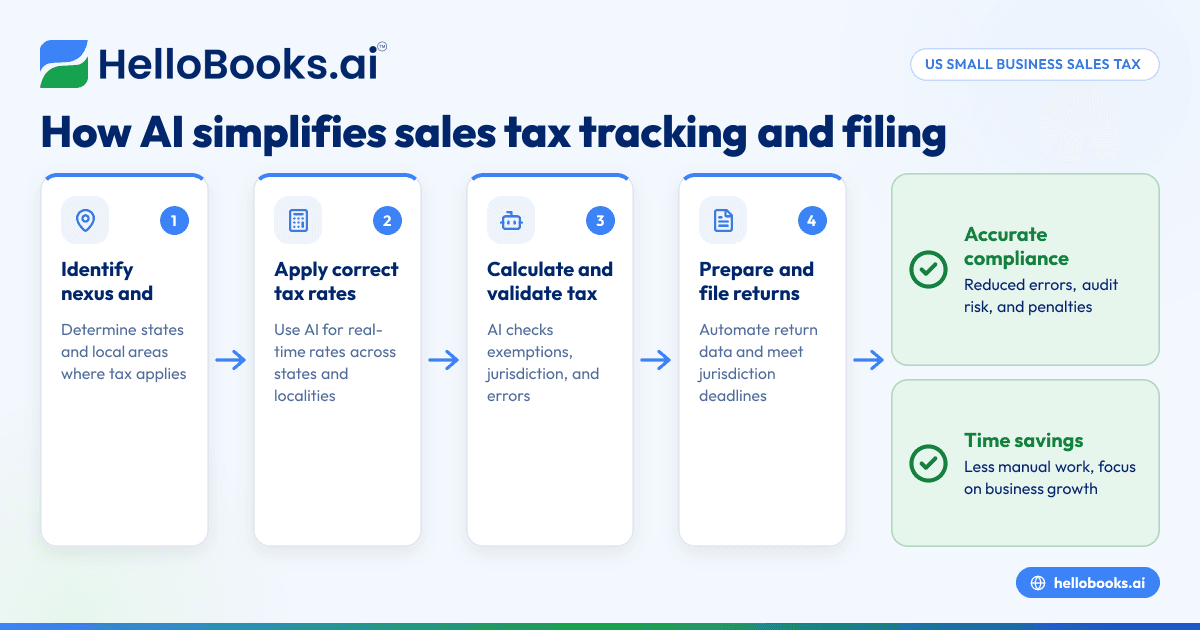
Small businesses must:
- Identify which states and local jurisdictions they have nexus in (physical presence, economic nexus thresholds, marketplace sales).
- Apply the correct tax rate based on the customer’s location.
- Collect and remit sales tax to the appropriate state and local tax agencies.
- File sales tax returns monthly, quarterly, or annually depending on their tax jurisdiction's requirements.
Accurate tracking and filing is essential to avoid interest, penalties, and the risk of audits. Manual sales tax tracking often results in errors due to the complexity of rates and frequent legislative changes.
How can AI sales tax tools help small businesses?
AI sales tax tools use artificial intelligence to automate and simplify sales tax management. They determine accurate tax rates for each sale, validate exemptions, and automate reporting. This reduces manual work and minimizes errors, helping small businesses stay compliant and save time.
These tools can quickly identify the precise jurisdiction of each transaction. They dynamically fetch up-to-date tax rates from authoritative sources, ensuring compliance with current laws. AI-powered systems validate transactions to identify exemptions and detect inconsistencies that could lead to audits.
Automation extends from rate calculation to return preparation and filing — minimizing manual data entry and simplifying reconciliation.
Adopting AI sales tax software reduces workload, timing delays, and errors. This lets business owners focus on growth, not tax admin.
What are the common sales tax challenges for small businesses?
Small businesses face many challenges managing sales tax compliance:
- Jurisdiction complexity: Sales tax applies based on where the buyer receives goods or services, which can be different from the seller’s state.
- Changing rates: Tax rates are frequently updated, sometimes mid-quarter.
- Taxability rules: Not all products and services are taxed uniformly; some are exempt or taxed differently.
- Nexus determination: Economic and marketplace nexus rules require filing across multiple states, even without a physical presence.
- Filing deadlines: Deadlines vary by state and filing frequency, risking penalties if missed.
- Manual calculations: Spreadsheet errors or improper setup in accounting software cause miscalculations.
- Audit risk: Incorrect filings may trigger costly tax audits.
How does AI improve the accuracy of sales tax tracking?
AI improves accuracy by continuously accessing updated rate databases and using machine learning to classify transactions correctly. It identifies applicable jurisdictions and flags potential errors or exemptions. This real-time validation reduces manual mistakes and ensures you apply the right tax every time.
How does AI sales tax work in practice?
AI sales tax software connects to your business systems, monitors transactions, and calculates taxes in real time. It applies current tax rates, considers exemptions, and collects data for accurate reports and filings. This reduces manual lookups and errors.
What should small businesses look for in AI sales tax software?
Look for real-time rate updates, nexus tracking across states, seamless integration with your accounting software like QuickBooks or Stripe, automated filing support, error detection, user-friendly dashboards, and scalability to grow with your business.
How does AI sales tax software integrate with accounting systems?
AI sales tax software automatically syncs sales tax calculations with your accounting platform. When your invoice software records a sale, the AI system calculates and updates the tax in your accounts. This integration reduces manual work and keeps your books accurate and up to date.
What are the common sales tax filing requirements in the United States?
Businesses must file periodic sales tax returns (monthly, quarterly, or annually) reporting total sales, taxable sales, and tax collected. They must remit taxes to the appropriate authorities, often electronically. States have varying deadlines and requirements, so staying compliant is essential.
How can AI sales tax software help with filing and compliance?
AI tools prepare return data automatically, reduce errors, and support electronic submission. They also remind you of upcoming deadlines and track filing status, ensuring compliance and reducing audit risk.
How do small businesses benefit financially from AI sales tax automation?
AI automation helps avoid penalties, decreases manual work, prevents overpayment, frees up staff time, and lowers audit risk—results that save money and improve cash flow.
Conclusion
Small businesses in the United States can dramatically improve the accuracy of their sales tax tracking and filing by adopting AI-driven solutions. Automated compliance helps owners avoid financial risks and devote more attention to growing their business.
For a practical and integrated solution, consider how HelloBooks can streamline your sales tax workflows and accounting processes. Book a demo to discover how AI-powered technology can transform your sales tax compliance and bookkeeping. You can also compare our plans at pricing.
Frequently asked questions
What is sales tax nexus and why does it matter?
Sales tax nexus is a connection between a business and a state requiring that business to collect and remit sales tax there. Nexus can be established through physical presence, economic thresholds like sales volumes, or marketplace activity. It determines where you must comply with sales tax laws.
Can AI sales tax software handle multiple states?
Yes, modern AI sales tax software supports multi-state compliance. It manages different nexus rules, tax rates, and filing requirements in all states where your business has obligations, simplifying complex multi-jurisdictional tax management.
How does AI help with sales tax rate updates?
AI sales tax systems continuously access official rate databases and legislative changes. They update rates automatically within your software, eliminating the risk of charging outdated taxes and needing time-consuming manual adjustments.
Is AI sales tax software only for large businesses?
No, AI sales tax solutions are scalable and highly beneficial for small businesses. They reduce manual work, minimize errors, and handle diverse requirements cost-effectively, helping small-to-medium enterprises stay compliant as they grow.
Are AI sales tax tools integrated with QuickBooks?
Many AI sales tax solutions offer seamless integration with QuickBooks and popular accounting platforms. This ensures sales tax calculations and transactions sync automatically for accurate books and easier reconciliation.
Does AI sales tax software comply with US tax regulations?
AI sales tax software is designed specifically to comply with US federal and state regulations. It uses current tax law data and supports electronic filing standards, helping businesses meet legal requirements. However, businesses should always consult a tax professional for specific advice.
Read next
This article covers one part of a bigger topic. For the complete picture, read our guide to sales tax.