
Key takeaways
What this article covers, in order:
- Key takeaways
- What is AI accounting software and why does it matter for small businesses?
- How does AI accounting software improve bookkeeping and invoicing?
- Can AI accounting software handle US tax compliance requirements?
- What benefits does AI bring to expense management and financial reporting?
- How easy is it to integrate AI accounting software with existing tools?
Managing finances is a crucial but time-consuming task for small businesses in the United States. AI accounting software offers automated solutions for bookkeeping, invoicing, bank reconciliation, and compliance, greatly reducing manual work and errors. This automation frees business owners and finance teams to focus on growing their business rather than getting bogged down in tedious data entry.
Key takeaways
- AI accounting software automates data entry, reconciliation, tax compliance, and reporting to save time and reduce costly errors.
- It supports complex US tax requirements, including multi-state sales tax calculations and 1099 filings for contractors.
- Integration with popular US financial tools such as QuickBooks, Stripe, and ERP systems streamlines workflows.
- AI-driven insights improve cash flow management and financial decision-making.
- Cloud-based solutions provide secure, real-time access to financial data from anywhere.
- Transitioning from spreadsheets or legacy software to AI platforms increases accuracy and lowers risk.
What is AI accounting software and why does it matter for small businesses?
AI accounting software uses artificial intelligence technologies to automate routine accounting tasks such as data entry, transaction categorization, bank reconciliation, and tax form preparation. It drastically reduces errors and speeds up financial closes and reporting.
Small businesses in the US face complex sales tax systems that vary by state, along with the need to file 1099 forms for contractors. AI software can handle these complexities automatically. For instance, a Detroit marketing firm working with multi-state contractors can use AI solutions to generate accurate 1099s, reducing hours of manual work and the risk of missing IRS deadlines. This makes managing accounting easier for owners, bookkeepers, and accountants juggling many responsibilities.
How does AI accounting software improve bookkeeping and invoicing?
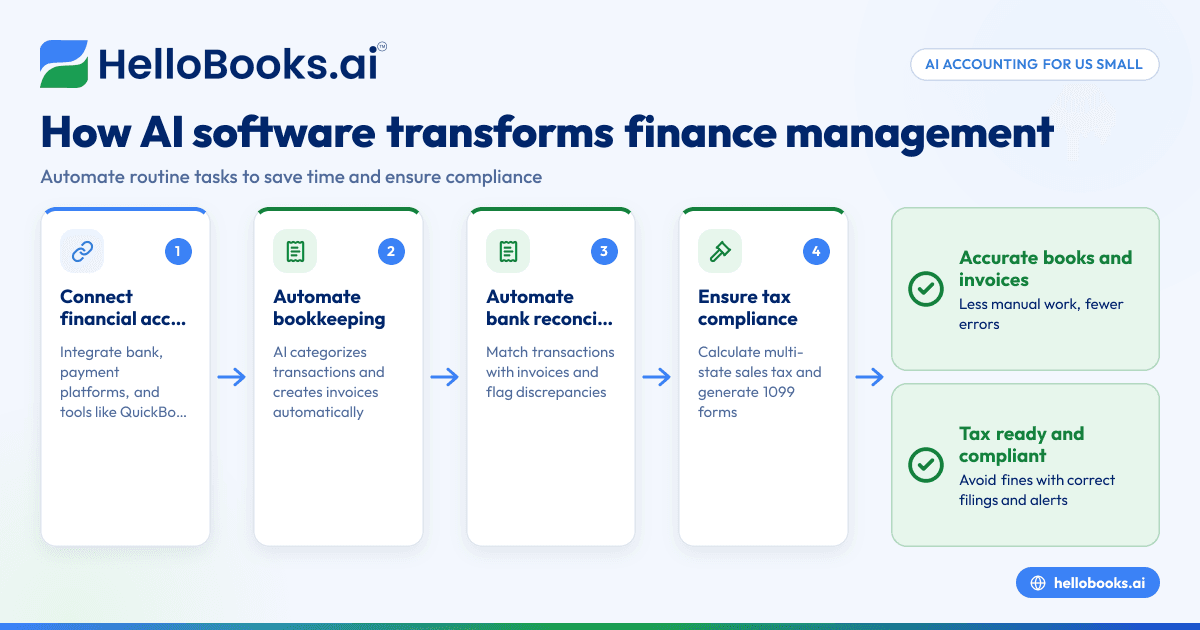
AI accounting software streamlines bookkeeping and invoicing by automating transaction classification, invoice creation, and payment reminders, making these processes faster and more accurate.
Automated transaction categorization
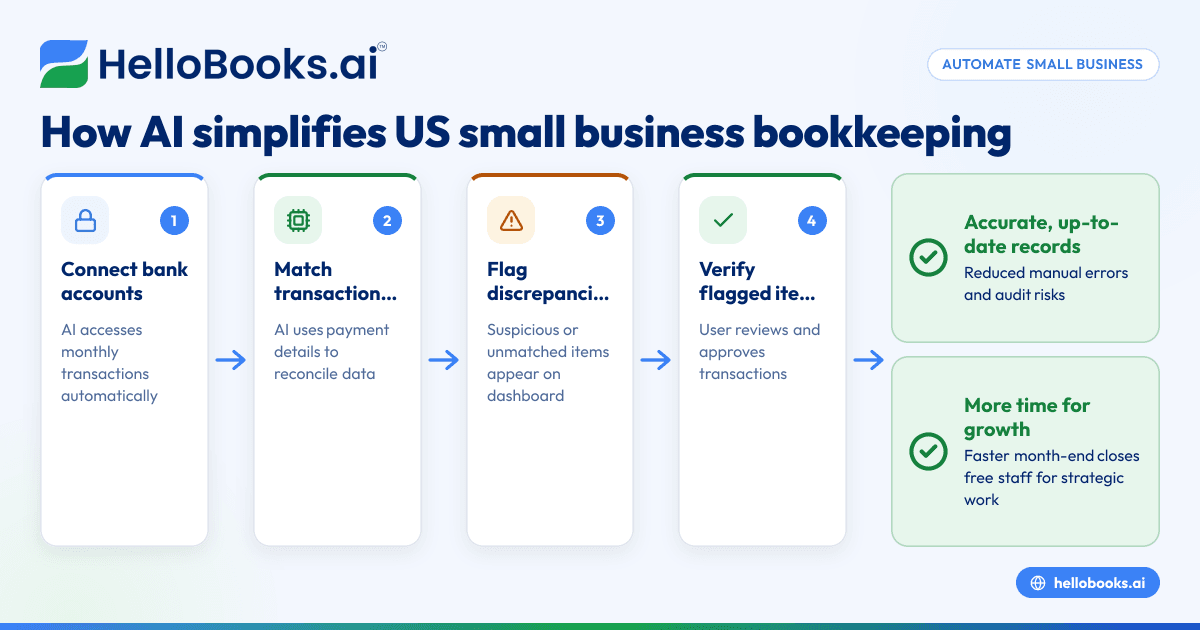
AI connects directly to your bank accounts and payment platforms like Stripe or Square. It pulls transactions and learns to classify them into correct accounting categories, improving accuracy over time based on your feedback.
For example, a Chicago boutique owner cuts hours of manual spreadsheet updates by reviewing and approving AI-suggested expense categories with a click.
Digital invoicing and payment reminders
The software generates invoices automatically, using stored customer information and payment terms. It also sends payment reminders when invoices are overdue, improving cash flow.
An independent graphic designer in Houston automates client invoicing and reminders, resulting in faster payments and less follow-up.
Automated bank reconciliation
AI quickly matches bank statement transactions to invoices and bills based on amount, date, and vendor. It flags unmatched transactions immediately.
For instance, a Detroit manufacturer reconciles hundreds of transactions daily without spreadsheets, avoiding month-end surprises.
Pitfalls to avoid
- Don’t rely blindly on AI categorizations—review corrections initially to train the system.
- Connect all bank accounts and vendors fully for comprehensive automation.
Can AI accounting software handle US tax compliance requirements?
AI accounting software supports US tax compliance by automatically calculating multi-state sales tax, generating 1099 forms, sending tax deadline reminders, and securely storing documents.
Multi-state sales tax complexity
US sales tax rates and rules differ by state. AI software applies correct rates and sourcing rules for each transaction and generates accurate tax reports for multiple jurisdictions.
1099 form generation
The software tracks contractor payments, produces 1099 forms when thresholds are met, and pre-fills IRS filing data, reducing errors and late filings.
Tax deadlines and document storage
AI platforms send alerts for estimated tax payments, sales tax returns, and other deadlines. They also keep digital records secured for audits.
Important notes
- Tax laws update regularly; AI helps but does not replace professional advice.
- Businesses must verify rules for sales tax nexus and exemptions in each state.
What benefits does AI bring to expense management and financial reporting?
AI enhances expense management and reporting by automating receipt processing, detecting fraud, and delivering real-time financial insights.
Receipt scanning and expense matching
Using OCR, AI extracts data from receipts and matches expenses to transactions, preventing lost or duplicate reports.
For example, a Houston logistics startup lets employees upload travel receipts via mobile app for instant categorization and matching.
Fraud detection
Algorithms identify unusual spending patterns like duplicate charges or large unexpected expenses to flag potential fraud early.
Real-time financial reports
AI generates up-to-date profit and loss statements, balance sheets, and cash flow forecasts, enabling sound decision-making.
A Chicago tech startup monitors monthly burn rate vs. revenue to adjust spending proactively.
Pitfalls to watch for
- Encourage clear receipt uploads to avoid processing delays.
- Combine AI fraud alerts with human review for best results.
How easy is it to integrate AI accounting software with existing tools?
AI accounting software integrates smoothly with major US finance tools and offers user-friendly onboarding.
Common US finance tech stack compatibility
Most AI platforms connect with QuickBooks, ERP systems, and payment gateways like Stripe, PayPal, or Square.
Data migration and onboarding
Historic data can be imported via CSV or migration wizards, ensuring continuity from spreadsheets or legacy software.
Workflow automation
Payments, invoices, and accounting entries sync automatically. For example, a Detroit retail shop unifies Stripe and QuickBooks through AI software for seamless bookkeeping.
User experience and support
Modern AI software offers intuitive dashboards plus tutorials and responsive customer support, reducing IT reliance.
How can AI accounting software help small businesses scale efficiently?
AI accounting software supports growth by automating compliance, enhancing cash flow visibility, and optimizing resource use.
Streamlined compliance and reporting
Automation of tax filings, audit trails, and financial documents prevents costly mistakes that block growth.
Cash flow monitoring and forecasting
Real-time analytics and predictive models help forecast cash flow and avoid surprises like overdrafts.
Resource allocation
By reducing bookkeeping workload, AI lets you grow without hiring proportionally in finance, freeing budget for other priorities.
Example
A Chicago e-commerce startup uses AI to manage rapid revenue growth, automating entries and filings so leadership stays focused on scaling.
Conclusion
AI accounting software offers small businesses in the United States a powerful way to automate bookkeeping, ensure tax compliance, and access real-time financial insights. Businesses moving from manual spreadsheets or outdated software experience improved accuracy, efficiency, and control. If you spend too much time managing books and compliance, consider exploring AI accounting platforms designed for US rules and business workflows. You can book a demo with hellobooks.ai to see our software in action or explore detailed pricing to find a plan that matches your needs.
Frequently asked questions
What is AI accounting software?
AI accounting software uses artificial intelligence to automate routine finance tasks such as data entry, invoicing, bank reconciliation, and tax reporting. It reduces manual work and errors, helping small businesses streamline their accounting processes.
Can AI accounting software handle multi-state sales tax?
Yes, many AI platforms are designed to handle the complexities of US sales tax by calculating rates based on state-specific sourcing and destination rules. They can prepare multi-state tax reports and simplify filing requirements.
Is AI accounting software secure?
Reputable AI accounting software providers follow strict security protocols including data encryption, secure cloud storage, and access controls. They comply with industry standards like SOC 2 to protect your sensitive financial information.
How does AI improve financial reporting?
AI automates the collection and aggregation of financial data to generate real-time reports such as profit and loss statements and cash flow forecasts. This instant access to accurate reports enables faster, better-informed business decisions.
Can AI replace human accountants?
AI automates repetitive and rule-based tasks but cannot replace the strategic insight, judgment, and advisory functions that experienced accountants provide. The best results come from AI-human collaboration.
How do I switch from QuickBooks to AI accounting software?
Most AI accounting platforms offer easy migration tools to import financial data from QuickBooks. A well-planned data migration and user training ensure a smooth transition without disrupting your day-to-day finance operations.
Read next
This article covers one part of a bigger topic. For the complete picture, read our guide to accounting software.