
Key takeaways
What this article covers, in order:
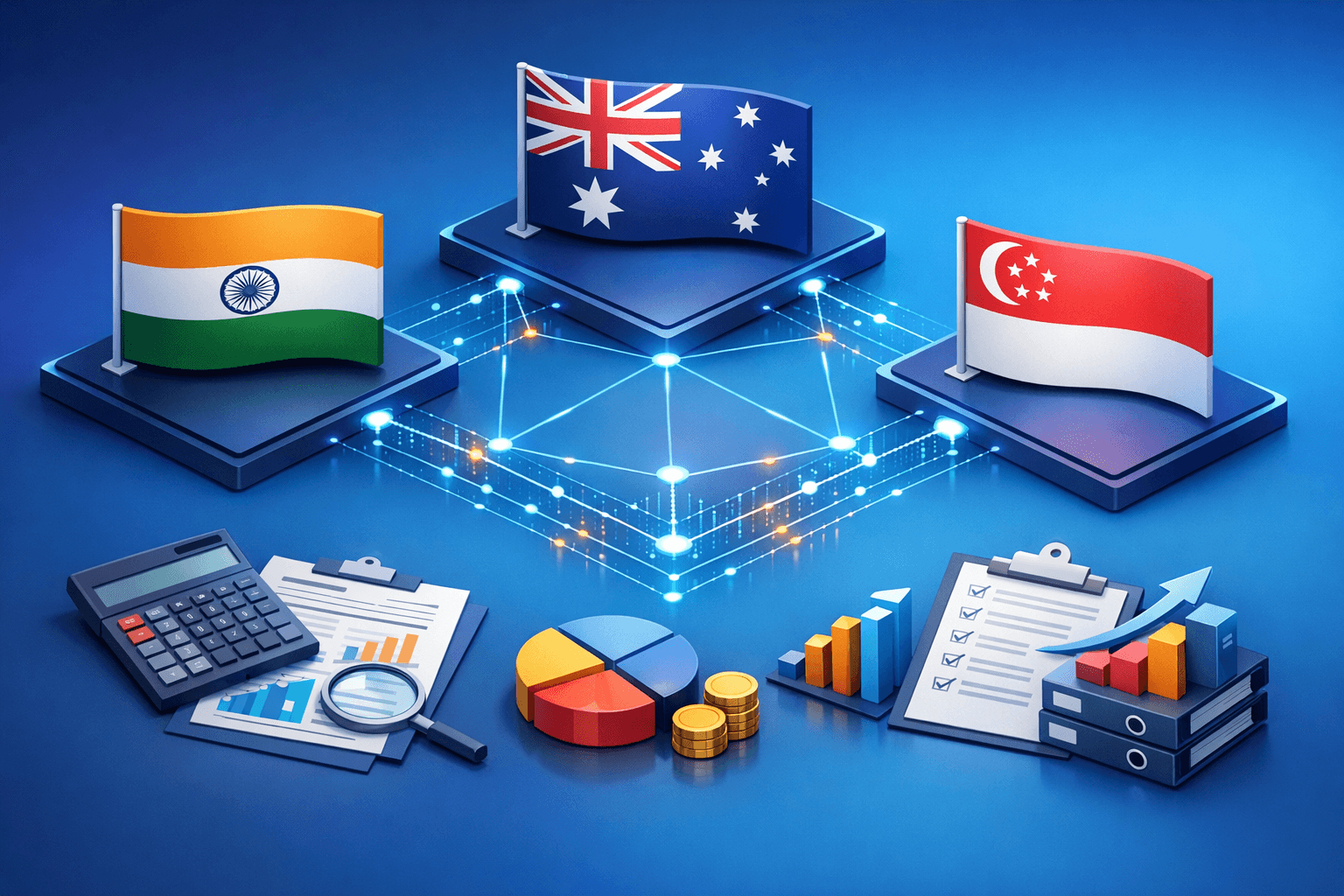
- Comparison on the Goods and Services Tax in India with Australia and Singapore
- Overview of GST systems
- Key rate structures compared
- Key rate comparison list
- Registration and compliance rules
- Registration highlights list
Comparison on the Goods and Services Tax in India with Australia and Singapore
Overview of GST systems
Goods and services tax (GST) is a value added tax across goods and services in many countries. Based on the performance of this tool I compare GST in India, Australia and Singapore. We analyze rates and registration, credits and nonsensical rhetoric — in plain English. The intent is to show how the systems affect companies and buyers.
Key rate structures compared
India: Multiple rate bands
India employs multiple GST rate slabs that are aimed at distinct sectors and commodities. It features reduced rates for basic goods and higher rates for luxury items and services. This multi-rate model is designed to balance revenue needs with policy objectives. Companies need to decide which rate applies per transaction.
Australia: Flat rate with multiple implementations
Australia has a single main GST rate, applied widely to most goods and services. For many businesses, the single rate streamlines pricing and tax collection. A few supplies remain GST-free or exempt for policy reasons, which leads to limited differences. In other words, a single rate will help decrease compliance cost and prices stability.
Singapore: Single rate, broad base
Finally, Singapore has a single GST rate, with few exemptions applied across most transactions. That broad base means many goods and services bear the tax, maintaining a relatively low rate. That base is wide enough to keep the system simple and transparent for businesses and consumers. The approach balances ease of administration with steady revenue.
Key rate comparison list
- India: Granular rates by category
- Australia: One headline rate, limited exceptions
- Singapore: High tax rate, low coverage
Registration and compliance rules
The threshold and administrative processes differ widely across the three systems. India has set registration thresholds and requires many businesses to do regular filing, placing a heavier compliance burden on smaller sellers. Australia established a turnover threshold for mandatory registration and has provided simple rules for small entities together with clear filing timeframes. Singapore also establishes a registration threshold and prioritizes filing electronically to stay efficient in compliance.
Registration highlights list
- India: Lower threshold activating registration frequently
- Australia: Specific turnover threshold for registration
- Singapore: Threshold using simplified filing rules
The biggest effort for businesses comes from the filing frequency and documentation. Most of the indirect taxes in India have become transaction-based like to do each transaction they require multiple returns along with detailed invoice. It is not common to have single return for the multiple countries one operates apart from Australia where its a more regular but it simplifies and reduces amount of paperwork. Singapore relies on timely electronic filing and succinct invoices to keep its records brief and utilitarian.
Input tax credit and exemptions
These include systems of input tax credit wherein taxes paid on inputs can be set off against output tax. Though input tax credit system in India is very well designed, it demands rigorous invoice matching and documentation. Australia permits credits in most instances, with clear guidelines as to what constitutes a valid input. Singapore allows credits widely and simplifies rules for registered businesses.
Input credit comparison list
- India: Rigid invoice matching rules
- Australia: Rules for credit claims
- Singapore: Broad credit availability
The existence of exemptions and zero-rated supplies does influence how this credit claim process works. In India, exempt supplies creates credits claim confused and can result with the partial credits. For example, Australia lists specific exports and other supplies that are wholly GST-free, do not attract GST and denied input credits. This keeps the credit system simple for registrants as Singapore has few exemptions.
Impact on businesses and consumers
Each system has different impacts on business pricing, record keeping and cash flow. India’s multiple rates and documentation regulations may lead to higher accounting effort, while delayed credits can strain cash flow. The single rate makes price calculation easier for Australia and helps firms avoid the need to check rates regularly when selling across categories. Singapore’s wide base with one rate makes it easier to plan for taxes and minimizes friction around audits.
Business and consumer impact list
- India: More work on accounting portion, pricing more diverse
- Australia: One price fits all, and moderate compliance requirements
- Singapore: Straightforward planning, steady revenue
The visibility of GST varies by market for consumers. Buyers in systems with a visible tax line typically see how much is taxed, and know how that affects price. In certain instances, enterprises apply tax to the price so that labeling will not be complex. Separating tax has an impact on how price changes and tax increases are perceived by consumers.
Key takeaways for writers and advisers
When explaining these systems to readers who are not tax specialists, writers should crack clarity. How the main differences India multiple number of rates, Australia a single top rate with exceptions and Singapore one broad based rate. Also emphasize how the fact that registration thresholds, filing norms and input credit systems will differ for businesses would increase their workload.
Simple checklist for comparison articles
- Clearly and simply describe the rate structure
- Explain country rules for registration and filing
- Demonstrate the functioning of input credits and exemptions
- For small business guidance, explain thresholds and filing frequency first
For small business guidance, explain thresholds and filing frequency first. These rules establish a business’s threshold for registration and frequency of return filing. Next, demonstrate the impact of credits on cash flow and pricing. Finally, you may also want to advise that the best approach is to maintain proper records and file promptly as doing so reduces risk (in many cases) as well as costs.
Conclusion
From International Comparison to Policy Implications Comparing GST across these three countries illustrates the impact of policy choices on tax systems. Several rates in India reflect delivery goals, but add complexity for firms. Australia and Singapore prefer a simpler single rate with fewer exemptions to lower compliance cost. Ambiguities will not help businesses nor readers as we unpack the practicality of GST choices in relation to writing.