
Key takeaways
What this article covers, in order:
- Tax Season Automation: US Accountants Say Goodbye to 1099/W-2 Madness with AI
- Why automation is important this tax season
- How data collection and matching is transformed by AI
- Reducing errors through smart checks
- Benefits of AI-driven matching
- Compliance and deadlines simplified
Tax Season Automation: US Accountants Say Goodbye to 1099/W-2 Madness with AI
Why automation is important this tax season
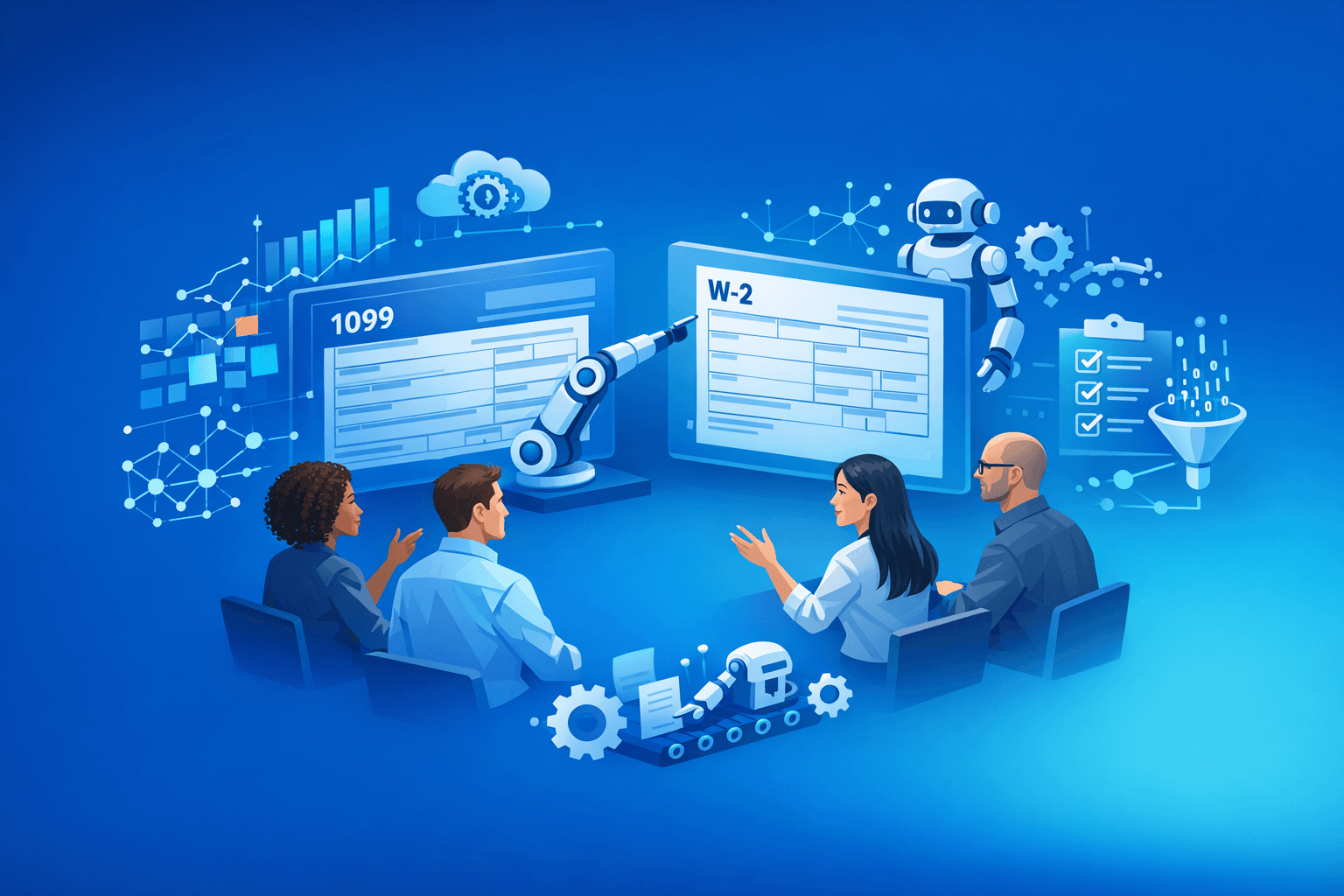
Tax season is stressful for accounting teams every year and it’s a high risk for many firm in terms of errors. Small mistakes compound into big corrections and late filings that take time, and money. Automation can eliminate repetitive work and free up accountants to concentrate on exceptions and advising clients. With 1099 automation and W-2 task automation, teams cut down on manual entry while leveraging improved accuracy across payroll and tax workflows.
How data collection and matching is transformed by AI
Artificial intelligence enhances the collection of data by quickly reading and organizing information from numerous sources in a consistent fashion. Without the need for constant human scrutinity, it is able to match payments and contractor records as well as payroll details making repetitive reconciliation a thing of the past. With better alignment, accountants spend the minimum time possible chasing down missing data and the maximum time resolving real issues that require judgement. This shift reduces preparation windows and the risk of missed or erroneous filings.
Reducing errors through smart checks
AI can apply business rules and learn typical patterns, so that unusual entries are flagged for review before submission. Such early flagging stops late corrections — and the penalties that often come from overlooked discrepancies. Accountants still determine the final call on flagged items, so AI remains a trusted companion rather than a replacement. This process boosts filing confidence while maintaining professional agency over critical decisions.
Benefits of AI-driven matching
- Speedy matching of payments to contractor records
- Increased number of unique or present entries before filing
- More specific exception lists for human inspection
Compliance and deadlines simplified
Automated workflows assist with managing filing windows and thresholds by establishing deadlines and requirements for data disclosure. These systems normalize the preparation and review of forms, decreasing the likelihood of missed steps or disparate practices. Having consistent processes means when filing rules change, teams update templates and rules once and the automation ensures updates happen everywhere for all clients. Not only does this reduce the pressure of frantic last-minute hustles, but it is also conducive to on-time submissions.
- AI and typical compliance tasks it can help
- Who needs 1099 forms for workers
- W-2 reporting of consolidated payroll totals
- Reminding teams of upcoming filing deadlines
Security and audit trails
Automation brings more transparency by having a clearly stated log of who changed what and at what time, which helps during audits and questions from clients. These audit trails display document versions and steps in an approval process, enabling teams to describe the history of every filing. Trust relies on secure handling of payroll and contractor data, meaning automated processes reduce the risk of human misplacement or loss. When necessary, accountants can provide a traceable record to clients and regulators.
Implementation (Practical steps for accountants to embrace automation)
To begin, map the current 1099 and W-2 process to identify repetitive tasks and hotspot for error. Select a small pilot with one client, or one class of form to understand how automation will reshape workflow in real time. Also trains staff on the new review workflows and establishes clear rules governing when humans need to step in. Measure time savings, error reductions and client satisfaction to inform any further rollout or refinement.
Simple implementation checklist
- Document existing workflows and extract repetitive tasks
- Automated pilot on one customer or process
- Educate staff on review process and exception for handling
Start small and scale
Start with a few clear and limited goals, then scale once the team sees reliable results and outcomes become better. Early successes establish credibility and help to facilitate broader adoption across client accounts and within internal operations. As processes scale, teams should further tighten rules and build in checks against irregular cases to ensure quality remains high. This measured approach minimizes disruption while delivering incremental performance improvement.
Autonomous tax data flow, the human element
Even with powerful automation, humans are still needed in complex or unusual situations, and accountants provide context AI cannot understand. This is how you get the best outcomes — professionals performing advisory work and exception handling informed by accurate automated data. This helps to enhance the quality of jobs and service delivered to clients, whilst ensuring responsibility remains with trained professionals. Automation reduces chaos while still keeping human oversight and accountability.
Calmer tax seasons ahead
Automation of 1099 and W-2, powered by the AI machine learning, equips accountants in US to do less repetitive work with a higher degree of accuracy and meet earlier deadlines. When teams use these tools with clear rules and leave time to roll them out carefully, they defend compliance and create space for strategic work. The outcome is more peaceful tax seasons, deeper client relationships and a sustainable road map to navigate increasing payroll complexity. But for accountants who embrace measured automation, tax season will only get easier and more predictable.