
Key takeaways
What this article covers, in order:
- Why Spreadsheets Are Failing Modern Businesses
- What Is an AI-Powered Ledger Software?
- Data Migration Best Practices
- Integrations To Consider
- Security And Compliance Measures
- Training Your Team For AI Adoption
Burned midnight oil in trying to fix financial irregularities, improperly filled rows and columns and the continuous to and for with a bulky shared spreadsheet. We have surely all had that experience, haven’t we? As a business owner, a part of the finance team, or a bookkeeper, financial data management with the help of spreadsheets may soon exceed critical limits.
Excel workbooks are full of limitations that complicate advancement. When entering the data manually, chances of human error are quite high, hence costly errors. There is also version confusion as various individuals worked on the same document at varying times, thus it becomes quite impossible to identify what version is newer than the other. Moreover, no synchronization of the data or real-time collaboration is provided. This way, important changes can either be overlooked or delayed.
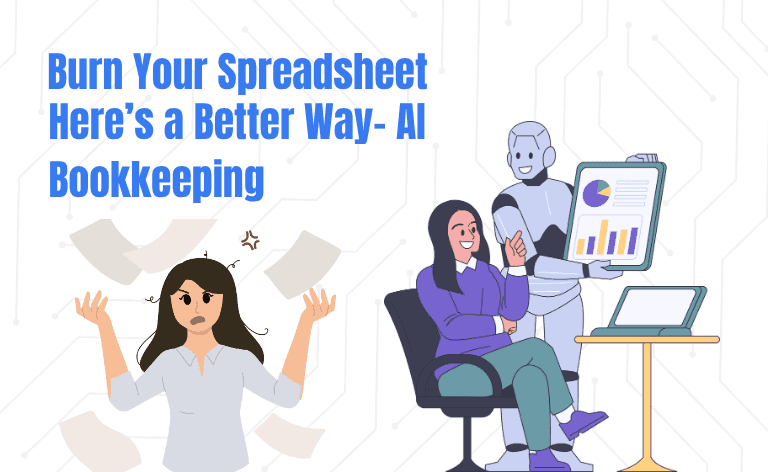
The good news is that there is an improved method. AI-powered bookkeeping is a more intelligent, effective solution that can revolutionize your financial management. The days of battling spreadsheets are over.
Why Spreadsheets Are Failing Modern Businesses
Spreadsheets are becoming outdated, yet they were once the standard instrument for handling company finances. They are failing modern businesses for the following reasons:
- Error-Prone Formulas: A single formula error can cause your entire report to be thrown off. Hours of aggravation trying to fix the data can result from a single missed decimal or erroneous computation.
- Manual Data Entry: Do you have to spend time pasting and copying information between sheets? That is unnecessary work that might be done automatically. Additionally, manual entry encourages inefficiency and human error.
- Poor Scalability: Spreadsheets get harder to handle as your company expands. They hinder your ability to scale smoothly, slow down, and become more difficult to navigate.
- Version Control Problems: With the problem of sharing the spreadsheets, version control is a problem all the time and teams would find it difficult keeping track of the latest information. Mistakes caused by such misconceptions can affect a critical business decision.
- Security Vulnerabilities: Spreadsheets face data leakage and access to unlawful information. It is very hard to keep secrets financial information, especially when in a group.
Spreadsheets came in handy, now a company needs something smarter, something that is made in the digital era where speed and complexity are dominant. And here it is AI-powered bookkeeping.
What Is an AI-Powered Ledger Software?
Ledger software with Artificial intelligence will be a new high-tech instrument to control the finances of your company. Automating this process with AI-ledgers enhances the book-keeping process since its accuracy and pace are expedited compared to the traditional methods, which rely on human interaction with manually introduced data and changes.
This is its mechanism of working: The transactions will be automatically placed in categories by AI-enabled software and recover a lot of your time and reduce the mistakes. It also scouts anomalies bringing to the limelight any differences or potential frauds before they can amount to serious cases. The other capability offered by AI is predictive recommendations, which display their analysis and forecasts based on previous information about your financial data.
It is clear AI ledgers are much better than the process of ledger updates using manpower. They make your accounting process easier, eliminate human error, and provide real-time financial information. With AI, there is no longer an issue with version control and no longer with missing upgrades. Ultimately, efficiency is boosted, and chances of costly mistakes are reduced due to saved time, heightened precision, and the ability of organizations to make decisions based on better information because of automation.
Data Migration Best Practices
Moving historical data to an AI ledger is a important process that requires thoughtful planning and care. Starting with a limited pilot dataset is always better to validate mappings and transformations. Standardize dates, account codes and vendor names to prevent down-street reconciliation issues before migration is complete.
Map Source fields To Target Ledger.
Deduplicate And Clean Records.
Use Trial Reports To Validate Balances.
Raw Source Files Archive For Audit.
Execute Parallel Reconciliations Prior to Cutover.
Integrations To Consider
AI bookkeeping system becomes even more powerful when it talks to other business systems. Focus on integrations that will reduce manual uploads and are easier to integrate such as POS, e-commerce, payroll, inventory etc. Where feasible, make API-based connections between all tools and systems — keep your data flowing in near real-time with minimal sync lags.
Integrate E-commerce Marketplaces With APIs.
Sync Payroll And Timekeeping Data.
Connecting Modules Of Inventory With Costing.
Make Bi-directional Customer And Vendor Sync
Security And Compliance Measures
Safeguarding financial data should be a priority during and after migration Use encryption for data at rest and in transit, implement multi-factor authentication, enforce fine-grained role access. Document the controls and retention policies as well to support audits and compliance with regulations.
Store Data With End To End Encryption.
Enforce Multi-factor Authentication.
Use Role Based Access Controls.
Maintain Immutable Audit Logs.
Define Data Retention And Backup Policies.
Training Your Team For AI Adoption
AI bookkeeping is as much about people as it is about technology. Create a training roadmap that goes over the new workflows, exception handling, and reading AI suggestions. From initial learn-how-to sessions, build on it with regular follow-ups and add hands-on refresher courses to keep building confidence and minimising resistance to change.
Decide Role Specific Training Modules.
Get Hands On Reconciliation Activities.
Show How to Say AI Tabbed Inputs.
Provide Fast Reference Guides And Videos.
Gather Feedback For Constant Development.
Measuring ROI Of AI Bookkeeping
Benefits Mitigating, such that the stakeholders are on board for adopting a new bookkeeping platform. Monitor time savings, reduced error rates, quicker close cycles and less external accounting fees. Overlaid with financial impact: avoided penalties, cash flow forecasting improvements and so forth.
Time Saving On Routine Tasks.
Monitor The Number Of Reduction In Error Rates.
Track Shorter Month End Close Timings.
Outset Avoided Taxes Or Fines.
Forecast Better Cash Flow Visibility.
Audit Trails And Explainability
Auditors and regulators will want to see a clear record of changes and decisions. You should design the AI ledger so that it creates useful readable audit trails showing who made what changes, and why. Explain which factors led to an automated categorization or anomaly flagging; should be human-reviewable, to ensure trust.
Record User Activity And Timestamps.
Keep Original Documents with Entries.
Offer Human Readable AI Decision Notes.
Support Exportable Audit Reports.
Maintain Versioned Ledgers For Traceability.
Custom Rules And Chart Design
The accounting need of every business differs and needs customization. Develop and test specific rules such as for recurring transactions, inter company entries and relevant tax treatments. Develop a concise chart of accounts structure in line with reporting requirements and scalable automation.
Define Reusable Categorization Rules.
Configure Intercompany Posting Logic.
Establish Tax Treatment Templates.
Make Your Chart Of Accounts Consistent.
Verify Rule With Real Sample Transactions.
Handling Exceptions And Edge Cases
No AI system is going to be perfect the first time it’s deployed, so you need to establish exception workflows upfront. Define what to flag in terms of uncertain transactions for manual review, and how to elevate suspected obvious fraud. Create a feedback loop where the AI learns over time from these corrected exceptions.
Flag Low Confidence Transactions For Review.
Direct Exceptions To Particular Users.
Document Common Edge Cases And Fixes.
Specifically the implementation and training of “(I) Correct”.
Monitor Exception Trends Monthly.
Setting KPIs For Financial Health
An AI ledger does not just drive operational improvements — it can power strategic KPIs that shape the decision making process. Outline a short dashboard that monitors cash runway, gross margin by product, DSO, and expense ratios. Demand metrics, use them to prioritize initiatives and resource allocation.
Regularly Monitor Days Sales Outstanding.
Track Gross Margin By Product Or Service.
Keep an eye on Cash Runway And Burn Rates.
Measure Operating Expense Ratios.
Targets And Monthly Review.
Vendor Selection And Support SLAs
There’s more to choosing a provider than its features. Consider vendor stability, onboarding support and training resources as well as uptime SLA commitments for issue response. A clear escalation path and reliable support minimize downtime and accelerate problem resolution.
Check That Vendor Is Financially And Technically Solvent.
Onboarding And Data Migration Support Review.
Validate Uptime And Response Time SLAs.
Make Sure Training Resources Are Available.
Inquire Along With Customer References As Well As Case Studies.
Migration Timeline And Rollback Plan
A realistic migration plan lowers risk and keeps business up and running smoothly. Create a phased timeline that includes pilot, validation and full cutover milestones. Establish rollback guidelines and maintain a working backup in case there are any issues during go-live.
Start With A Small Scale Pilot.
Check Outputs with Reported Evidence.
Define Cutover And Freeze Windows.
Have a Tested Rollback Procedure.
Make Sure All Stakeholders Are Aware Of Milestones.
Spreadsheet vs AI Bookkeeping Software
When comparing traditional spreadsheets to modern AI ledger software, it’s clear that AI-powered tools are far superior for managing finances. Here’s a quick look at how they stack up:
The transition to bookkeeping powered by AI enhances all aspects of accuracy, security, and collaboration as well as time management. It is an improved alternative through which firms can make more informed decisions.
Real-World Benefits of Upgrading
Besides the fact that you will save time, the transition to AI-powered bookkeeping can change your business. That is the way in which it does have an effect:
- Time Gain to Bookkeepers: With the AI, bookkeepers no longer require hours to reconcile their books manually since they can now undertake more valuable and strategic tasks.
- Real Time Profit / Loss Reports: Business owners can have real-time access to accurate profit and loss reports, with the help of AI, that will help them make faster business decisions and understand the running of their businesses better.
- Minimized Tax Filing Errors: Say Goodbye to tax filing mistakes that cost a fortune. AI ensures effective calculations that will help companies comply and prevent fines.
“We would take days to validate numbers and correct mistakes. All this is being automated and hence we can trust the information as timely and accurate.”
Automating bookkeeping to AI will not only make it easier to do your job but also ensure future success and wiser actions of your company.
How to Upgrade: Your Bookkeeping Software Checklist
Are you ready to enhance your bookkeeping? You need to be sure that you choose the most viable AI-driven software to work with your company, that is why we propose the following list of criteria:
- Categorization with AI: Minimize errors and save hours of the staff by automating the categorization of transactions in which the AI processes the categorization of the transactions and entry of the data becomes effortless.
- Bank Syncing: All you need to do is to connect your software with your bank accounts in Real Time, and it happens automatically that the details of each transaction being made are recorded truthfully without human interference.
- Multi-user Access: Improve the degree of transparency and minimize bottlenecks by allowing your team to operate on your financial information in real-time and collaborate with each other.
- Customized Reports: customized Reports will provide you with knowledge that will enable you to make prudent decisions on behalf of your specific firm.
- Scalability: Choose software which will scale with your business. As your activities increase, you will need a system that provides more data and complex management capabilities.
These features will make your financial process easy as your firm grows in addition to enabling you to resource yourself with the information that allows you to make better decisions that inform your operations.
Take the Leap: Burn Your Spreadsheet
This is the moment to welcome the future of bookkeeping and stop being caught up in spreadsheets. Artificial intelligence-based software allows you to make better decisions, waste less time, and reduce errors. Do not allow your company to be stumped by dated tools and upgrades now. Dump your spreadsheet and you are entering into a new age of successful and intelligent bookkeeping!